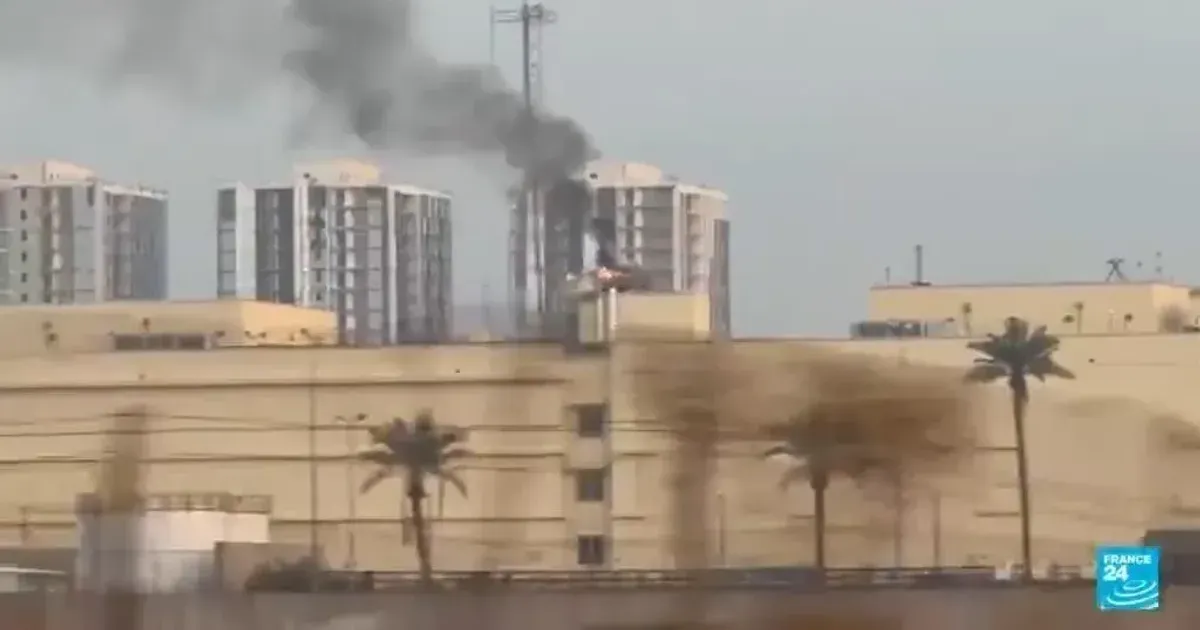
Explosions shattered the early morning calm in Baghdad on Saturday as a suicide drone penetrated the most heavily defended airspace in Iraq. Smoke billowed from the high-security Green Zone following the impact on the sprawling diplomatic compound. Witnesses described a single, low-flying aircraft that bypassed automated defense systems before crashing into a primary administrative annex. Explosions at the Baghdad diplomatic compound have turned a fortified embassy complex into the clearest test yet of cheap aerial attack systems. Fires broke out immediately within the complex. Iraqi security forces cordoned off all access roads to the international zone while American military helicopters began circling the perimeter. Reports from the scene indicate that the U.S. embassy suffered structural damage to at least two buildings. No casualties have been officially confirmed by the State Department, yet local medical sources reported seeing ambulances entering the compound under heavy escort. Shrapnel from the blast scattered across the parking areas and nearby reinforced checkpoints. This event is a direct test of the security protocols established over decades of American presence in the city. Intelligence officials in Washington are now reviewing flight data to determine the origin of the unmanned aerial vehicle. Early assessments point toward a complex model frequently used by regional proxy groups. The precision of the strike suggests a high degree of technical expertise and pre-flight reconnaissance. Security contractors at the site activated emergency protocols, moving personnel to hardened underground bunkers as a precaution against follow-up attacks. Search teams are now combing the wreckage for components that might identify the manufacturer. One fragment recovered near the impact site shows markings consistent with specialized electronic guidance systems. Security at other Western diplomatic missions in the capital has been elevated to the highest level. Most staff members at the British and French embassies have been ordered to remain indoors until further notice.
The Baghdad drone strike exposed the gap between fortified diplomatic architecture and cheap aerial attack systems.
Baghdad Green Zone Comes Under Attack
Attacks on the diplomatic quarter are not a new phenomenon, but the use of a precision drone marks a technical evolution in the conflict. Previous assaults typically relied on unguided Katyusha rockets that often missed their targets or were intercepted by C-RAM defense batteries. This drone managed to evade detection until seconds before the explosion. Such a failure in the defensive shield has prompted an immediate review of electronic warfare capabilities at the site. Military analysts suggest the drone may have used a low-altitude flight path to hide within the urban clutter of the city. Baghdad's dense architecture provides ample cover for small, slow-moving objects that lack the heat signature of larger missiles. By the time the threat was identified visually, it was already too close for defensive systems to engage effectively. This vulnerability has now been exploited in the heart of the Iraqi capital. Ground sensors failed to trigger the usual sirens until after the initial blast occurred. Local residents in the Al-Karkh district reported hearing a low hum followed by a deafening roar that shook windows for several blocks. A second blast was heard moments later, though it remains unclear if that was a second drone or an ammunition cook-off within the embassy walls.
Security perimeters around the compound have been expanded by an additional 500 meters. Iraqi soldiers at the 14th of July Bridge are turning back all civilian traffic, leading to severe gridlock across the central city. Tensions between the various militia factions in the city remain at a boiling point. Many of these groups have previously called for the complete withdrawal of foreign forces from Iraqi soil.
Energy Threats Widen the Crisis
While the fires burned in Iraq, Tehran issued a series of aggressive statements targeting the maritime stability of the Persian Gulf. Iranian officials warned citizens of the United Arab Emirates to evacuate port areas immediately. The threat directly targets the infrastructure that handles millions of barrels of crude oil every day. Market analysts responded by pushing Brent crude prices toward $115 per barrel during weekend trading.
Energy supply lines through the Strait of Hormuz are now under direct threat of disruption. Iran has historically used its naval proximity to these shipping lanes as a lever in geopolitical negotiations. The current language suggests a move toward active interference with commercial traffic. Shipping companies are already rerouting vessels or seeking additional insurance coverage for transits through the Gulf of Oman.
Ports in Dubai and Abu Dhabi are essential hubs for global trade and logistics. Any prolonged disruption to these facilities would ripple through international supply chains within days. Iranian military commanders have frequently practiced swarm tactics involving fast-attack boats and sea-skimming missiles in these waters. Saturday's warnings suggest these drills could be converted into actual operations without further notice.
Vessels now docked at Emirati ports have been advised to increase their bridge watches and maintain a state of high alert. The UAE government has not yet issued a formal response, but military activity at the Al-Dhafra Air Base has increased sharply. Joint patrols with Western naval assets are expected to begin in the coming hours to secure the primary shipping channels.
Washington Faces a Deterrence Test
Saturday saw a series of unexplained blasts across multiple Middle Eastern cities, indicating a coordinated wave of violence. Reports emerged from locations as far apart as the Lebanese border and the outskirts of Damascus. Each incident follows a similar pattern of sudden, high-intensity explosions targeting military or logistical hubs. Satellite imagery suggests that several of these targets were warehouses used for the storage of advanced weaponry. The synchronicity of these events points toward a major intelligence operation designed to degrade proxy capabilities simultaneously. In Syria, local sources reported seeing jets overflying the Homs region shortly before a series of blasts at an airfield. Ground-based air defenses were active but failed to intercept the incoming ordnance.
Lebanese authorities are investigating a major explosion near the city of Sidon. Initial reports suggest a vehicle was targeted while traveling on a coastal highway, though the identity of the occupants remains unknown. The sequence of strikes has forced regional actors to reassess their defensive postures. The lack of a clear signature for some of these attacks adds an element of psychological pressure to the physical damage.
Casualty counts from these various locations are difficult to verify due to strict military censorship in the affected areas. Hospitals in southern Lebanon were reportedly placed on emergency footing to deal with a sudden influx of wounded personnel. Some analysts believe these strikes are a preemptive response to the drone attack in Baghdad. The region now sits in a state of suspended animation, waiting for the next move in this high-stakes exchange.
Embassy Security Is Now the Signal
Washington's continued reliance on a policy of de-escalation has invited the very chaos it sought to avoid. For years, the American administration has treated every proxy strike as an isolated incident, failing to recognize the singular thread connecting Baghdad to the shipping lanes of the Gulf. The reactive posture has signaled to Tehran that the costs of aggression are manageable. While diplomats talk in circles, drones are rewriting the rules of engagement on the ground.
Is the West prepared to defend the energy arteries of the global economy, or will it watch as ports are emptied by fear? The warning to the UAE is not a bluff. It is a calculated test of American resolve in a post-unipolar world. If a multi-billion-dollar embassy complex in a fortified zone cannot be protected, then a tanker in the middle of the ocean is a sitting duck.
History shows that silence in the face of such provocation is often interpreted as consent. The coordinated explosions across the Levant suggest that some actors are no longer willing to wait for a diplomatic miracle. We are moving past the era of gray-zone conflict and into a period of overt regional warfare where geography is the ultimate weapon. Those who believe this crisis will stay contained within the Middle East are willfully ignoring the reality of the global energy market. A fire in Baghdad is a fuse for a global economic explosion.