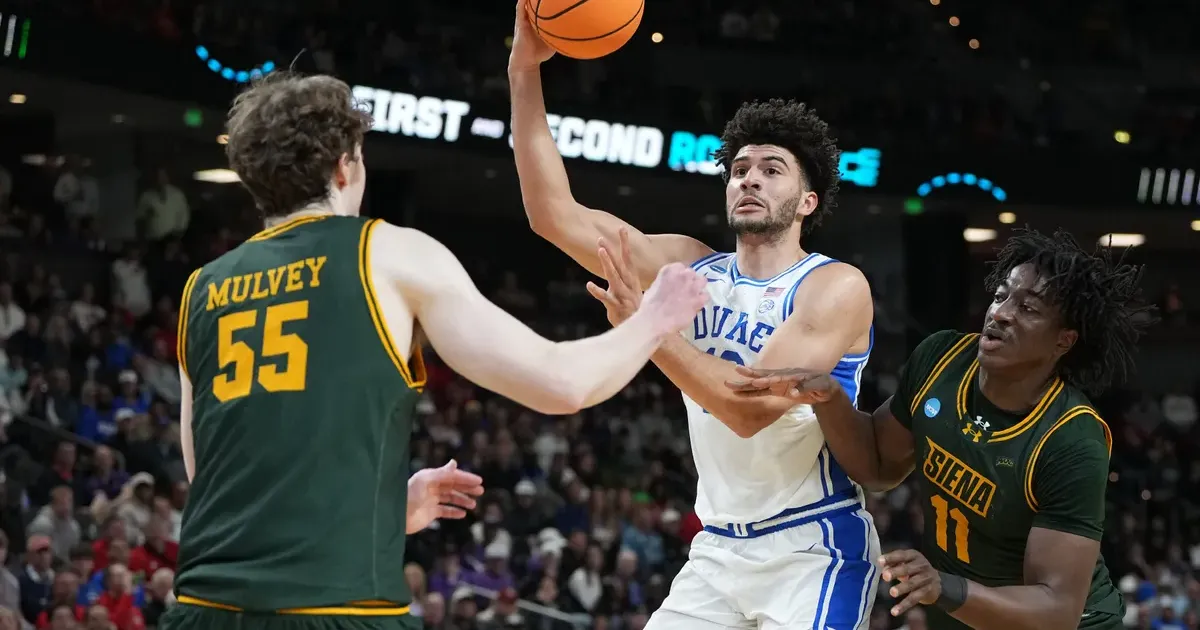
Cameron Boozer and his teammates stared at a scoreboard in Charlotte on March 19 that defied every mathematical probability of the NCAA Tournament. Thousands of spectators watched in disbelief as Siena, a program from the Metro Atlantic Athletic Conference, held an eleven-point lead over the top-seeded Blue Devils at the halftime intermission. Bookmakers had listed Duke University as a 28.5-point favorite prior to tip-off, yet the underdogs dictated the tempo through physical interior defense and transition scoring. Not a single person in the arena expected a No. 16 seed to threaten the overall number one seed so late into a first-round contest.
Siena entered the locker room with a 13-point advantage at one stage during the first half, marking the largest deficit Duke had faced during the entire 2025-2026 season. Defensive lapses allowed the Saints to find open lanes to the basket while the Blue Devils struggled with unforced turnovers. Statistics from the first twenty minutes showed a Duke team that looked lethargic and perhaps overconfident in their path to the second round. Fans from rival schools began to sense a repeat of the UMBC or Fairleigh Dickinson upsets that redefined the tournament in previous years. Pressure mounted as the second half began with the heavy favorites still struggling to find their rhythm.
Siena Halftime Lead Shakes Duke Tournament Run
Gerry McNamara, the former Syracuse standout turned head coach, orchestrated a game plan that specifically targeted Duke's younger perimeter defenders. His players utilized an aggressive zone that forced the Blue Devils to rely on three-point shooting rather than feeding their lottery-bound big men in the paint. By the time the clock hit the ten-minute mark in the first half, Siena had already converted six shots from beyond the arc. Reporters noted that the energy on the Siena bench felt electric, contrasting sharply with the frustration visible on the face of Jon Scheyer. No top seed had ever trailed by ten points or more to a bottom seed at the half until this specific Thursday afternoon.
It was the first time in NCAA tournament history that a No. 1 seed trailed by 10 points or more to a No. 16 seed at the halftime break.
Blue Devil supporters grew quiet as the second half opened with another Siena basket that pushed the margin back to thirteen. Every possession felt like a gamble for a Duke squad that typically dominates early-round matchups with ease. And the tension only increased when Boozer picked up his third personal foul with over fifteen minutes remaining on the clock. So the burden shifted to the freshman guards to handle the suffocating defense applied by the Saints. Even so, the deficit remained in double digits for the first eight minutes of the second period. Momentum seemed stuck in a stalemate that favored the persistent underdogs.
Gerry McNamara Employs Iron Five Substitution Strategy
Gerry McNamara decided to ride his starting lineup for an extraordinary length of time, in effect ignoring his bench for the duration of the contest. This coaching decision mirrors the legendary 1979 DePaul Final Four run where starters played the full forty minutes without relief. For instance, the Saints did not make their first substitution until the final ten seconds of the game remained. Fatigue eventually began to weigh on the Siena roster as their shooting percentages plummeted during the final stretch. Analysts observed that tired legs led to several missed opportunities at the rim that could have iced the game. Saints players missed multiple layups and shot less than 25% from the field across the final twenty minutes of play.
Siena went over six minutes without scoring a single point as the game entered its most critical phase. Duke capitalized on this drought by utilizing a full-court press that rattled the exhausted Siena ball handlers. Meanwhile, the depth of the Blue Devils finally became an advantage as Scheyer rotated fresh bodies into the game to maintain defensive intensity. Constant pressure forced three consecutive turnovers that allowed Duke to cut the lead to five. In fact, the physical toll of playing forty minutes without rest appeared to drain the defensive energy that had characterized Siena's first-half success. Still, the Saints clung to a narrow lead as the clock ticked under six minutes.
Cameron Boozer and Isaiah Evans Reclaim the Lead
Boozer returned to the floor and immediately changed the geometry of the Duke offense by drawing double teams in the post. He eventually tied the game at 61-61 after sinking two high-pressure free throws with 5:08 left in the game. That sequence marked the first time the score had been level since early in the first half. After the free throws, Duke forced another turnover on the baseline that sent the crowd into a frenzy. Isaiah Evans grabbed the loose ball and drove toward the basket for a contested layup. This basket gave Duke its first lead of the second half with 4:25 remaining on the game clock.
Siena refused to disappear despite the momentum shift and the obvious exhaustion of their primary contributors. Riley Mulvey managed a difficult putback with 1:06 remaining to cut the Duke lead to just four points. A sudden turnover by Boozer on the following possession gave the Saints one final opportunity to bridge the gap and force overtime. Gavin Doty found himself open for a three-pointer that would have brought the score within one point, but the shot rattled off the back iron. Duke secured the rebound and iced the game at the charity stripe. Final score tallies showed a 71-65 victory for the favorites that felt much closer than the numbers suggested.
Winning programs often point to close calls as necessary growing pains for a championship run. Yet the vulnerability shown by Duke in this opening round prompts scrutiny about their defensive consistency against disciplined mid-major opponents. National media outlets were quick to highlight that Siena's 13-point lead was the largest any team had held against Duke all year. Scouts and rival coaches will certainly review the film to see how McNamara’s zone nearly broke the tournament bracket. Duke advances to the second round with their season alive, but the aura of invincibility has been sharply dimmed. Siena exits the tournament with the respect of a national audience after nearly achieving the unthinkable.
The Elite Tribune Perspective
Should we be celebrating Duke's resilience or interrogating their deep lack of preparation for a supposed cakewalk? The sports media industrial complex loves a comeback story, but this performance was an indictment of a program that recruits at the highest level yet almost tripped over the lowest hurdle. Jon Scheyer’s squad walked into that arena as if the jersey alone would secure a thirty-point victory, ignoring the reality that mid-major basketball has never been more competitive. McNamara nearly exposed the Blue Devils as a collection of high-end talent lacking the collective grit required for the pressure of March.
If one coach with zero bench depth can push the number one overall seed to the brink, what will a top-tier program do to them in the Sweet Sixteen? Duke fans might breathe a sigh of relief, but the smart money suggests this team is a paper tiger waiting for a more seasoned predator. Historical data from past tournaments shows that number one seeds who struggle this mightily in the first round rarely possess the mental stamina to reach the Final Four.
Rather than praising a narrow escape, we should be asking why a roster worth millions in NIL valuation was outplayed by a group of iron-men from the MAAC for thirty-five minutes.