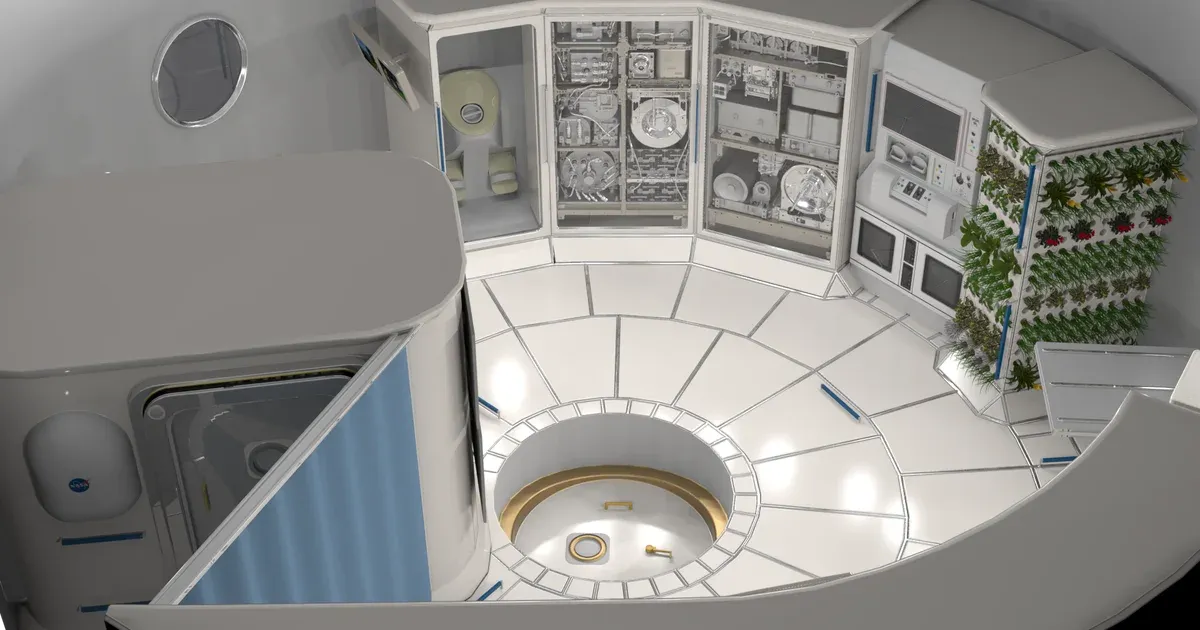
NASA scientists and Earth educators gathered on April 4, 2026, to reveal how orbital habitat designs now dictate terrestrial living space standards. By translating the restrictive environment of the International Space Station into classroom curricula, researchers aim to instill a radical sense of resource stewardship in the next generation. The education model used space-habitat constraints to teach resource efficiency. Cognitive shifts once reserved for elite astronauts are becoming accessible through simulated environments and systems-thinking modules. These programs strip away the illusion of infinite resources by treating classrooms as closed-loop life support systems. Total enrollment in space-integrated STEM programs reached 1.2 million students this academic year.
Resource scarcity in orbit forces a level of efficiency that Earthbound societies have historically ignored. Every liter of fluid and watt of power on a station must be accounted for with mathematical precision. This necessity birthed the technological foundations for modern water reclamation and air filtration now being miniaturized for residential use. Educators argue that the best way to understand Earth is to view it as a singular, fragile vessel moving through a vacuum. Observation from a distance creates what scholars call the Overview Effect, a mental transformation that highlights the interconnectedness of global systems.
Resource Management Curricula Gain Global Momentum
Schools in the United States and United Kingdom are currently replacing traditional environmental science with comprehensive systems-engineering curricula inspired by the European Space Agency. Instead of studying ecology in the abstract, students manage micro-habitats that mirror the regenerative life support systems of the ISS. Practical application of these concepts requires students to balance nutrient cycles and energy consumption within fixed limits. Waste ceases to exist in these models because every output becomes an input for another process. Failure to maintain this balance results in the immediate collapse of the simulated habitat.
Implementation costs for these high-tech labs averaged $450 million across major urban school districts over the last decade. While Bloomberg data indicate some pushback regarding budget allocation, the long-term savings in energy literacy appear to justify the initial capital expenditure. Schools using these modules report a 40 percent reduction in campus waste production within the first two years of adoption. These metrics demonstrate that the psychological shift regarding living space translates into measurable physical changes in how facilities operate. Teachers observe that students develop a heightened sensitivity to resource depletion that goes beyond the classroom wall.
"The perspective of looking back at Earth from space offers a cognitive shift that is essential for long-term sustainability education on the ground," a NASA Office of STEM Engagement report said.
Earthbound classrooms are finally adopting this uncompromising logic.
Psychological Impact of Orbital Perspective on Learning
Frank White, the author who first defined the Overview Effect, suggests that the mental clarity gained from seeing the planet without borders is the ultimate educational tool. Traditional geography often emphasizes division, whereas the orbital perspective emphasizes unity. Students participating in virtual reality simulations of the lunar surface or Mars outposts report a decreased interest in geopolitical conflict. Instead, they focus on the technical requirements of cross-border cooperation for survival. This cognitive restructuring aligns with the needs of a globalized economy that requires high-level collaborative problem-solving skills. Living space is no longer defined by square footage alone. In space psychology, living space includes the mental and emotional volume required to maintain health in confined environments. Research conducted by the University of Exeter suggests that students trained in space-style living modules show higher resilience in high-density urban settings. These individuals learn to optimize small areas for maximum psychological comfort. The data show a direct correlation between habitat design and stress reduction in crowded primary schools.
Architectural firms are increasingly hiring former aerospace engineers to design high-efficiency urban dwellings. These micro-living units use the same modularity found in the nodes of the International Space Station to save space. Furniture folds into walls, and air circulation systems use botanical filters to maintain oxygen quality without bulky mechanical ducting. Urban developers in Tokyo and London have already broken ground on apartment complexes that function as semi-closed loops. These buildings harvest rainwater and use solar-glass facades to reach near-total energy independence. Power consumption in these units remains below 15 kilowatt-hours per day. Space-based insights provide the blueprint for a future where humanity lives within its means. By treating every home as a spacecraft, society can reduce the impact of rising utility costs and resource volatility. Educational initiatives serve as the testing ground for these radical shifts in lifestyle. Every student who learns to manage a closed-loop system becomes a citizen capable of navigating a resource-constrained world. The integration of aerospace logic into daily life provides a plan for a more resilient civilization. Knowledge gained from the stars is finally being used to save the ground beneath our feet. Success in this field is measured by the reduction of the human footprint to zero.
Teachers are using closed-loop habitat models to make energy budgets visible. Students can compare how much water a system consumes, recycles and wastes during a simulated mission.
Space Habitat Lessons Fit Classroom Constraints
Space-habitat lessons fit classrooms because they make resource limits concrete. When students design around water, power and waste constraints, efficiency becomes a practical exercise rather than an abstract lecture.