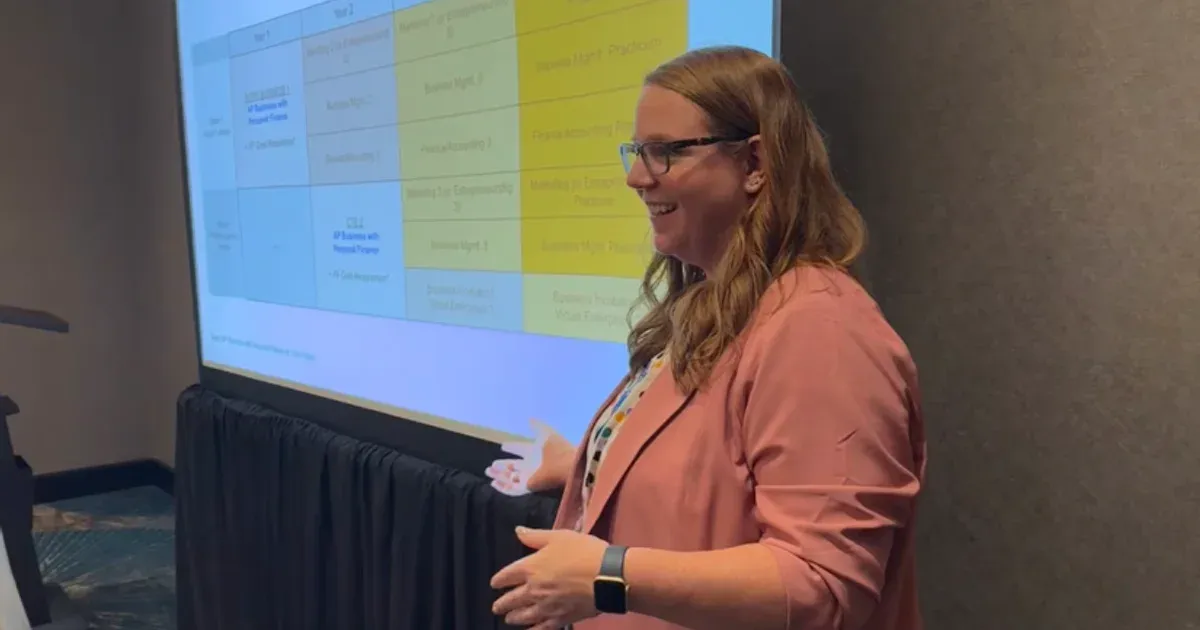
Kristin Lidstrom, a veteran business educator at Hamilton Southeastern High School, launched her AP Business with Personal Finance pilot program on April 4, 2026, to address a widening gap in student financial literacy. High schoolers in Fishers, Indiana, are now testing a curriculum that the College Board intends to distribute across the United States for the 2026-2027 academic year. Kristin Lidstrom brings over two decades of classroom experience to this initiative, aiming to convert complex fiscal theories into manageable life skills for teenagers. Participation in the program spans grades nine through 12, reflecting a broad effort to introduce professional economic concepts earlier in the educational timeline.
Hamilton Southeastern High School became a main testing ground for this specific Advanced Placement expansion because of its established business department. Business educators locally recognized that standard economics courses often skipped the details of debt management and investment cycles. Educational leaders in the district noticed that students could calculate supply and demand curves but struggled to understand how credit card interest compounded over time. Lidstrom transitioned from a career path at the Indiana University Kelley School of Business to teaching because she saw a need for practical application in secondary education.
Hamilton Southeastern High School Pilots National Curriculum
Development of the AP Business with Personal Finance course involved extensive cooperation between higher education institutions and secondary schools. This pilot year at Hamilton Southeastern High School allows Lidstrom to refine the pacing of projects that simulate real-world financial decision-making. Students engaged in the course do not just read textbooks; they create full business pitches and draft realistic monthly budgets based on projected entry-level salaries. Financial outcomes for these students are measured by their ability to navigate simulated market fluctuations and rising living costs. While the College Board historically focused on academic theory, this new offering signals an emphasis on vocational and personal utility.
Success in Fishers has caught the attention of the Indiana Chamber of Commerce, which views the curriculum as an essential component of workforce development. Local employers have voiced support for the course, noting that graduates with high financial literacy are more stable and productive in their early professional years. Lidstrom observes that students often become more engaged when the curriculum touches on their own spending habits or the financial pressures they witness at home. Interest rates, once just numbers on a whiteboard, take on a different character when tied to the cost of a first car or a college loan. Enrollment numbers suggest that students from various backgrounds are seeking out these skills regardless of their ultimate career aspirations.
Economic Shift Drives Indiana Graduation Reform
Indiana state legislators have already codified the importance of these skills through updated educational mandates. Starting in 2029, new graduation requirements will prioritize career-connected learning and financial literacy for every student in the state. These reforms intend to move away from traditional seat-time metrics in favor of competency-based assessments that reflect modern economic needs. State officials argue that a high school diploma must mean that a young adult can manage a paycheck and understand the implications of a lease agreement. Hamilton Southeastern remains at the front of this shift by integrating these standards years ahead of the legal deadline.
"Concepts like interest rates or debt suddenly carry weight when they realize how long it can take to pay something off or how quickly costs can grow," Lidstrom said.
Lidstrom spends her typical instructional day enabling active, hands-on projects rather than delivering long lectures. Individual students are tasked with analyzing the cost-benefit ratios of different career paths, factoring in the cost of necessary certifications or degrees. Class sessions frequently involve debates over risk management and the ethics of different business models. Lidstrom's 22 years of tenure in the district allow her to bridge the gap between traditional business education and the evolving requirements of the 21st-century economy. Her background in marketing provides a unique lens for teaching students how to identify predatory lending practices and deceptive advertising.
Business Principles Meet Classroom Financial Realities
Project-based learning is the main pedagogical tool in Lidstrom's classroom. Students might spend an entire week building a business plan that requires them to account for $22,000 in initial overhead costs. Such exercises force teenagers to confront the reality of tax obligations, insurance premiums, and emergency fund allocations. Evidence from these classroom simulations suggests that students become much more risk-averse once they see how quickly a budget can collapse under the weight of unplanned expenses. This level of detailed analysis is rarely found in traditional high school social studies or mathematics tracks. Participants often report that the class changes their perspective on part-time employment and personal savings.
College Board representatives are monitoring the Hamilton Southeastern pilot to determine if the curriculum requires adjustment before the 2026-27 rollout. Observations from the classroom indicate that younger students in the 9th and 10th grades are capable of grasping sophisticated investment concepts when presented through a lens of personal goal-setting. Lidstrom maintains that the goal is not to turn every student into a business major but to ensure they possess the defensive financial skills required to survive in an increasingly complex economy. Schools across the country are expected to follow this model as the demand for practical education outweighs the traditional focus on rote memorization.
Finance Pilot Makes Money Skills Practical
The finance pilot is strongest when it turns abstract money concepts into choices students can practice. Budgeting, credit, debt and interest become more useful when they are tied to decisions teenagers will actually face.