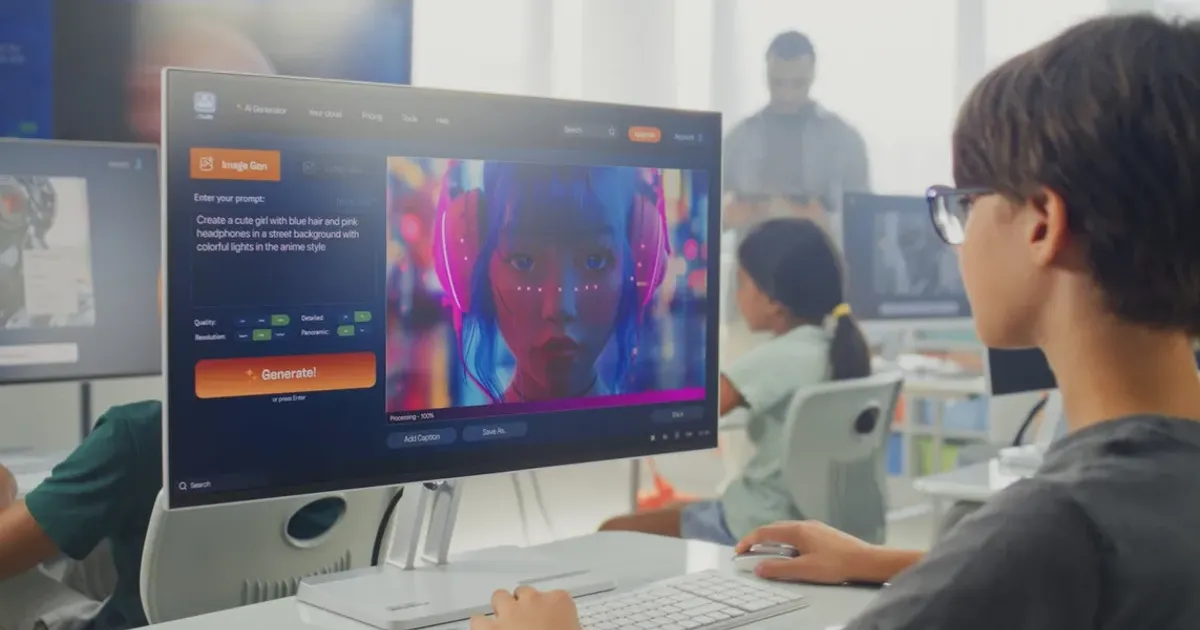
The old promise that every student simply needed to learn code is being tested by a new generation of AI tools. Schools are now asking whether syntax lessons still prepare students for the work software actually requires. Teachers are also weighing what should replace the old boot-camp logic. The curriculum debate sharpened on March 30, 2026, as administrators compared coding mandates with the rapid spread of generative AI.
Early exposure to basic commands like ‘Hello, World!’ provided an entry point for many, yet the direct correlation between middle school coding classes and long-term career success remains difficult to quantify. EdSurge reports that while access to these courses grew, the actual mastery of the material often failed to keep pace with industry demands. Software development moved faster than textbook cycles could manage. Students who learned specific syntax frequently found their knowledge obsolete by the time they reached high school graduation. This mismatch suggests that the focus on the mechanics of code may have overshadowed the deeper logic required to solve complex problems.
Computer Science Curricula Face Obsolescence Pressures
Generative AI now drives a new wave of urgency within educational institutions. Schools feel pressured to adapt to Google and Microsoft AI integrations, often using the same rationale that fueled the coding movement of the early 2010s. Proponents of rapid adoption claim that students must master AI prompting to remain competitive. Historical data indicates that chasing specific software tools is a losing strategy for public education systems. Tools evolve every six months, whereas a standard school budget cycle operates on a multi-year horizon. This disparity creates a permanent lag between what is taught and what is used in professional environments.
Instructional roles for AI are currently caught in a state of flux. Teachers who once championed coding now express skepticism about the utility of teaching students how to interact with specific large language models. These instructors worry that focusing on the output of an AI tool sacrifices the development of critical thinking. A two-year research project involving computer science and engineering teachers found that many still struggle to find a universal application for these tools in a classroom setting. Educators often find that the AI provides the answer too quickly, bypassing the mental struggle necessary for genuine learning.
Generative AI Adoption Lags Among Classroom Instructors
Researchers conducted an extensive study into how AI integrates into existing lesson plans. They found that uptake is surprisingly low, even among those comfortable with advanced technology. Participants in the study noted that the tools themselves change so frequently that developing a stable curriculum is nearly impossible. Many engineering teachers voiced concerns that reliance on AI-generated solutions prevents students from understanding the underlying architecture of a system. Without that foundational knowledge, a student cannot effectively debug or verify the accuracy of the AI output.
Most of our participants, including those who are engineering or computer science teachers, still struggle to identify a clear or universal instructional use case for widespread AI integration.
Evidence from the two-year study suggest that the problem is not a lack of interest but a lack of pedagogical value in current AI tools. Teachers prefer to focus on durable skills that survive technological shifts. They argue that the ability to break down a problem into smaller, logical parts is more important than knowing which button to click in a specific app. This sentiment reflects a broader move away from vocational tool training and toward intellectual frameworks. Logic remains the primary requirement for any advanced technical work, regardless of whether a human or a machine is writing the final line of code.
Computational Concepts Outlast Software Tool Life Cycles
Durable education focuses on computational ideas rather than the fleeting syntax of the moment. These ideas include abstraction, decomposition, and pattern recognition. A student who understands how an algorithm functions can easily switch between different programming languages or AI interfaces. By contrast, a student who only knows how to prompt a specific AI will be lost when that system is replaced by a newer iteration. Mastery of logic allows an individual to oversee the automated processes that are now common in Silicon Valley firms. Productivity in the modern era depends on the ability to verify and refine machine-generated work.
State departments of education are beginning to revise their standards to reflect this shift. They are moving away from specific coding requirements and toward broader data literacy goals. The change acknowledges that the era of the manual coder may be ending, but the era of the systems architect is just beginning. Understanding how data flows through a network is a more versatile skill than memorizing the rules of a single language. 2.4 million students currently enrolled in computer science tracks may need to pivot their focus to these higher-level concepts to stay relevant.
Workforce Realities Demand Literacy Over Syntax Mastery. Employers now prioritize candidates who can demonstrate a deep understanding of how systems interact. The ability to write a script is less impressive than the ability to explain why that script is necessary for a business objective. Industry leaders note that AI can handle the repetitive parts of software development, but it cannot yet define the strategy or the ethical constraints of a project. So, schools are being asked to produce graduates who are skeptics and critics of technology, not just users. The require a curriculum rooted in the humanities as much as the sciences. Effective communication and logical reasoning have become the most resilient technical skills.
Current trends suggest that the hype surrounding AI literacy will eventually cool, just as the coding movement did. Schools that succeed will be those that resisted the urge to buy every new software package. They instead invested in teachers who could explain the mathematical and logical foundations of the digital world. These institutions produce students who are adaptable because they understand the ‘why’ instead of just the ‘how.’ Future labor markets will likely reward those who can bridge the gap between human needs and machine capabilities. The transition marks the end of the school as a vocational training center for specific tech companies.
Imagine a vocational school in 1920 that spent its entire budget teaching students how to repair one specific model of steam engine just as the internal combustion engine took over the world. It is the exact trap currently catching Western education systems. We are obsessed with the shiny exterior of generative AI while the engine of our pedagogical theory is rusted and immobile. The ‘Learn to Code’ era was a multi-billion dollar experiment that proved syntax is a commodity, not a career. Now, we risk repeating the mistake by treating AI prompting as a specialized craft instead of a basic utility.
School boards are throwing money at AI integration because they are terrified of appearing obsolete to parents and donors. The reactionary spending is a dereliction of duty. Real education is not about keeping pace with the frantic release cycles of Google or OpenAI. It is about providing the intellectual armor necessary to survive a world where tools are disposable. If a student cannot solve a logic puzzle without a screen, they are not literate; they are merely an extension of a corporate software license. The focus must return to the brutal, difficult work of thinking. Stop teaching the tool. Teach the logic.