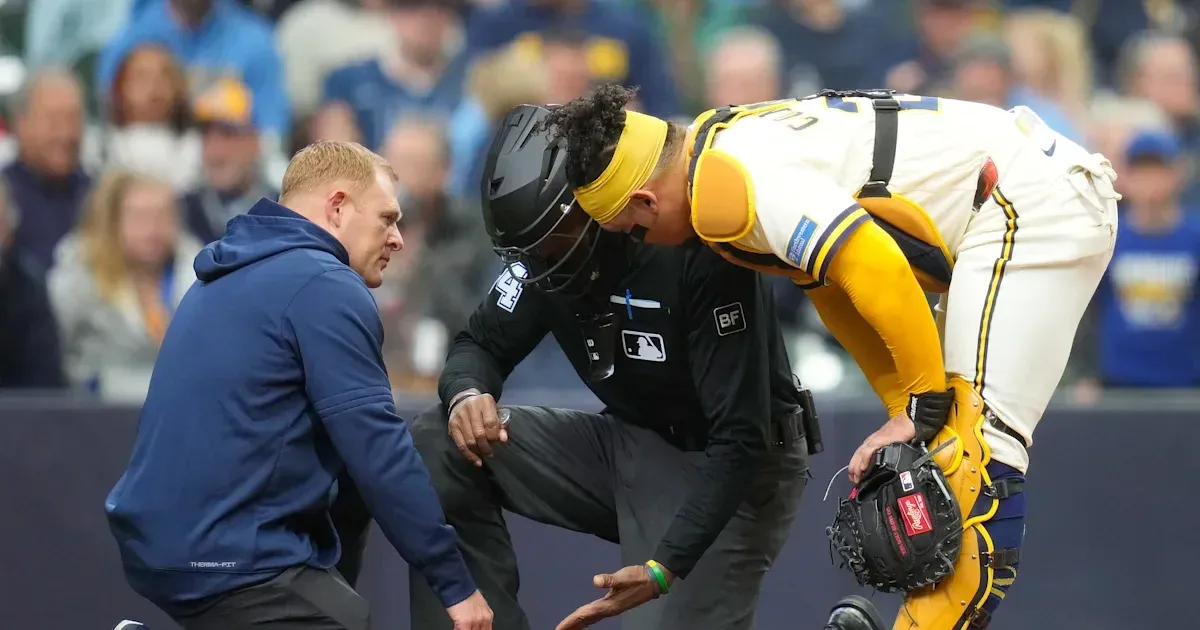
April 1, 2026, saw veteran umpire C. B. Bucknor collapse behind home plate during the second inning of a matchup between the Tampa Bay Rays and the Milwaukee Brewers. Impact occurred with two outs in the inning when a 99-mile-per-hour fastball took a sharp, upward trajectory into the official’s face mask. Bucknor, 63, immediately stumbled to the dirt while players from both dugouts looked on with visible concern.

Milwaukee Brewers pitcher Jacob Misiorowski delivered an inside fastball on a 1-2 count to start the sequence. Nick Fortes, batting for the Tampa Bay Rays, swung just under the ball, generating a direct foul tip that moved backward with nearly the same velocity as the original pitch. Kinetic energy from the strike threw Bucknor’s head backward, causing his knees to buckle. Protective steel and padding absorbed a portion of the blow, yet the force proved sufficient to disorient the veteran official instantly.

Collision Mechanics in the Second Inning

Brewers catcher William Contreras dropped his glove to assist the fallen umpire before trainers could emerge from the dugout. Bucknor appeared dazed, kneeling on the grass for several minutes while medical staff conducted a preliminary neurological evaluation. Initial reports from the stadium suggest the ball hit the center of the cage, which is designed to distribute force across the forehead and jawline. Despite this protection, the sheer speed of a Misiorowski pitch creates a risk profile that modern equipment cannot entirely reduce. Professional baseballs weigh five ounces and possess a cork core that does not compress easily upon impact.

Training staff eventually helped Bucknor to his feet after he spent nearly five minutes on the ground. He attempted to remain in the game, shaking his head as if to clear the fog of the collision, but Brewers medical personnel insisted on a closer inspection. He left the field under his own power, walking toward the home dugout while leaning slightly on the arm of a trainer. Milwaukee staff guided him into the tunnel for further testing in a quiet environment. Spectators at American Family Field provided a polite ovation as the umpire disappeared from view.

Major League Baseball Concussion Protocol Procedures

Major League Baseball mandates immediate removal from play if an official displays signs of a concussion. These symptoms include loss of balance, confusion, or a delayed verbal response, all of which were observed in the moments following the hit. Secondary evaluations typically take place in a specialized room away from stadium noise and bright lights. Physicians use the SCAT6 protocol to assess cognitive function and eye tracking. Bucknor will likely face a mandatory cooling-off period before he is eligible to return to the rotating crew.

Officiating duties fell to the remaining three umpires for the duration of the contest. The game continued with a vacant spot behind the plate as the second-base umpire moved to take over the calling of balls and strikes. Every second matters in these medical assessments, particularly for officials in their sixties who face longer recovery windows. Major League Baseball has not yet released a formal timeline for his return to the diamond. Recent data shows that head injuries among umpires have increased as average pitch velocity continues to climb across the league.

Veteran Umpire Career Scrutiny and Safety

Bucknor arrived at this game following a series of high-profile officiating errors that had already drawn national attention. During a Tuesday game between the Milwaukee Brewers and Tampa Bay Rays, he erroneously ruled that Jake Bauers failed to touch first base. Replay footage quickly contradicted the call, leading to a reversal that prompted laughter from both managers in their respective dugouts. Announcers for the Milwaukee broadcast had openly speculated about the quality of the strike zone for the following day. These frustrations highlight the high-pressure environment in which senior officials operate.

“I’m really excited for him to have the plate tomorrow,” quipped Brewers play-by-play announcer Jeff Levering during the Tuesday broadcast.

Fans in Cincinnati had also expressed vocal displeasure with Bucknor just days earlier. Two consecutive calls were overturned during a single at-bat, prompting the Reds faithful to erupt in cheers once the scoreboard showed the corrections. Physical health and mental acuity are often linked in professional sports, and some analysts suggest the physical toll of a 162-game season weighs heavily on the league’s oldest employees. Statistics provided by independent tracking services show that Bucknor ranks in the lower quartile for strike zone accuracy this season. His performance at the plate has been a recurring theme in league-wide discussions regarding umpire accountability.

Physical Risks for Senior League Officials

Age remains a factor in how the body reacts to blunt force trauma behind the plate. Medical researchers note that older adults are statistically more susceptible to long-term complications from repeated sub-concussive impacts. Nick Fortes and Jacob Misiorowski were both involved in the play, yet the physical consequences fall entirely on the man in the blue uniform. League officials have experimented with different mask materials, including carbon fiber and titanium, to better protect the neck and skull. None of these advancements can fully negate the danger of a foul tip at point-blank range. Bucknor’s mask appeared to hold its structural integrity during the incident.

Future safety improvements may involve mandatory retirement ages or the implementation of automated ball-strike systems to move umpires further from the line of fire. Critics of the current system point to the rising number of veteran officials who have suffered season-ending injuries from foul balls or wild pitches. Officiating remains one of the few roles in professional sports where a person over the age of sixty is expected to perform at an elite physical level for three hours daily. Tampa Bay Rays representatives expressed their well-wishes for Bucknor’s recovery after the final out. The veteran’s absence leaves a hole in the officiating rotation for the upcoming series in New York.

The Elite Tribune Strategic Analysis

Should Major League Baseball enforce a mandatory retirement age for home plate umpires? The injury to C. B. Bucknor is not merely a medical event, it is a flashing red light for a league that prioritizes tradition over the safety of its aging workforce. Standing behind the plate is no longer a job for a 63-year-old, especially when pitchers like Jacob Misiorowski are routinely firing triple-digit heat. The physics of the modern game have outpaced the biological capacity of senior citizens to react and protect themselves. When an official is hit in the face and spends five minutes in the dirt, the league must acknowledge that the human element is becoming a liability.

Officiating quality has plummeted as veteran umpires cling to their positions long after their reflexes have faded. Bucknor’s recent string of reversed calls is not a coincidence, it is a symptom of a systemic failure to refresh the ranks. The league’s refusal to implement a rigorous performance-based exit strategy has created a situation where subpar officiating is protected by tenure. This incident provides the perfect cover for the commissioner’s office to speed up the move toward an automated strike zone. Protecting the health of the officials and the integrity of the game requires removing the human bottleneck from behind the mask. The era of the senior citizen home plate umpire is over.