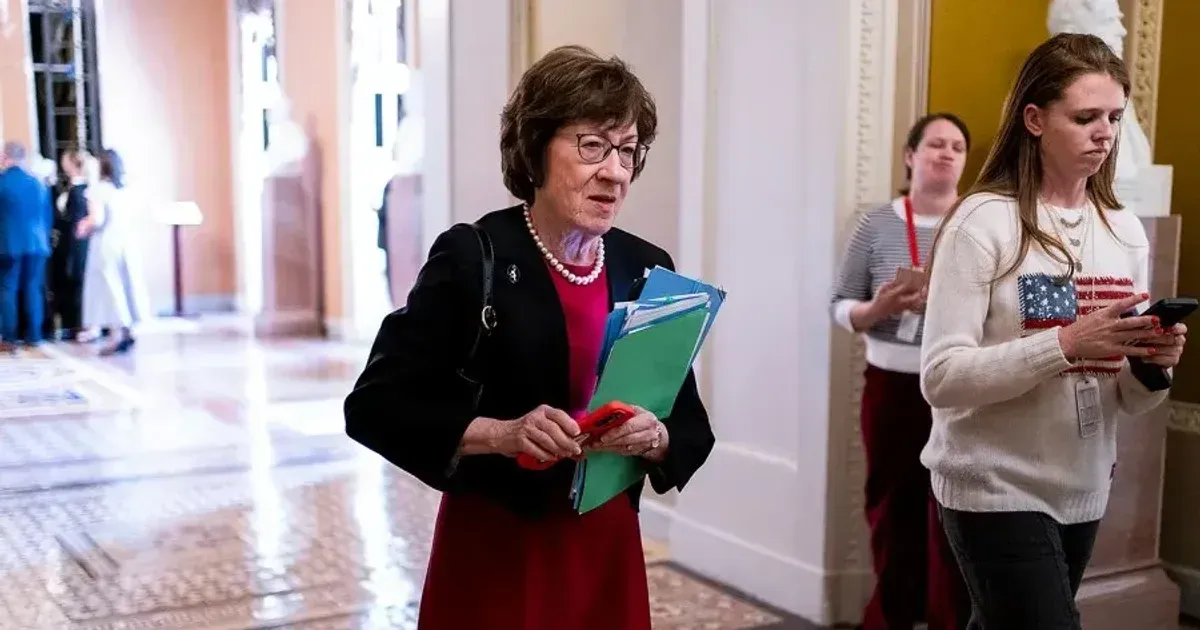
Susan Collins and Dan Sullivan broke with their party leadership on April 23, 2026, during a series of tense Senate floor proceedings regarding social spending and food security. These defections occurred during votes on amendments designed to roll back provisions of the previously passed One Big Beautiful Bill Act. Republican leadership successfully whipped the majority of the caucus to defeat the measures, yet the splintering of two senators highlighted internal friction over fiscal priorities. Senator Ben Ray Luján of New Mexico sponsored the primary challenge to the existing spending framework through an amendment aimed at food assistance.
Luján proposed creating a reserve fund specifically intended to lower grocery costs for American families. His amendment sought to reverse an estimated $187 billion in cuts to the Supplemental Nutrition Assistance Program (SNAP) that were codified in last year's legislative package. While the broader Republican caucus viewed these cuts as essential fiscal discipline, the loss of Collins and Sullivan suggests that the political cost of reduced food benefits remains a concern for those representing states with high rural poverty. The amendment ultimately failed to gather enough support to bypass the procedural hurdles required for adoption.
Senate Democratic Leader Chuck Schumer simultaneously forced a vote on a separate amendment focusing on out-of-pocket healthcare expenses. Schumer sought to establish a point of order against any future budget reconciliation bill that fails to lower healthcare costs for the general public. To bring this to a vote, he offered a motion to waive the Budget Act, a technical maneuver that requires a sixty-vote threshold in the upper chamber. Republican leadership remained unified against the motion, arguing that it would create an unnecessary legislative roadblock for future fiscal reforms. The motion failed, keeping the current budget rules intact.
SNAP Funding Reversal and Republican Resistance
Internal Republican debates over the SNAP program have intensified as grocery inflation continues to impact household budgets across the country. The $187 billion reduction in food assistance was a foundation of the One Big Beautiful Bill Act, intended to curb federal spending growth. Opponents of the cuts argue that the reduction disproportionately affects children and the elderly in states with high living costs. Luján framed his amendment as a necessary correction to prevent a spike in food insecurity. Republican leadership countered by emphasizing the need to return to pre-pandemic spending levels.
Maine and Alaska present unique challenges for Republican senators trying to balance party loyalty with constituent needs. Collins often faces pressure from a moderate electorate in Maine, where food assistance programs provide a critical safety net for rural communities. Sullivan represents a state where the logistics of food delivery drive prices much higher than the national average. Their decision to vote with Democrats on the Luján amendment reflects a calculation that the specific cuts to SNAP were too deep for their respective populations. Party leadership, however, maintained that the fiscal integrity of the budget must outweigh individual regional concerns.
Legislative records show the amendment would have functioned by establishing a deficit-neutral reserve fund. This mechanism allows the Senate to adjust budget allocations if the move does not increase the overall federal deficit over a ten-year window. Luján argued that lowering grocery costs would provide an indirect stimulus to the economy by freeing up household income for other expenditures. Critics of the plan described the reserve fund as a budget gimmick designed to hide the true cost of reinstating SNAP benefits. The final tally fell short of the necessary majority, reinforcing the current legislative status quo.
Schumer Pushes Healthcare Cost Point of Order
Healthcare spending surfaced as the second major trigger point during the legislative session on April 23, 2026. Schumer targeted the budget reconciliation process, which allows certain tax and spending bills to pass with a simple majority. By proposing a point of order against bills that do not lower out-of-pocket costs, Schumer attempted to force Republicans into a difficult public position regarding medical affordability. The procedural vote required a waiver of the Budget Act of 1974, a statute that governs how the Senate handles fiscal legislation. Republicans viewed the move as a partisan attempt to limit their future legislative options.
My amendment provides a simple test for future legislation: if it does not lower the out-of-pocket costs for healthcare that Americans are struggling to pay, it should not be allowed to proceed under the fast-track rules of budget reconciliation.
Congressional analysts noted that the Schumer amendment would have effectively blocked any Republican attempt to repeal or modify existing healthcare laws using reconciliation. This tool is the only way for a party with a slim majority to pass meaningful policy changes without the threat of a filibuster. By voting down the motion to waive the Budget Act, Republicans preserved their ability to use reconciliation for future healthcare or tax reforms. Two Republicans broke rank on this vote as well, joining Democrats in what was ultimately a symbolic effort. The names of those who crossed the aisle aligned with the same moderate faction that voiced concern over the SNAP reductions.
One Big Beautiful Bill Act Spending Impacts
Financial implications of the One Big Beautiful Bill Act continue to ripple through the federal budget landscape. The law implemented the most extensive changes to the US social safety net in a generation, prioritizing debt reduction through targeted cuts. These reductions targeted not only SNAP but also various grant programs that support state-level healthcare initiatives. Budget hawks within the GOP argue that these measures are necessary to stabilize the national debt-to-GDP ratio. Democrats contend that the cuts have created a vacuum that states are unable to fill with their own limited tax bases.
Data from the Congressional Budget Office indicates that the SNAP cuts will reduce average monthly benefits by nearly twenty percent for some households. This reduction is scheduled to phase in over the next three fiscal years. Luján’s failed amendment was the first major legislative attempt to halt this progression. Failure to pass the amendment means the scheduled cuts will proceed as planned, starting in the next budget cycle. Local food banks have already reported an uptick in demand in anticipation of the federal benefit reduction.
Projections from health policy experts suggest that out-of-pocket costs may continue to rise without federal intervention. The Schumer amendment was designed to provide a legislative hook for future debates on drug pricing and insurance premiums. While Republicans agree that costs are too high, they prefer market-based solutions over the procedural constraints proposed by the Democratic leadership. These ideological differences ensure that healthcare will remain a primary focus of the upcoming election cycle. The defeated motion leaves the current reconciliation rules unchanged for the foreseeable future.
Internal GOP Fractures and Reelection Pressures
Political observers point to the 2026 midterm elections as a primary driver for the recent break in GOP unity. Susan Collins faces a consistently competitive political environment in Maine, where voters often reward independent streaks. Dan Sullivan must navigate the unique economic pressures of Alaska, where the cost of living is a top-tier voter concern. By voting for these amendments, both senators signaled to their constituents that they are willing to prioritize local economic relief over national party directives. Leadership appears to have tolerated these defections because they did not threaten the ultimate outcome of the votes.
Maintaining a unified front on budget issues is a core strategy for the Republican majority. Leadership relies on the One Big Beautiful Bill Act as proof of their commitment to fiscal responsibility. Any successful attempt to roll back the cuts in that bill would be viewed as a retreat from their primary legislative achievement. The pressure keeps the vast majority of the caucus in line, even when individual amendments might be popular with the general public. The strategy hinges on the belief that voters will ultimately prioritize long-term economic stability over short-term benefit increases.
Senate floor dynamics suggest that more challenges to the budget framework will emerge as the fiscal year progresses. Democrats have indicated they will continue to introduce amendments targeting specific popular programs. Each vote forces vulnerable Republicans to choose between their party's national platform and the immediate needs of their home states. These procedural skirmishes serve as a preview for the larger debates that will occur during the next appropriations cycle. The April 23, 2026, votes confirmed that while the GOP majority is narrow, it is currently resilient enough to withstand minor defections.
SNAP and Health Votes Expose Senate GOP Friction
Does the Republican Party have a cohesion problem, or is this merely the theater of a healthy democracy? The recent defections by Collins and Sullivan on SNAP funding and healthcare cost amendments suggest a fragility in the GOP coalition that leaders in Washington are desperate to ignore. While the party successfully blocked the Luján and Schumer amendments, the victory feels hollow when viewed through the lens of electoral survival. Vulnerable senators are beginning to realize that the fiscal austerity of the One Big Beautiful Bill Act may be a political suicide pact in states where the cost of living is a daily crisis.
Party leadership acts as if fiscal discipline is a universal virtue that voters will reward, yet they ignore the visceral reality of grocery store receipt shock. By refusing to even debate a reserve fund for food costs, the GOP allows Democrats to claim the mantle of the party for the working class. It is a strategic error that could cost them the majority in the next cycle. Collins and Sullivan are not rebels; they are the proverbial canaries in the coal mine. If the party continues to prioritize theoretical debt ratios over real household stability, the current majority will be a temporary historical footnote. Hard-line fiscal conservatism rarely survives a hungry electorate. The Republican center cannot hold.