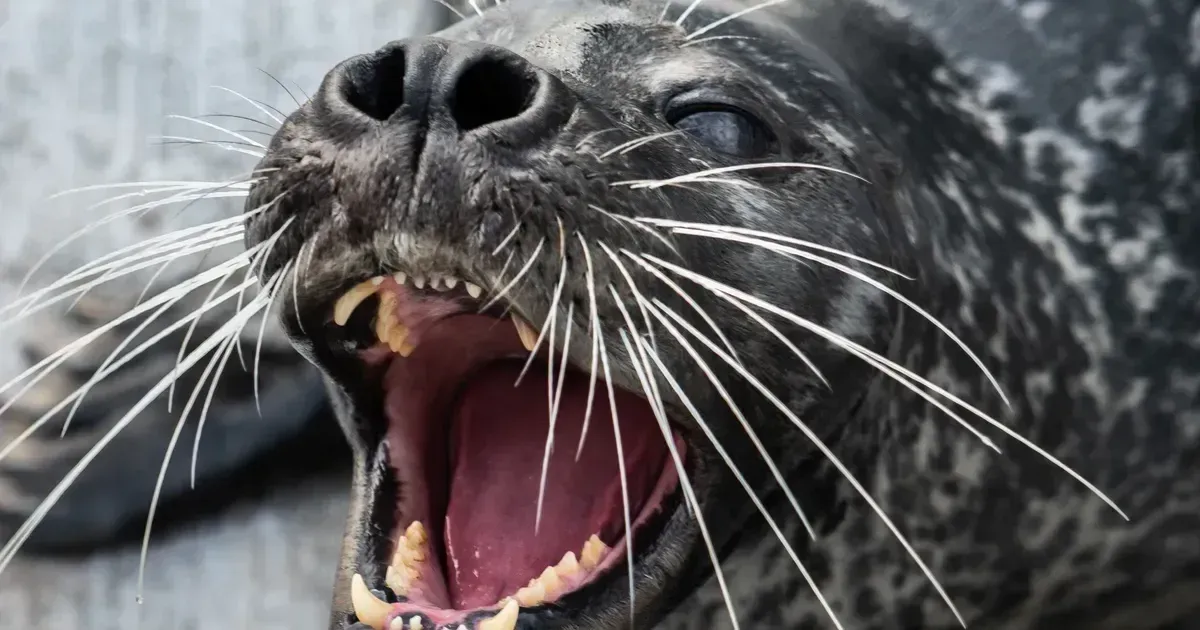
Harbor seal whiskers are giving researchers a clearer view of how marine predators hunt when vision is limited. Researchers reported that specialized whiskers can detect hydrodynamic trails left by moving fish, allowing seals to follow prey through dark or murky water. By April 16, 2026, the finding helped explain how an animal can hunt effectively in environments where sight alone is not enough. The whiskers, or vibrissae, are not simple hairs. They are sensory structures tuned to changes in water movement. When a fish swims, it leaves tiny disturbances behind. A seal can use those disturbances like a temporary track.
Flow Trails Become Underwater Clues
Fish movement creates vortices and pressure changes that persist briefly after the fish has passed. To a human swimmer, those traces are invisible. To a seal, they can provide direction, speed and possibly size information. That allows the predator to follow a path even when the fish is no longer directly in front of it. Harbor seal whiskers have a wavy shape that may reduce self-generated noise as the seal moves. That design helps the animal distinguish its own motion from the signal left by prey. In engineering terms, the whisker is both sensor and filter.
The Discovery Matters Beyond Seals
Understanding seal sensing can inform underwater robotics. Engineers want vehicles that can navigate, inspect structures or track objects without relying only on cameras or sonar. Biological systems offer clues for sensors that read water flow more efficiently. The research also deepens ecological understanding. Predator success affects fish behavior, food webs and how animals use dark coastal environments. A seal that can hunt by wake detection has options that visual predators may not.
Nature Solves a Signal Problem
The challenge for any underwater hunter is separating useful signals from background noise. Waves, currents, other animals and the predator’s own movement all create disturbance. The seal whisker system appears adapted to extract the right pattern from that clutter. That ability likely matters most at night, in deep water or in cloudy coastal zones. It may also help seals follow prey that tries to escape through sudden turns, because the water still carries a record of the movement for a short time.
A Small Structure With Large Consequences
The finding is a reminder that evolution often hides sophisticated sensing in ordinary-looking anatomy. A whisker may look delicate, but it can act as a high-resolution instrument in the right environment. For marine science, the next questions involve limits: how old a trail can be, how far away seals can detect it and how different prey species change the signal. Answering those questions could improve both animal-behavior models and artificial sensors. Harbor seals are not just seeing the ocean. They are reading its recent motion. Their whiskers turn water itself into a map. Researchers can test these abilities by creating artificial wakes and measuring how seals respond. Those experiments help separate smell, sound and sight from flow sensing. The more precisely scientists isolate the signal, the more useful the findings become for both biology and engineering. The whisker structure is especially interesting because it appears to reduce vibration noise while preserving sensitivity to outside disturbances. That is a difficult balance. Human-made sensors often struggle with the same problem when they move through water. The discovery also changes how people imagine marine hunting. Predation is not only about speed and teeth. It can be about reading the environment better than the prey expects. A fish may vanish visually while still leaving a physical trace in the water. Climate and habitat changes could affect these sensory interactions. Turbulence, prey distribution and water conditions influence how useful flow trails are. Understanding the mechanism may help researchers predict how seals adapt as coastal ecosystems change.
The small whisker therefore opens a large window. It connects animal behavior, fluid physics, robotics and conservation in one structure that most observers would barely notice.
The research may also help conservationists explain why noisy or turbulent environments matter. Human activity can alter underwater sound and movement patterns. If seals depend on subtle flow information, changes in coastal conditions could affect hunting success in ways that are not immediately visible.
Comparative work with sea lions, walruses and other whiskered marine mammals could show whether this sensing strategy is widespread or especially refined in harbor seals. That would help scientists understand how different predators divide the same environment.
The finding is elegant because it turns a familiar animal feature into a sophisticated instrument. The ocean is full of signals humans miss, and harbor seals have evolved to notice one of the most useful ones.
Engineers may study the same principle for underwater robotics. A sensor that can read trails without relying on cameras would be valuable in dark, cloudy or cluttered environments where machines currently struggle.
For the public, the research offers a cleaner way to understand animal intelligence. The seal is not guessing in the dark. It is reading a physical record that humans usually cannot perceive.
That is why the finding reaches beyond one species. It shows how evolution can turn a small anatomical detail into a complete navigation system.