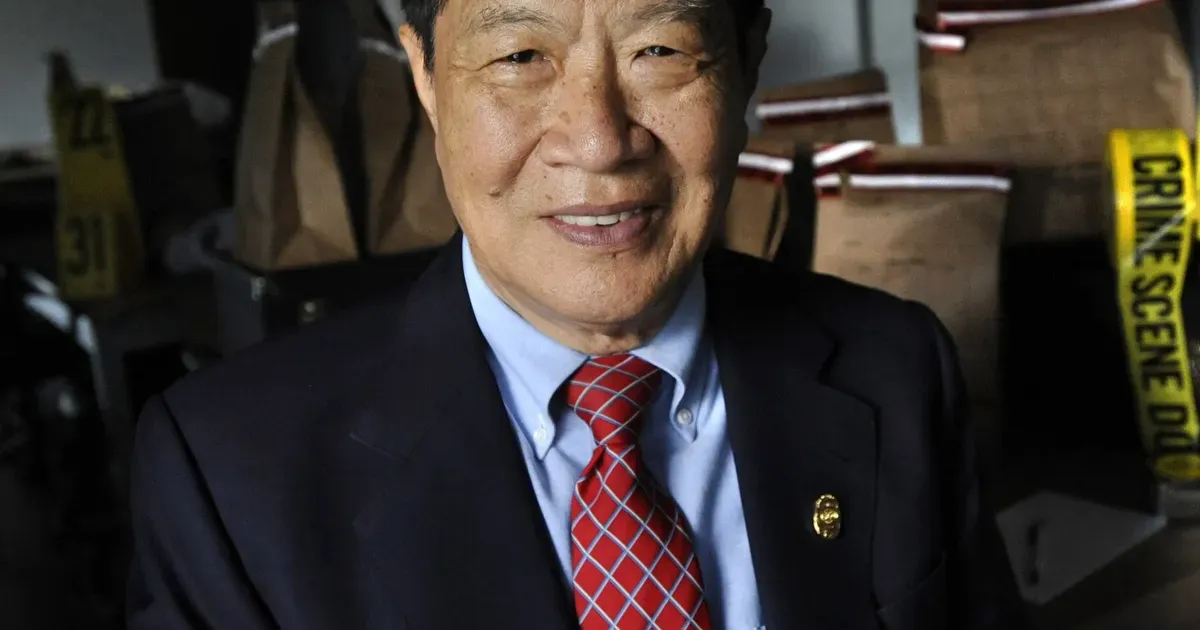
Henry C. Lee, the forensic scientist whose career mixed courtroom fame with later legal controversy, died at 87. His death was reported on March 27, 2026, closing a public life that helped turn forensic science into a recognizable part of American courtroom culture. Lee was best known to a mass audience for his role in the O.J. Simpson murder trial.
Lee's career was unusually broad. He worked with law enforcement, built academic programs and consulted in high-profile cases that made him a familiar expert witness. He also became a symbol of the risks that come when forensic authority is treated as personal prestige rather than a method that must be checked and replicated.
From Laboratory Work to Courtroom Fame
Lee became nationally known in 1995 when he testified for Simpson's defense team. His analysis focused on evidence handling and bloodstain questions, and his courtroom presence helped cement the idea of the forensic expert as a central figure in televised trials. The Simpson case made him famous far beyond scientific circles. That visibility created opportunities. Lee appeared in media, taught students and helped expand public interest in crime-scene investigation. The Henry C. Lee Institute of Forensic Science at the University of New Haven became part of his institutional legacy, training students and professionals in investigative methods.
Celebrity Cases and Scientific Scrutiny
Lee later consulted or testified in other high-profile matters, including cases connected to JonBenet Ramsey and Phil Spector. Celebrity cases made his name more valuable, but they also placed his methods under sharper review. In court, forensic claims can shape verdicts, settlements and public understanding of guilt.
That is why the later disputes over Lee's work carried such weight. Forensic science is not immune to human error, overstatement or institutional pressure. The field has spent years reexamining older methods, especially where bloodstain interpretation and other pattern evidence were presented with more certainty than the science could support.
Lee's defenders often emphasized his training role and the breadth of cases he touched. Critics focused on what happens when a famous expert's confidence travels further than the underlying test. Both views are part of the record, and both explain why his death prompted reflection rather than a simple tribute.
The Birch and Henning Ruling
The most damaging controversy came from the Connecticut case involving Ralph Birch and Shawn Henning, who were convicted in the 1985 killing of Everett Carr and later freed. A federal judge ruled in 2023 that Lee had fabricated evidence tied to testimony about a towel. The ruling said the claimed blood evidence did not exist as described. Connecticut later agreed to a $25.2 million settlement in the wrongful conviction lawsuits. Lee denied wrongdoing and said he had no reason to fabricate evidence. The legal outcome nevertheless made the case a central part of any fair assessment of his legacy.
The controversy also pushed attention back onto the justice system around him. A single expert can influence a jury, but prosecutors, defense lawyers, judges and laboratories all share responsibility for how evidence is tested, preserved and presented.
Wrongful-conviction cases rarely turn on one failure alone. They often expose a chain of assumptions that went unchallenged because the evidence sounded scientific and the expert sounded authoritative. The Birch and Henning litigation became a warning about that chain.
Forensic Legacy
Lee's death leaves a complicated record. He helped popularize modern crime-scene work and trained generations of investigators. He also became an example of why forensic evidence must be treated as data, not theater. The more famous the expert, the more important independent verification becomes. That lesson is broader than one career. Courts now face a more skeptical era, with DNA testing, evidence audits and wrongful-conviction reviews challenging older assumptions. Lee's name will remain attached to both the rise of forensic science in public life and the demand for stronger standards.
Universities and laboratories have also changed the way they discuss expertise. The modern emphasis is on protocols, documentation, peer review and transparent limits. That does not erase the importance of skilled investigators, but it reduces the chance that a case depends on a single personality.
The fairest verdict is not simple praise or simple condemnation. Lee expanded the reach of forensic science, but his later controversies show why the field cannot depend on personal authority alone.
Science in court has to survive without the charisma of the witness.That is the legacy institutions will have to manage after his death. They can acknowledge the public interest he brought to forensic work while also treating the evidence-fabrication finding as a serious boundary marker for the field. The most useful response is not to erase Lee from forensic history, but to teach the full arc: the immigrant scientist who helped professionalize crime-scene work, the celebrity expert who shaped juries and television audiences, and the controversial witness whose later record forced courts to ask harder questions. That full arc is uncomfortable, but it is more honest than memorializing only the famous cases. Forensic science has gained public trust when it has admitted uncertainty, corrected old methods and separated laboratory evidence from courtroom performance. Lee's career now belongs to that larger argument.