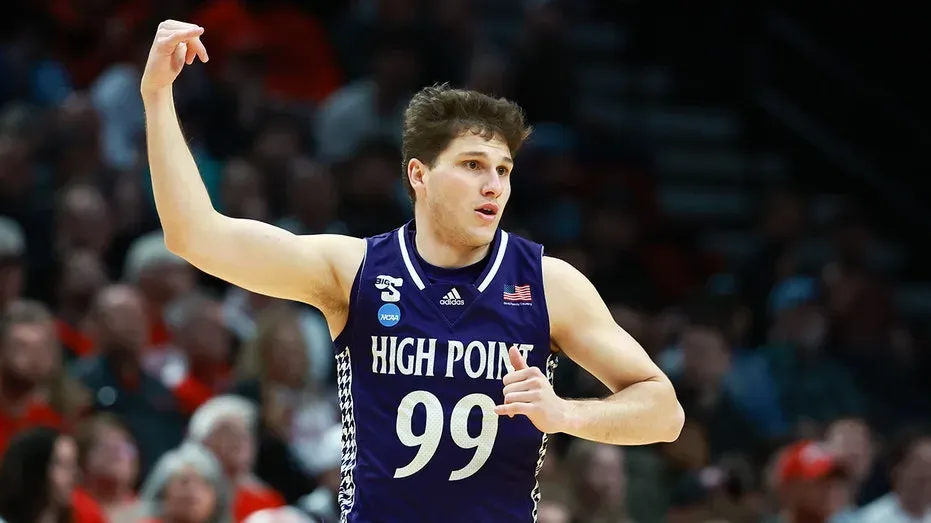
High Point University secured its first NCAA Tournament victory on March 20, 2026, by defeating Wisconsin in a game that exposed the fragile hierarchy of college basketball. The 12th-seeded Panthers overcome a double-digit deficit at the Moda Center in Portland to win 83-82, marking a definitive entry into the national conversation for a program that previously struggled for recognition. This result arrived during a chaotic opening round where the Duke Blue Devils also nearly succumbed to 16th-seeded Siena, highlighting the parity now defining the postseason. Elite programs face increasing pressure from mid-major opponents that leverage seasoned rosters and aggressive offensive schemes to negate historical talent gaps.
Coach Flynn Clayman watched his High Point squad execute a late-game surge that culminated in a breakaway layup by guard Chase Johnston with 11.7 seconds remaining. Johnston had not converted a two-point field goal during the entire regular season, yet his final sprint downcourt secured the most significant win in school history. Wisconsin guard Nick Boyd missed a potential lead-extending layup moments earlier, allowing Rob Martin to secure the rebound and trigger the transition play.
Martin finished the contest with 23 points and 10 assists, acting as the primary engine for an offense that refused to wilt under Big Ten pressure. Wisconsin struggled to contain the perimeter movement of the Panthers, who found repeated success through high-screen actions and quick ball reversals.
High Point Panthers Challenge Power Four Scheduling
Flynn Clayman used the post-game press conference to address an enduring grievance regarding how major conferences treat successful mid-major programs. He argued that Power Four schools deliberately avoid scheduling competitive teams from smaller leagues during the non-conference slate to protect their strength of schedule metrics. High Point won the Big South title for two consecutive seasons but found few opportunities to test itself against elite competition before the tournament began. Clayman suggested that the lack of regular-season matchups creates a false sense of security for high-seeded teams that eventually meet these squads in March.
I know how good of a team we are. But nobody would play us, just like they wouldn't play Miami (Ohio). But they gotta play us in this tournament.
Wisconsin guard Nick Boyd led the Badgers with 27 points, but his late-game miss became the defining image of the upset. The Badgers led by 10 points in the second half before High Point ignited a 14-4 run to reclaim momentum. Owen Aquino contributed 11 points and a critical block on Boyd in the final seconds to preserve the one-point lead. Wisconsin has now lost in the first round as a No. 5 seed in two of the last three years, continuing a trend of early exits that dates back to 2017. Financial disparities between these programs do not always translate to on-court dominance when a mid-major roster features fourth and fifth-year seniors who have played thousands of minutes together.
For instance, High Point utilized a rotation of players who remained committed to the program despite the allure of the transfer portal. Terry Anderson and Cam'Ron Fletcher combined for 29 points, providing the physical presence necessary to compete with Wisconsin's frontcourt. The Panthers shot effectively from deep, with Johnston hitting four three-pointers before his deciding layup. Even so, the victory required a defensive steal by Anderson on a long pass by Andrew Rohde with 1.8 seconds left to finalize the result. High Point players celebrated on the floor as the Badgers retreated to the locker room, facing another offseason of questions regarding their postseason durability.
Duke Blue Devils Overcome Historical Pressure
Duke avoided becoming the third No. 1 seed in history to lose to a No. 16 seed by staging a late rally against Siena. The Blue Devils trailed 43-32 at halftime, a scoreline that suggested a repeat of Virginia's loss to UMBC or Purdue's collapse against Fairleigh Dickinson. Siena shot 55% from the field in the first half and exploited a sluggish Duke defense that seemed unprepared for the Saints' intensity. Brendan Coyle and Francis Folefac combined to push the lead to double digits, silencing the pro-Duke crowd. But the second half saw a shift in defensive urgency from the Blue Devils that eventually turned the tide.
In fact, Duke outscored Siena 39-22 in the final 20 minutes to escape with a 71-65 win. Freshman forward Isaiah Evans converted a layup with 4:25 remaining to give the Blue Devils their first lead of the second half. This basket initiated an 8-2 run that finally provided the top seed with some breathing room. Duke struggled from the perimeter for much of the night, making only two of their first 15 three-point attempts. Still, their superior depth and athleticism allowed them to dominate the glass during the closing minutes when Siena players showed visible signs of exhaustion.
Yet the Saints never surrendered their poise despite the mounting fatigue. Gavin Doty led all scorers with 21 points and kept Siena within striking distance until the final minute. He attempted a three-pointer with 28 seconds left that would have cut the lead to one, but the shot missed the mark. Duke secured the rebound and made the necessary free throws to seal the victory. Blue Devils head coach Jon Scheyer noted that the pressure of being the top overall seed can weigh heavily on a young roster during the opening round. Only the second-half defensive adjustments prevented a total collapse of the tournament's primary favorite.
Fatigue Factors Impact Siena Saints Performance
Siena head coach Gerry McNamara chose a high-risk strategy by playing his five starters for the entire 40 minutes of the game. This decision helped the Saints build their initial lead as the starters developed a rhythm that Duke could not disrupt. However, the lack of bench support became a liability as the game entered its final quadrant. Players like Francis Folefac, who recorded 18 points and seven rebounds, began to miss rotations and lose their lift on jump shots. Duke recognized this decline and increased the pace of the game to further strain the Siena starters.
Meanwhile, the Blue Devils rotated nine players to keep their primary scorers fresh for the final stretch. The depth advantage allowed Duke to maintain high-intensity ball pressure that forced several Siena turnovers in the second half. By contrast, Siena relied on isolated scoring from Doty and Coyle, who were forced to take difficult shots against fresh defenders. The Saints did not record a single bench point, a statistic that highlights the narrow margins they navigated throughout the evening. Fatigue often is the equalizer in these matchups, turning a precision offense into a stagnant one as the clock winds down.
Wisconsin Badgers Defensive Failures in Portland
Wisconsin allowed 83 points to a High Point team that had rarely seen a defense of Big Ten caliber. The Badgers struggled with ball containment, allowing Rob Martin to penetrate the paint and find open shooters at will. John Blackwell scored 22 points and Austin Rapp added 12, but these offensive contributions were negated by a defensive unit that lacked communication on switches. The loss marks another chapter in a period of stagnation for the Wisconsin program, which has not advanced past the Sweet Sixteen in nearly a decade. High Point simply outworked the Badgers on the perimeter, winning the 50-50 balls that often determine the outcome of one-possession games.
Separately, the victory for High Point validates the aggressive coaching style of Flynn Clayman in his first year. He pushed his players to play without fear of the Wisconsin name or the Big Ten logo on the jerseys. The mindset is becoming more common among mid-major programs that no longer see themselves as mere participants in the tournament. They are built to win, often featuring rosters with more experience than the blue-blood programs they face. The gap between the 5th and 12th seeds continues to shrink as coaching talent and data analytics become more widely distributed across the college basketball landscape.
71-65.
High Point prepares for its second-round matchup with the momentum of a program that has finally broken through the glass ceiling. The Panthers demonstrated that scheduling snubs cannot prevent a talented team from making its mark when the lights are brightest. Wisconsin returns to Madison to evaluate a system that appears increasingly vulnerable to the high-variance nature of modern college basketball. Duke moves forward with the relief of a survivor, knowing that their path to the Final Four was nearly severed before it truly began. Siena departs with the respect of the nation but the bitter taste of a missed opportunity to join the most exclusive club in sports history.
The Elite Tribune Perspective
Does the NCAA Tournament exist to crown a champion or to satisfy a voyeuristic desire for the destruction of established powers? The near-death experience of Duke and the total collapse of Wisconsin suggest that the current tournament structure is the only remaining venue where merit actually trump's brand value. Flynn Clayman is entirely correct to call out the cowardice of Power Four athletic directors who hide behind metrics to avoid playing dangerous mid-majors like High Point.
These major programs have turned the regular season into a protected bubble, only to find that bubble burst the moment they face a team of hungry veterans in Portland or Charlotte. We should stop pretending that the gap between a 5-seed and a 12-seed is a matter of talent; it is a matter of exposure and opportunity. If the Big Ten and the ACC truly believe in their superiority, they should stop ducking the High Points of the world in November and December.
The reality is that these blue bloods are terrified of the optics of a home loss, so they wait until the tournament where their failure becomes a national spectacle. Competitive integrity demands a scheduling overhaul that forces these giants out of their comfort zones before the brackets are even drawn.