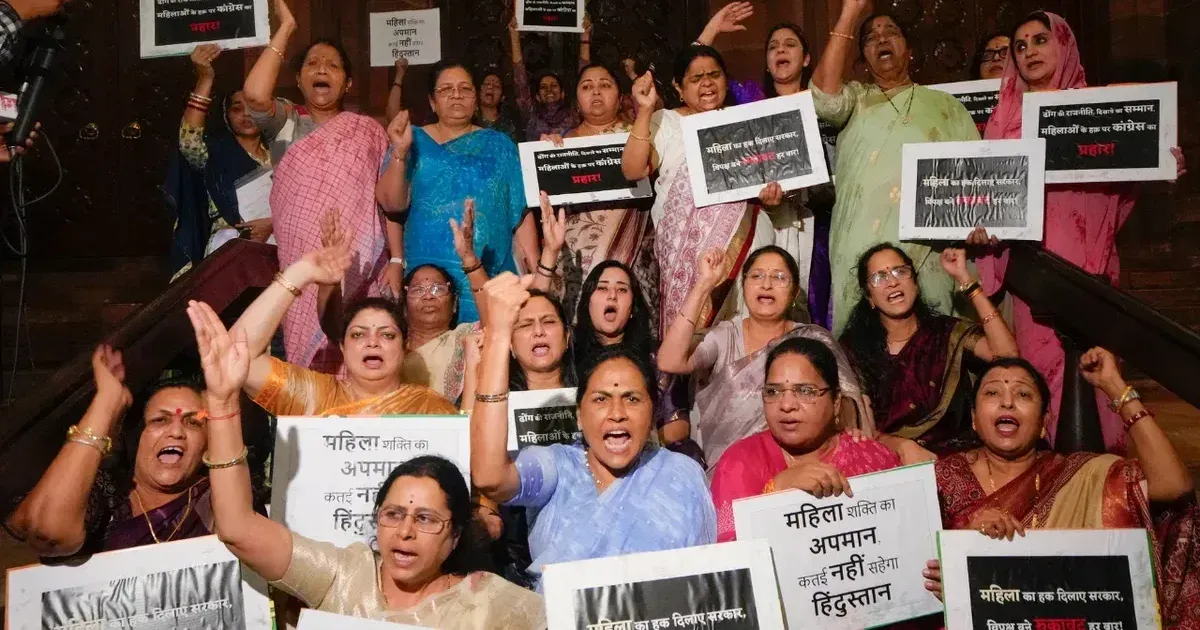
Indian lawmakers blocked a bill to reserve more legislative seats for women, reviving a long argument over representation and political control.
The vote came after years of promises that women's representation would be treated as a democratic priority. On April 17, 2026, it exposed how a proposal that sounds simple in principle can become difficult once parties calculate who gains, which constituencies change and how candidate lists are reshaped. Women's representation has broad rhetorical support, but the mechanics of quotas still produce resistance.
India has debated gender reservation for years, and each failed attempt deepens frustration among advocates who argue that Parliament cannot keep praising women's participation while delaying structural change.
Representation Bill Stalls
The bill's defeat gave opposition parties and government allies different ways to claim principle. Some argued the measure was flawed; others treated the failure as proof that political leaders remain unwilling to share power.
Narendra Modi faced criticism because the government has often presented women's empowerment as a national priority. Blocking or failing to pass a quota bill makes that message harder to defend.
The debate also touches caste, regional parties and constituency rotation. Women's seats are not only gender seats; they alter local political maps and the careers of incumbents.
Power Sharing Remains the Test
Quota opponents often ask for more consultation or different sequencing. Supporters hear those arguments as delay tactics because the demand for representation has already been studied for decades.
Parliament now faces the same question again: whether it can design reform that expands representation without becoming trapped in tactical bargaining.
The bill's failure is not the end of the issue. It is another reminder that symbolic support for women in politics means little unless parties are willing to surrender some safe seats and internal control.
The strongest argument for the quota is that normal party processes have not delivered enough women to office. Parties often praise female voters and leaders during campaigns, then return to candidate lists dominated by men when winnable seats are allocated.
Opponents raise questions about implementation, including rotation, local representation and how quotas interact with caste and regional demands. Those concerns are not meaningless, but supporters argue they have become a permanent excuse for delay.
The debate also affects party strategy. Reserving seats would force leaders to cultivate women candidates before elections rather than treating them as symbolic additions. That could change local party networks and threaten incumbents who expect safe nominations.
India's political system is large enough to absorb reform, but only if parties accept that representation requires giving up some control. The blocked bill shows that the hardest part of quota politics is not the principle. It is the redistribution of opportunity.
The bill's defeat will also shape how parties campaign to women voters. Promises about safety, welfare benefits and economic opportunity may still matter, but representation advocates will ask why women are trusted as voters more readily than as lawmakers. That question is difficult for every major party because candidate selection remains tightly controlled. There is a generational dimension too. Younger voters have grown up seeing women lead in business, media, local government and civil society, yet national legislative bodies still lag. A failed quota bill can make Parliament look older than the society it claims to represent. The next version of the proposal will need careful design, but design cannot become an endless holding pattern. If parties believe women should have more power, they will have to accept reforms that disrupt incumbent comfort. Without that, the debate will return every few years with the same speeches and the same result. The blocked bill also leaves civil-society groups with a tactical choice. They can keep pressing for the same quota framework, or they can build pressure through state-level reforms, party candidate pledges and public scorecards that identify which parties nominate women in winnable seats. A constitutional or parliamentary quota would be the clearest route, but it is not the only way to expose the gap between public promises and actual candidate selection. The debate will return because the underlying imbalance remains visible. Every election that sends too few women to Parliament strengthens the case that voluntary party reform is not enough. The blocked bill delays that fight; it does not settle it. Until that question is answered, the quota debate will remain a measure of political will. Parties can support women in speeches, but the test is whether they are prepared to change who gets access to winnable seats. That is why the issue will keep returning to Parliament. That pressure will not disappear because one bill failed. Women's representation has become a recurring test because the gap is visible after every election. If lawmakers keep blocking quota mechanisms, parties will face more pressure to prove through nominations that they are willing to change without being forced by statute.