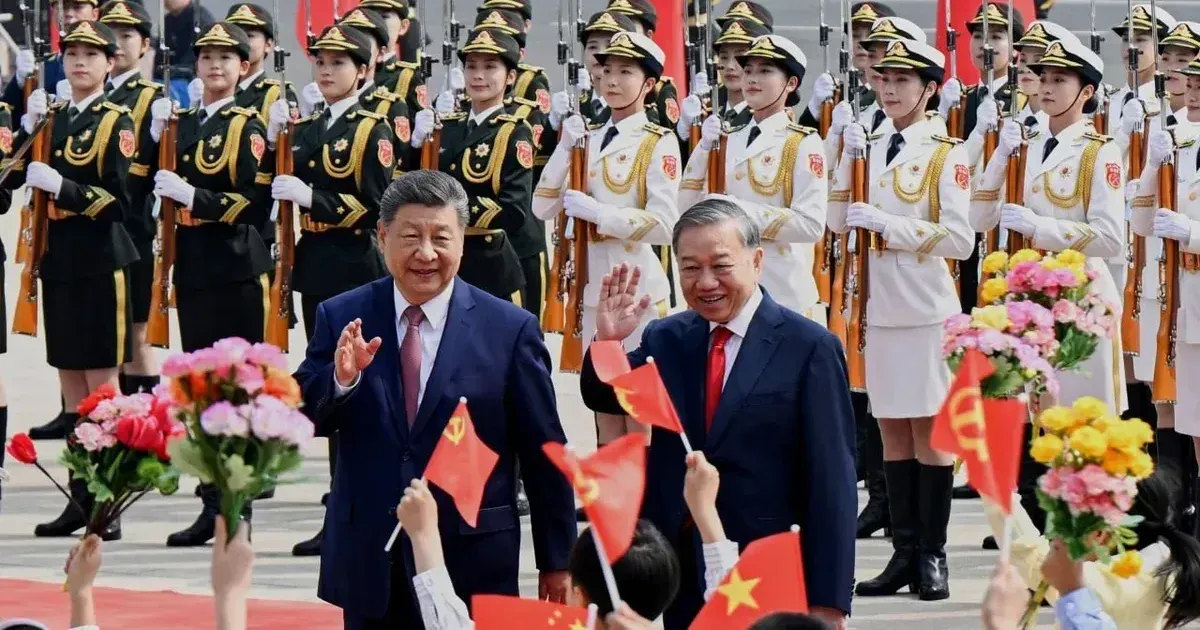
Vietnam's strategy is moving toward a more explicit China hedge. The shift matters because U.S. pressure has not erased Hanoi's regional calculations. To Lam, Vietnam’s top leader, concluded a high-stakes visit to Beijing on April 17, 2026, signaling a definitive shift in Hanoi's strategic orientation. Documents emerging from the summit confirm that the Vietnamese government is actively distancing itself from Western security frameworks in favor of a closer ideological and military alignment with China. This move effectively ends years of speculation regarding Vietnam’s potential role as a defense partner in the American strategy to contain Chinese expansion in the Asia-Pacific. Officials in Beijing expressed satisfaction with the new direction, which prioritizes the survival of communist governance over maritime territorial grievances.
Security planners in Hanoi have finalized a radical internal doctrine that reclassifies the United States as a primary threat to national stability. Internal military records, specifically the “Second U.S. Invasion Plan” issued in August 2024, provide the foundation for this realignment. Those documents reveal a deep suspicion within the Communist Party of Vietnam regarding American intentions under the guise of promoting democratic values. Vietnamese military leadership now views the promotion of human rights as a cynical mechanism for regime change rather than a genuine diplomatic objective.
Vietnam Secret Military Strategy Analysis
Hanoi's defense establishment spent the early months of 2026 refining its response to what it describes as Western hegemony. While previous administrations maintained a careful balance between Washington and Beijing, the current leadership has opted for a lopsided embrace of the Chinese model. Military analysts note that the 2024 doctrine explicitly rejects participation in any U.S.-led coalition. Instead, the focus has shifted toward building a regional security architecture that excludes non-Asian powers. Experts point to a series of joint exercises scheduled for late 2026 as evidence of this growing cooperation.
Beijing has responded to this loyalty with promises of infrastructure investment and technological transfers. Xi Jinping emphasized the shared destiny of the two nations during a private banquet held on the third day of the visit. Reports from the state-controlled press in both nations omit any mention of historical animosity or the 1979 border war. This erasure of historical friction allows both parties to present a united front against what they perceive as external interference. Control over information remains a central component of this bilateral agreement.
Maritime Demarcation and Sovereignty Talks
Territorial disputes in the South China Sea, once a source of frequent naval standoffs, are being moved to the negotiating table. The joint communiqué released on Friday outlines a renewed commitment to the demarcation of contested waters. Both nations pledged to manage bilateral frictions with a degree of maturity not seen in previous decades. This diplomatic pivot suggests that Hanoi is willing to trade certain maritime claims for the security of its political system. The communique specifically mentions the Gulf of Tonkin as a model for future cooperation.
Hanoi and Beijing have agreed to accelerate the implementation of the Declaration on the Conduct of Parties in the South China Sea. The effort seeks to marginalize the influence of the United Nations Convention on the Law of the Sea (UNCLOS) in regional disputes. Legal scholars in China argue that bilateral agreements provide a more stable framework than international arbitration. Recent satellite imagery shows a reduction in Vietnamese construction on certain features in the Spratly Islands. Vietnam has focused its efforts on stabilizing existing holdings instead of expanding its footprint. This policy pivot follows the recent internal ascent of To Lam as he solidifies control over state affairs.
The countries’ ruling communist parties had agreed to shore up each other’s leadership at home with the adoption of a new five-year action plan.
Direct communication channels between the two navies are now operational 24 hours a day to prevent accidental escalations. Earlier incidents involving fishing fleets and coast guard vessels often led to weeks of diplomatic cooling. Under the new protocol, such events will be handled by a joint committee before they reach the public sphere. Both capitals have agreed to limit the publication of maritime incidents to prevent the stoking of nationalist sentiment. The media blackout serves to protect the image of a unified socialist bloc.
Communist Party Consolidation Efforts
Internal party stability is the primary driver of this geopolitical reversal. The five-year action plan mentioned in the April 17, 2026, communiqué focuses heavily on preventing color revolutions. Vietnam’s Ministry of Public Security and China’s Ministry of State Security have established a joint task force to share intelligence on dissident groups. These agencies will cooperate on the surveillance of cross-border activists and the regulation of internet platforms. The partnership aims to harden both regimes against the perceived threat of Western-backed democratization movements.
Hanoi recognizes that its survival depends on the economic and political patronage of a friendly neighbor. While trade with the United States remains substantial, the ideological rift between a one-party state and a liberal democracy has become too wide to bridge. Chinese advisers are now helping the Vietnamese government modernize its digital censorship tools. These upgrades include advanced facial recognition and traffic analysis software. Security forces in Hanoi have already begun deploying these systems in urban centers.
Regional Rejection of Western Containment
Washington’s attempts to bring Vietnam into the Quad or other security arrangements have met with consistent resistance. Military planners in Hanoi view the American presence in the South China Sea as a destabilizing factor. Their internal documents suggest that a second US invasion would likely take the form of economic sanctions and political subversion. The fear outweighs the traditional concern over Chinese territorial encroachment. Because of this, Vietnam has effectively withdrawn from many informal intelligence-sharing agreements with the United States.
Regional neighbors are watching this alignment with varying degrees of concern. Countries like the Philippines, which have moved closer to the United States, now find themselves increasingly isolated in ASEAN. Vietnam was once the most vocal opponent of Chinese maritime policy within the bloc. Its sudden silence has paralyzed the group’s ability to form a cohesive stance on the South China Sea. Beijing has used this opportunity to push for a regional code of conduct that favors its own interests. The power balance in Southeast Asia has shifted toward a China-centric order.
Vietnam Strategy Moves Toward China
Western diplomats have long indulged in the fantasy that Vietnam could be transformed into a democratic outpost through trade and shared anxiety over China. The belief was always rooted in a fundamental misunderstanding of the Communist Party of Vietnam’s core priority: the absolute preservation of its own power. To Lam’s visit to Beijing proves that the ruling elite in Hanoi fear the ballot box more than they fear Chinese frigates. They have correctly calculated that China will never demand human rights reforms as a condition for friendship, whereas the United States inevitably will. By framing the relationship as a joint struggle against Western subversion, Hanoi has secured a powerful patron that is indifferent to its domestic repression.
The so-called “Second U.S. Invasion Plan” is a masterstroke of internal propaganda. It allows the Vietnamese military to justify a pivot that would otherwise be unpopular with a public that retains a deep historical skepticism of China. If the United States is the primary threat, then China becomes the necessary protector. The narrative effectively neutralizes the nationalist opposition that has historically fueled anti-China protests in Hanoi and Ho Chi Minh City. Washington is now left with a shrinking list of allies in the region. The American strategy of building a ring of democracies around China is collapsing under the weight of autocratic survival instincts. Vietnam has chosen its side.