Ruturaj Gaikwad surfaced as a leading contender for the Indian red-ball squad on April 23, 2026, as national selectors began evaluating performers from the ongoing professional T20 circuit. Reports indicate that Gaikwad, who leads the Chennai Super Kings, is being monitored alongside other franchise stars for an upcoming one-off Test match against Afghanistan. Selection committee members are reportedly looking to integrate younger talent into the middle order to ensure long-term stability in the longest format of the game. Ruturaj Gaikwad remains a high-priority target for this transition due to his consistent technical proficiency across multiple formats.
Potential inclusions also feature Devdutt Padikkal and Dhruv Jurel, both of whom have demonstrated the temperament required for international red-ball duties during recent domestic campaigns.
Cricket experts suggest that the performance of these individuals in high-stakes franchise matches provides a unique psychological vetting process. While the T20 format emphasizes aggression, the pressure of captaincy and the scrutiny of global audiences test a player's mental resilience. Ruturaj Gaikwad has previously showcased his ability to anchor an innings, a trait that appeals to selectors looking to replace aging veterans in the national side. Padikkal and Jurel are viewed as flexible options who can adapt to the shifting demands of a five-day match.
This specific strategy focuses on rewarding those who can maintain focus despite the distractions of the lucrative T20 circuit. National coaching staff members have reportedly requested data on these players to assess their fitness levels before the Afghanistan fixture.
National Selectors Eye Ruturaj Gaikwad for Afghanistan Test
International scheduling often dictates these experimental windows where fringe players receive opportunities to prove their worth. Afghanistan is a powerful opponent in Asian conditions, making the one-off Test an ideal proving ground for Gaikwad and his contemporaries. Padikkal has already tasted the rigors of Test cricket, while Jurel impressed during previous home series with his wicket-keeping and lower-order batting. Selectors believe that integrating these players now will prevent a vacuum when senior players eventually move toward retirement. Recent scouting reports highlight Gaikwad's improved footwork against spin, which is a critical requirement for facing the Afghan bowling attack. Internal discussions at the BCCI suggest a desire to move away from specialists in favor of all-format technicians.
Success in the IPL frequently accelerates careers, but the jump to Test cricket requires a fundamental adjustment in defensive technique. Critics of this selection policy argue that T20 form is a poor indicator of red-ball success. Statistics from the current season show that Gaikwad has managed to balance high strike rates with a low dismissal percentage in the powerplay. These figures suggest a level of control that selectors value beyond mere run-scoring. Padikkal has found similar success, using his height to dominate both pace and spin.
Jurel provides an additional layer of utility, offering a reliable gloveman who can also contribute valuable runs under pressure. The squad announcement is expected within the next fortnight following the conclusion of the current league stage.
Kevin Pietersen Rebuts Alastair Cook on Jacob Bethell Progress
External debates regarding the utility of the IPL for international development reached a boiling point between two former England captains. Kevin Pietersen defended the presence of young English talent in the league after Alastair Cook questioned the development of Jacob Bethell. Cook expressed concern that the youngster was losing valuable red-ball experience by sitting on the bench for Royal Challengers Bengaluru. Pietersen disagreed, asserting that the training environment and exposure to world-class coaching outweigh the benefits of early-season county matches.
The disagreement highlights a widening chasm in how different generations of cricketers view the role of franchise leagues in career progression. Bethell has yet to see substantial game time this season, fueling the fire of those who prefer traditional developmental paths.
"He has no idea what he is talking about," Kevin Pietersen said in response to Cook's criticism of the IPL developmental environment.
Pietersen argued that the intensity of practicing alongside icons like Virat Kohli provides a psychological edge that cannot be replicated in domestic cricket. Jacob Bethell is considered one of the brightest prospects in the England system, and his placement at Royal Challengers Bengaluru was intended to fast-track his growth. Cook, however, maintains that actual match play is the only way for a 20-year-old to understand his own game. He pointed out that several English players have returned from the IPL with their techniques slightly eroded by the demands of the short-form game.
Royal Challengers Bengaluru management has defended their handling of Bethell, claiming his development is being tracked by specialized strength and conditioning coaches. The friction between the two legends reflects a larger anxiety within the England and Wales Cricket Board regarding player availability for the home summer.
Modern coaching philosophy often prioritizes high-performance environments over the quantity of matches played. Pietersen noted that the sheer quality of the net sessions in Bengaluru offers a higher standard of bowling than what is typically found in the County Championship. Jacob Bethell has been observed working closely with international batting consultants to refine his power-hitting. This exposure is meant to prepare him for the demands of the modern international game, which increasingly requires players to be aggressive from the first ball. Supporters of Pietersen's view argue that the mental toughness gained from being part of a high-pressure franchise is invaluable.
Opponents of this view suggest that the lack of competitive overs will leave Bethell undercooked for the rigors of the upcoming international calendar. The debate persists as younger players opt for the financial security and global visibility of the IPL.
Nandre Burger Faces Financial Penalty After Rishabh Pant Clash
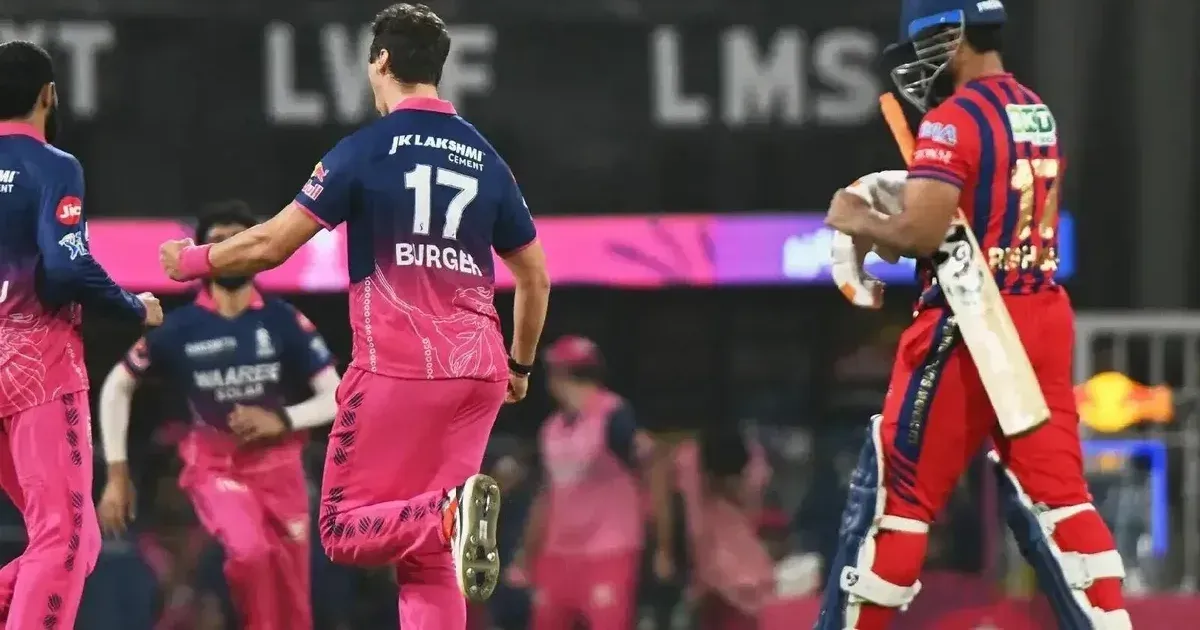
Disciplinary issues surfaced during a recent encounter between the Rajasthan Royals and the Lucknow Super Giants. Nandre Burger, a South African pacer representing the Royals, was fined 10 percent of his match fees following a verbal altercation. Match officials cited a send-off gesture directed at Rishabh Pant as the primary reason for the sanction. Burger received one demerit point on his disciplinary record, a move that places him closer to a potential suspension if he commits further infractions. The incident occurred during a tense period of the match where Rishabh Pant was attempting to rebuild the innings for his side. Officials noted that Burger's behavior violated the code of conduct regarding sportsmanship and respect for opponents.
Despite the controversy, the bowling performance from the Rajasthan Royals was clinical throughout the evening. They restricted their opponents to a total of 119 runs, securing a dominant 40-run victory that strengthened their position at the top of the table. Nandre Burger played a key role in this effort, providing early breakthroughs that put the opposition on the defensive. The fine is a reminder that the league is tightening its grip on player behavior to maintain a family-friendly image. Rishabh Pant did not publicly comment on the exchange, focusing instead on his team's inability to chase down a modest target.
Coaches from the Rajasthan Royals admitted that while they value Burger's aggression, it must be channeled within the rules of the game. The league's disciplinary committee has been particularly active this season in penalizing excessive celebrations. Maintaining order in a high-octane tournament requires a consistent application of the rulebook. Burger is the third player this month to face financial penalties for on-field conduct. Rishabh Pant has also been under the microscope for slow over-rates earlier in the season. These incidents illustrate the mounting pressure on players as the tournament nears the knockout stages. The Rajasthan Royals now have to manage Burger's temperament to ensure he remains available for the playoffs. Analysts believe that the 10 percent fine is a standard deterrent for first-time offenders in this category. The focus now shifts to the upcoming matches where the Rajasthan Royals look to maintain their winning momentum without further disciplinary distractions. Team management has reportedly held internal meetings to address player conduct and the importance of maintaining focus on the cricket. The bowling unit remains the strongest asset for the franchise as they eye the championship trophy.
IPL Performance Intensifies Test Selection Pressure
Will the pursuit of T20 profit eventually destroy the technical foundations of the Test game? The current obsession with using the IPL as a primary scouting tool for red-ball cricket is a dangerous gamble that ignores the vast differences in mechanics and mentality between the two formats. Selecting Ruturaj Gaikwad based on his ability to manipulate a white ball in a 20-over setting is an admission that traditional domestic structures have failed. If the BCCI continues this path, they risk producing a generation of players who are mentally fragile when faced with the grinding reality of a five-day match. The spectacle of the IPL should remain separate from the prestige of the Test cap. The clash between Pietersen and Cook is more than a war of words; it is a battle for the soul of the sport. Pietersen's suggestion that sitting on a bench in Bengaluru is superior to playing competitive matches in England is a fantasy driven by the commercial interests of franchise leagues. Young players like Jacob Bethell are being treated as commodities to be polished rather than cricketers who need to learn through failure on the pitch. This reliance on high-performance bubbles creates athletes who are physically elite but tactically illiterate. The result is a shallow talent pool that can smash a ball over mid-wicket but cannot survive a testing spell of swing bowling on a cloudy morning. Disciplinary actions like the one against Nandre Burger are necessary but often performative. The league wants the fire of competition to drive viewership but punishes the heat it produces. The hypocrisy creates a sanitized version of the sport where genuine emotion is replaced by pre-approved celebrations. If the authorities want to fix the game, they should focus on the quality of the pitches instead of the volume of a bowler's shout. The IPL is a business first and a sport second. We must stop pretending it is anything else. The system is purely commercial.