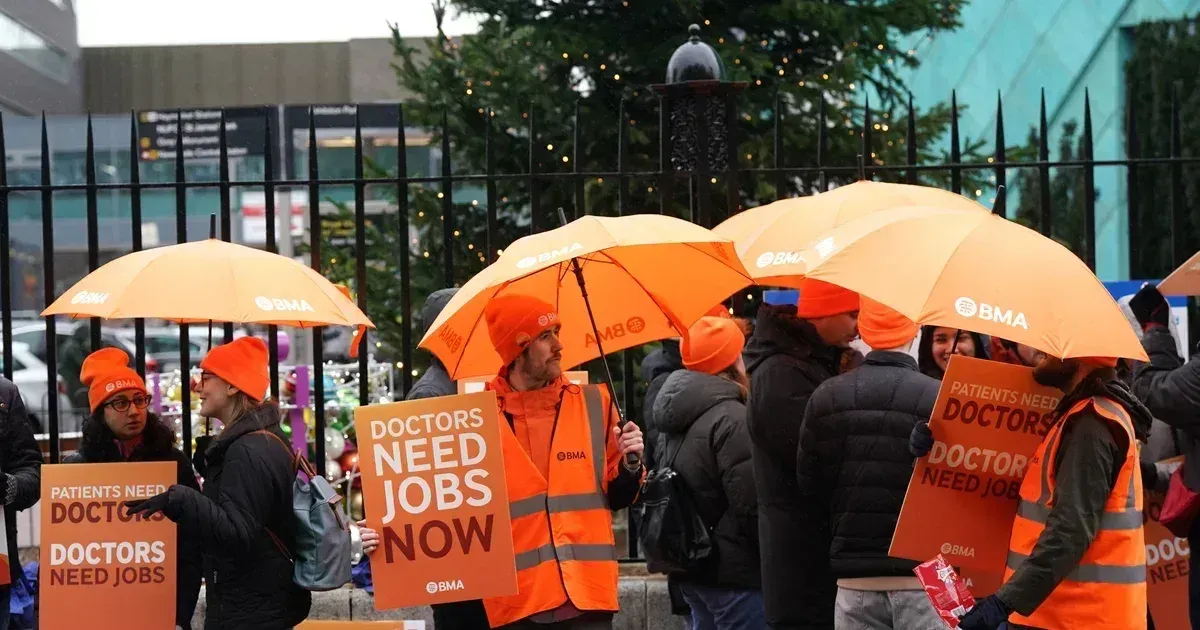
Officials from other health unions privately questioned the British Medical Association's pay strategy before six days of resident doctor strikes in England. The April 4, 2026 report documented unease among three unnamed union figures. It did not establish a formal split across the trade union movement.
That boundary changes the story. The concern was real enough to report, but anonymous criticism cannot be inflated into secret resolutions, coordinated opposition or an agreed attempt to force the BMA back to the table.
The Pay Comparison Was 3.5% Versus 3.3%
The immediate source of tension was the difference between two NHS pay processes. Resident doctors were due a 3.5% award. More than one million nurses, ambulance staff and other workers covered by Agenda for Change were due 3.3%.
A senior figure in another union told the Guardian that the BMA's demand for more would make the smaller award harder for other unions to sell to their members. The official's concern was comparative pressure, not evidence that those unions had accepted the 3.3% figure or abandoned their own negotiations.
Talks on changes to the Agenda for Change pay structure had not yet begun. Unison analysis cited by the Guardian found no marked improvement in pay satisfaction among staff covered by that framework, with declines in some occupations. Satisfaction among medical and dental staff had risen by 18 percentage points since 2023.
Anonymous Sources Criticised the Negotiations
A second union figure described the resident-doctor-led talks as chaotic and said they lacked a pragmatic approach. A third acknowledged resentment among other unions while adding that the BMA was doing its job by representing doctors.
Those comments show friction, not a single position shared by Unison, GMB and the wider union movement. The Guardian attributed the remarks to unnamed figures and did not report national executive votes, member ballots or public statements opposing the BMA's action.
The original article turned that limited evidence into private documents, emergency meetings and a historic collapse of labour unity. Its source contained none of those details. It also supplied no basis for claims that the Trades Union Congress had attempted and failed to mediate.
The BMA Defended a Separate Pay Claim
The BMA said resident doctors were in a different position from other NHS staff. It said their pay had fallen by more than one-fifth in real terms since 2008-09 and that the 3.5% award did not make meaningful progress toward restoration.
The association's resident doctors committee called action in England from 7am on April 7 until 6.59am on April 13 after rejecting the government's final offer. The BMA said the package included reimbursement of mandatory royal college exam fees, changes to pay progression and additional specialty training places, but did not resolve its pay demand.
The government described the package differently. It said resident doctors would receive 3.5% even without a deal and that acceptance would have unlocked 4,500 specialty training places over three years, including 1,000 in an April recruitment round. These were opposing negotiating positions, not neutral proof that either side's broader judgment was correct.
A Separate Dispute Involved BMA Employees
The Guardian also reported a dispute between the BMA and GMB over pay for some of the association's own employees. GMB said a 2.75% offer was inadequate and planned action by BMA staff to coincide with the resident doctor strike.
The BMA replied that it had a strong record on staff pay, conditions and retention. It also argued that the circumstances of its employees were not equivalent to those of resident doctors employed by the NHS.
That dispute created an uncomfortable comparison for the association. It did not prove that the BMA's medical pay case was invalid, nor that GMB had rejected resident doctors' industrial action. Two bargaining relationships can be compared without pretending they are the same negotiation.
The Report Did Not Quantify Patient Harm
The original article attached precise claims about the elective backlog, daily cancellations, total strike costs, ambulance handovers and hospital staffing decisions. None appeared in the cited report. It also introduced a multibillion-pound estimate for the BMA demand without a source or calculation.
Removing those numbers does not imply that industrial action has no effect on care. It means this article cannot assign a scale that its evidence never measured. A responsible account would need dated NHS operational data, a defined strike period and a transparent method for separating strike effects from existing capacity pressures.
The defensible conclusion is political rather than clinical. A higher settlement for one workforce can complicate bargaining for another, and the anonymous comments revealed that pressure. But three private voices are not a union-wide rebellion. Until named organisations adopt positions, members vote or negotiations produce comparable settlements, describing discomfort as an organised rift gives the government leverage that the evidence itself did not earn.