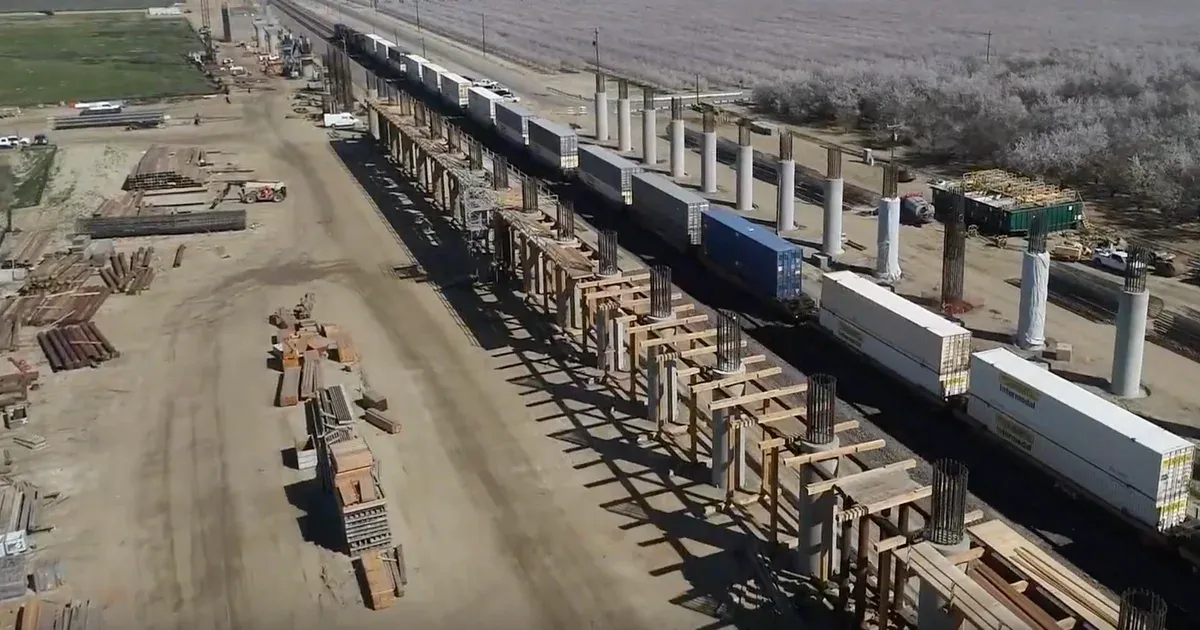
Investors questioned the future of U.S. high-speed rail as California costs, contract delays and land-rights disputes mounted. A revised fiscal report showed how far the project had moved from early cost assumptions. The warning arrived on April 6, 2026, as suspended tunneling work, Central Valley delays and private-sector regulatory hurdles raised doubts about whether the national rail vision could attract durable capital.
Engineering teams currently face serious delays in the Tehachapi Mountains where seismic activity requires reinforced structural designs that were not part of the original scope. Budgetary oversight remains a point of contention among state legislators who previously approved multi-billion dollar bond measures. Costs have surged due to specialized labor shortages and the rising price of American-made steel required by federal procurement laws. Public support for the transit link has softened as the timeline for completion moves into the late 2030s. Critics argue the project is a textbook case of bureaucratic overreach. Proponents insist that the environmental benefits of reducing short-haul flights between Los Angeles and San Francisco justify the expenditure. Recent data from the California High-Speed Rail Authority indicates that land acquisition costs have risen 400% in certain agricultural zones since the project began.
Farmers in the Central Valley have filed dozens of lawsuits to block the seizure of their property through eminent domain. These legal challenges have frozen construction on several segments for years at a time. Construction crews have completed several viaducts and overpasses in Madera and Fresno counties, yet these structures currently lead to nowhere. The lack of a completed operational segment means the state cannot begin generating revenue to offset its huge debt service. Investors have expressed skepticism regarding the long-term viability of the route if it fails to reach the high-density population centers of Los Angeles and San Francisco. Private equity firms once interested in the venture have largely withdrawn, citing the unpredictability of state funding cycles.
California High-Speed Rail Authority Stalls in Central Valley
Federal grants have provided a temporary lifeline, but these funds come with strict deadlines that the agency is struggling to meet. Political shifts in Washington often result in the freezing or redirection of these essential infrastructure dollars. This volatility has made long-term planning nearly impossible for the engineers on the ground.
“Yet so far, the projects haven't tracked in the U.S., where both the public and private sectors have faced ballooning costs and delays,” according to a CBS News investigative report on the state of high-speed infrastructure.
The money ran out before the tracks reached the first major metropolitan hub. Voters originally approved the project under the impression that federal partnerships would cover the majority of the costs. Washington has instead prioritized highway repairs and bridge maintenance over new rail initiatives. International consultants from France and Japan have noted that the lack of a centralized national rail strategy hinders progress in a way not seen in Europe or Asia. European nations often provide 80% or more of the funding for high-speed corridors through national budgets. By contrast, the American model relies on a patchwork of state bonds, local taxes, and occasional federal windfalls.
This fragmented approach creates bottlenecks whenever a single county or city raises an objection to the proposed route. Local municipalities often demand expensive deviations or underground stations as the price for their cooperation.
Investors Monitor Global High-Speed Rail Efficiency
Japan began operating its Shinkansen network in the 1960s, proving that high-speed transit could be both profitable and reliable. China has built more than 25,000 miles of high-speed track in less than two decades. American projects struggle with a regulatory environment that prioritizes individual property rights over collective infrastructure needs. Environmental impact studies for the California route alone have cost hundreds of millions of dollars and taken over a decade to complete. These studies are frequently challenged in court by interest groups seeking to protect specific habitats or noise levels.
The resulting delays add carrying costs that can exceed the actual construction budget. Labor unions have also fought for specific work rules that increase the total man-hours required for every mile of track laid. Such internal pressures make the American cost per mile much higher than its global counterparts. Europe and Asia achieved what the United States continues to treat as a science fiction concept.
Private-sector initiatives like Brightline West have attempted to bypass some of these public-sector pitfalls. By using existing highway medians, Brightline West avoids the most expensive aspects of land acquisition. However, the private model still faces the challenge of low ridership projections in a culture dominated by the automobile. Investors worry that without an enormous shift in urban planning, Americans will continue to prefer the flexibility of personal vehicles. High-speed rail requires high-density urban hubs at both ends of the line to be truly effective. Many American cities are too sprawled to support the foot traffic needed for a major rail terminal. Developers are beginning to plan transit-oriented housing around proposed stations, but these projects are also years away from completion. Current interest rates have made the financing of these secondary developments increasingly difficult for mid-sized firms.
Private High-Speed Rail Faces Growing Regulatory Hurdles
Safety regulations designed for heavy freight trains often apply to lightweight high-speed passenger cars in the United States. This requirement forces engineers to build heavier, slower trains that cannot reach the 200-mile-per-hour speeds seen in Europe. The Federal Railroad Administration has been slow to update these standards to account for modern crash-avoidance technology. Without these updates, the competitive advantage of rail over air travel diminishes. Airlines have capitalized on this stagnation by offering more frequent and cheaper flights on the very routes rail is intended to replace. Jet fuel prices would need to rise sharply for the economics of rail to become more attractive to the average traveler. Legislative attempts to tax short-haul flights have met fierce resistance from the aviation lobby and regional airports. These airports fear losing the landing fees and tax revenue associated with busy commuter corridors.
Technological limitations also play a role in the sluggish rollout of domestic high-speed lines. Most existing US track is owned by freight companies like Union Pacific or BNSF. These companies prioritize slow, heavy cargo over fast passenger trains. Building dedicated passenger tracks is the only solution, but this doubles the infrastructure cost. Most states simply do not have the tax base to support such an undertaking without large federal intervention. The California High-Speed Rail Authority has explored public-private partnerships, but the risk profile remains too high for most commercial banks. Insurance premiums for such large-scale projects have also skyrocketed due to the history of litigation and delays. Every year of delay adds roughly 5% to the final price tag due to inflation alone.
Eminent Domain and Land Rights Create Legal Gridlock
State attorneys have spent years in courtrooms across the Central Valley trying to settle land disputes with thousands of individual owners. Each case requires a separate appraisal and negotiation process that can take months. Property owners often hold out for higher payouts, knowing that the state is on a tight construction schedule. The process has allowed some owners to secure settlements well above the market value of their land. In some cases, the state has had to redesign segments of the track to avoid particularly litigious property owners. These redesigns require new environmental clearances and engineering drawings. The administrative costs of these changes often exceed the cost of the land itself. Public trust in the California High-Speed Rail Authority continues to erode as these details become public. Legislative committees have called for more transparency in how the agency manages its legal department.
Operational costs represent the next major hurdle for the project once construction is complete. Maintaining hundreds of miles of high-precision track and specialized rolling stock requires a workforce that does not currently exist in the United States. Training programs and specialized maintenance facilities must be built from scratch. The lack of a domestic supply chain for high-speed rail components means that every spare part must be imported from overseas. This dependence creates a vulnerability to global trade fluctuations and shipping delays. Domestic manufacturing requirements under the Buy America Act make it difficult for the agency to source these parts legally.
Some experts suggest that the only way to finish the project is to grant a series of waivers to these federal rules. Such a move would be politically unpopular in rust-belt states that rely on manufacturing jobs. The project remains caught between competing political and economic priorities.
Rail Investment Credibility Test
Ignoring the sheer scale of the North American continent is the primary delusion of rail advocates who believe European models translate perfectly to the California desert. The United States was built for the car and the airplane, and the California High-Speed Rail Authority is essentially trying to perform heart surgery on a patient who refuses to stop smoking. We are pouring billions of taxpayer dollars into a concrete monument to sunk-cost fallacy. The obsession with connecting Los Angeles and San Francisco via a land-based system ignores that the airline industry has already solved this transit problem with greater flexibility and lower infrastructure overhead. It is a 19th-century solution to a 21st-century logistics challenge that has been rendered obsolete by the very delays meant to perfect it.
Will we ever see a train move at 200 miles per hour through the Central Valley? Perhaps, but only after the original engineers have retired and the initial bondholders have passed away. The project is no longer an infrastructure initiative; it is a permanent employment program for consultants and lobbyists. If the private sector cannot find a way to make the numbers work without a bottomless pit of public subsidies, then the market has already spoken. We should stop pretending that this is a visionary leap forward and admit it is a costly administrative failure.
The future of American transit belongs to autonomous systems and regional air mobility, not to a fixed-line rail system that is too expensive to build and too slow to adapt. Dead on arrival.