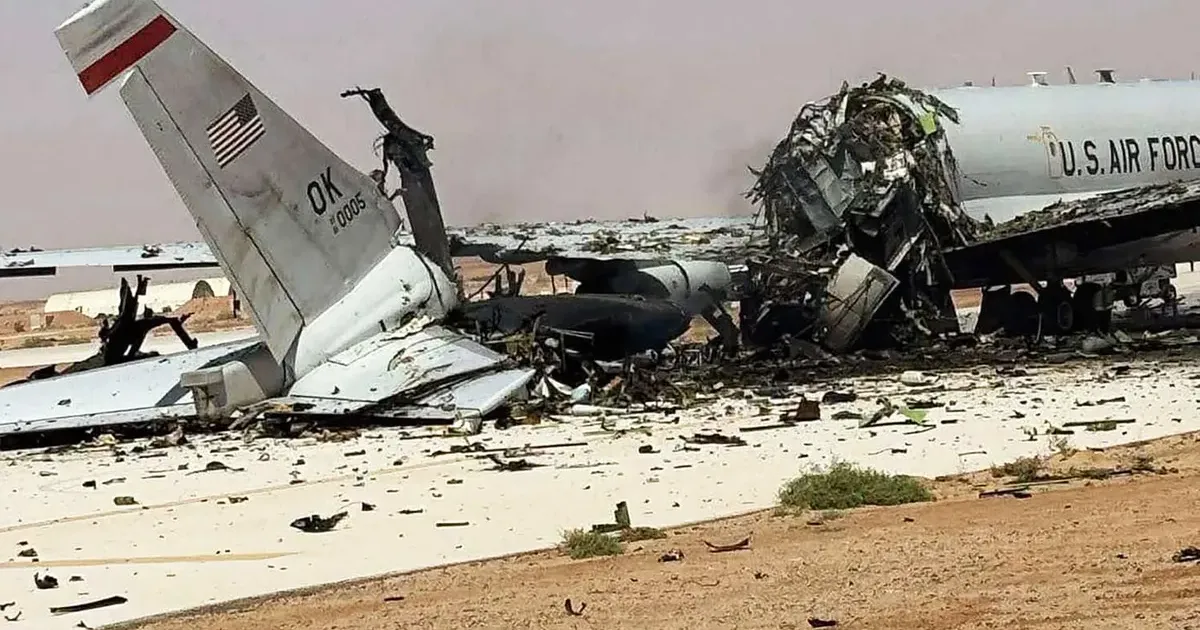
The reported aircraft loss changes the regional military picture. Surveillance capacity is now part of the escalation debate. The claim immediately raised the stakes for Gulf air defense. Satellite imagery confirmed on March 30, 2026, that an Iranian strike destroyed a critical U.S. radar aircraft stationed at an airbase in Saudi Arabia. Regional militaries will also study whether the reported strike exposed a temporary gap or a deeper vulnerability in surveillance coverage around Saudi airspace.
Damage to the Boeing E-3 Sentry, often referred to as the AWACS, sharply degrades the ability of the United States to monitor aerial threats across the Persian Gulf. Defense analysts note that this specific warning and control system is the eyes and ears for carrier strike groups and ground based interceptors alike. Tehran launched the barrage targeting the Saudi facility during a period of escalating rhetoric and shifting military postures. Saudi Arabia has not yet provided an official casualty count from the installation.
Detailed reconnaissance photos published on Monday show the charred remains of the $270 million airframe sitting on a tarmac. Shrapnel patterns suggest a direct hit by high precision munitions or loitering drones. This strike effectively blinds tactical commanders in a region where split second decisions determine the survival of naval assets. Losing a single E-3 Sentry is a logistical crisis because of the small size of the global fleet and the high demands for its surveillance suites.
E-3 Sentry Destruction at Saudi Airbase
Intelligence officials in the Pentagon are currently assessing the impact of the E-3 Sentry loss on regional defense networks. These aircraft provide 360 degree surveillance from the stratosphere, allowing them to detect low flying cruise missiles that ground based radar might miss. Without this airborne coverage, American bases in Saudi Arabia and Qatar are much more vulnerable to the types of saturation attacks Tehran has perfected. Combat commanders frequently rely on the E-3 Sentry to coordinate intercepts between F-35 fighters and Patriot missile batteries. Surveillance gaps now exist where before there was a seamless electronic shield.
Records show that the E-3 Sentry airframe is no longer in production, making every loss permanent. Replacements consist of the newer E-7 Wedgetail, but those units are not yet available in sufficient quantities to fill the void. Tehran likely chose this specific target to demonstrate its ability to strike high value, low density assets. Precise targeting of such a sophisticated platform suggests an advanced level of intelligence gathering by Iranian operatives within the region. Previous intelligence reports detail how the attack on the Saudi facility wounded ten American service members.
Trump Claims Peace Progress During Troop Surge
President Donald Trump stated on March 30, 2026, that his administration is making great progress on peace talks despite the ongoing violence. Simultaneously, the White House confirmed that additional combat units are currently deploying to the Middle East to reinforce existing positions. This dual track approach of touting diplomatic breakthroughs while increasing the kinetic footprint creates confusing signals for regional partners. Critics in Congress argue that the surge in personnel directly contradicts the message of de-escalation being broadcast to the American public.
Defense Department sources indicate that thousands of soldiers are currently boarding transport planes destined for staging areas in Kuwait and Jordan. The discrepancy between the rhetoric of peace and the reality of mobilization is widening. Trump insists that the military buildup is a necessary leverage point to force Tehran back to the negotiating table. Peace talks, however, appear to be stalled as both sides demand concessions that the other is unwilling to grant.
Iranian Threats against U.S. Ground Forces
Iran responded to the news of the American troop surge with a series of graphic warnings regarding a potential ground invasion. Official state media channels broadcasted messages promising that any soldier stepping onto Iranian soil would face a brutal response. Rhetoric from the Revolutionary Guard suggests they have prepared a sophisticated network of asymmetric defenses designed to maximize casualties. Tehran remains committed to a policy of total resistance against foreign intervention.
Iran reacted to the possibility of U.S. troops on the ground by threatening to set them on fire.
Eleanor Watson of CBS News reported that the Iranian government is using this incendiary language to deter a full scale ground operation. Military planners in Washington are taking these threats seriously because of Iran's extensive experience with guerrilla warfare and urban combat. Tehran's arsenal includes thousands of anti tank missiles and sophisticated sea mines intended to turn the Persian Gulf into a graveyard for invading forces. Ground operations carry a risk of casualties that the American public may not be prepared to accept.
Pentagon officials have not yet specified the exact number of troops heading to the theater, but the deployment includes heavy mechanized units. Armor and artillery assets are moving toward the border regions in a display of force meant to intimidate the Iranian leadership. Tehran sees this move as a prelude to a wider conflict rather than a defensive measure. Regional analysts believe the window for a non-violent resolution is closing rapidly as both nations move past the point of no return.
Gulf Airpower Exposure
Airborne radar aircraft are force multipliers because they organize the air picture for pilots, ships and missile defenses. Losing one can narrow warning time across the theater.
That is why the strike matters beyond the damaged airframe: it affects how the United States monitors escalation and protects regional bases.