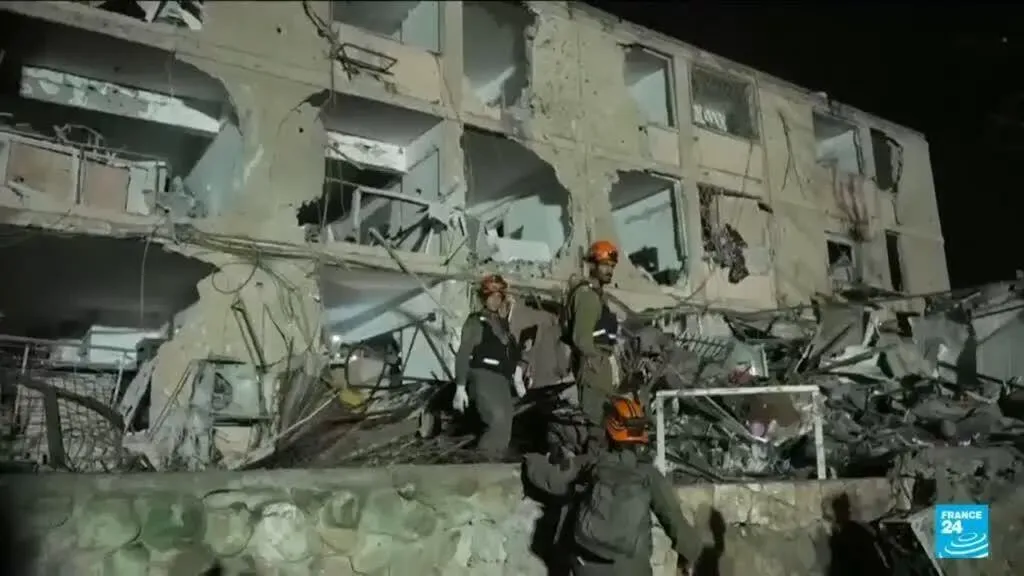
Iran launched a barrage of ballistic missiles on March 22, 2026, targeting two southern towns in close proximity to a critical Israeli nuclear facility. Medical responders reported that the strikes wounded 160 people, many of whom were pulled from the rubble of residential apartment blocks. Shrapnel and pressure waves from the impacts shattered windows and tore through structural walls in the early hours of the morning. Emergency sirens failed to provide adequate warning for many residents in the path of the incoming projectiles. Local clinics in the Negev desert struggled to manage the sudden influx of trauma patients during the initial hour of the crisis.

Direct hits on civilian infrastructure in Yeruham and Dimona have raised urgent questions regarding the reliability of regional security shields. Early assessments indicate that several Iranian missiles successfully bypassed the multi-layered defense network designed to protect sensitive strategic zones. Fragments of what appear to be medium-range ballistic missiles were recovered from craters that measured several meters in depth. Ground-level footage showed car shells incinerated by the heat of the explosions. Most of the injured were treated for shrapnel wounds, burns, and respiratory issues caused by thick plumes of dust and smoke.

Israel now faces a major intelligence and technical challenge as it reviews the performance of its detection systems. Success for Tehran in this operation suggests a refinement in saturation tactics or the deployment of advanced maneuvering warheads. While previous escalations saw high interception rates, this specific volley managed to place multiple warheads on target. Military analysts are currently inspecting the failure points of the radar arrays near the Negev site. Debris has been transported to a secure location for forensic analysis by the Ministry of Defense.

Israeli Air Defense Failures Near Dimona

Defense analysts are scrutinizing why the Arrow 3 and David’s Sling systems did not achieve their usual high rate of neutralization. According to military reports, the sheer volume of missiles launched in a single wave may have overwhelmed the local sensor processing capacity. But technicians are also investigating the possibility of electronic countermeasures used by the Iranian Islamic Revolutionary Guard Corps to blind Israeli tracking stations. Some projectiles followed paths that suggest they were designed to dive at extreme speeds to minimize the window for interception. High-altitude tracking data showed the missiles entered the atmosphere at a nearly vertical angle.

It was the first time Iranian missiles had penetrated Israeli air defence systems in the area around a key nuclear site.

To that end, the failure of the automated defense response is being treated as a major security breach. Officials at the Dimona nuclear research facility confirmed that the site itself was not hit, though the proximity of the impacts has caused international alarm. Satellite imagery from the morning showed craters less than five kilometers from the perimeter of the sensitive compound. Security protocols for the reactor were immediately upgraded to their highest level. Engineers are conducting structural checks on all nearby support facilities to ensure no seismic damage occurred from the heavy impacts.

Meanwhile, the towns of Yeruham and Dimona remain under a strict curfew as munitions disposal teams sweep for unexploded ordnance. Ballistic projectiles often leave behind sensitive fuses or submunitions that can pose a secondary threat to civilians. Several streets have been cordoned off as heavy machinery moves in to stabilize damaged residential buildings. Residents described a series of deafening booms that felt like an earthquake. The local municipality has opened temporary shelters for those whose homes are no longer structurally sound.

Iranian Missile Technology Advances and Strike Impact

Tehran appears to have utilized a new generation of solid-fuel missiles that require very little launch preparation time. Yet the penetration of the southern defense corridor suggests that these weapons also possess enhanced terminal guidance systems. In turn, the accuracy of the strikes on residential areas indicates a deliberate attempt to demonstrate precision capabilities. Iranian state media claimed the operation was a response to recent covert actions against its own infrastructure. Foreign observers noted that the missiles used in this attack were much more sophisticated than those seen in previous years.

At least two direct hits were recorded on high-density housing units where families were sleeping. In fact, the carnage would have been far worse if the missiles had struck during the daytime when streets are crowded with shoppers. Rescue workers from Magen David Adom worked through the night to locate survivors in the debris. One four-story building in Yeruham had its entire front facade sheared off by the blast. Heavy lifting equipment was required to remove concrete slabs that had pinned residents in their beds.

By contrast, earlier missile engagements in the Negev region typically saw interceptions happen at much higher altitudes. The lower altitude of these recent explosions suggests the defense missiles may have engaged too late or lost their targets in the final seconds of flight. In turn, the lack of aerial destruction meant that the full weight of the Iranian warheads reached the ground. Technicians are now examining the software logs of the battery systems located near the Dead Sea. This investigation will likely take weeks to produce a definitive technical explanation for the lapse.

Regional Security Crisis and Retaliatory Risks

Even so, the geopolitical consequences of the strike began to manifest within hours of the first explosion. Separately, neighboring countries expressed concern that the conflict could expand into a broader regional war involving multiple fronts. Diplomatic channels between Washington and Middle Eastern capitals were flooded with calls for restraint to prevent a cycle of kinetic retaliation. For one, the target proximity to a nuclear site is viewed by many as a crossing of a red line that was previously respected. National security councils across the globe are convening to assess the potential for an Israeli counter-strike.

For instance, the Israeli cabinet met in an emergency session to discuss military options against Iranian launch sites. So the calculus for deterrence has shifted as the perceived invincibility of the defense shield is challenged. Intelligence agencies are monitoring Iranian mobile launch platforms for signs of a second wave. No further launches have been detected since the initial barrage ended. Military aircraft have been positioned at northern and southern airbases to respond to any further provocations from the air.

In fact, the economic impact of the attack was immediate as international airlines cancelled flights to Ben Gurion Airport. Security at other sensitive infrastructure sites including desalination plants and power stations has been tripled. Israel is now under immense internal pressure to restore a sense of safety for its citizens in the south. The current casualty count of 160 remains the highest from a single missile event in several years. Civil defense authorities have instructed all citizens to ensure their bomb shelters are fully stocked and accessible.

The Elite Tribune Perspective

Diplomacy in the Middle East is a corpse that Western powers continue to dress in fine linens. The strikes of March 22, 2026, have exposed a reality that many in the security establishment were desperate to ignore. Deterrence is not a static achievement but a decaying asset that requires constant, brutal maintenance. Iran has successfully demonstrated that even the most expensive defense technology in the world can be defeated by a determined adversary with a sufficient stockpile of hardware.

This breach at Dimona is more than a technical failure; it is a psychological defeat for a nation that has built its identity on the premise of absolute security. Waiting for a diplomatic solution is a luxury that the 160 injured residents of the Negev no longer possess. The Israeli government must now choose between a massive, potentially catastrophic escalation or the acceptance of a new, vulnerable status quo. Neither path offers a clean exit from the violence that has come to define the region.

If a nuclear-adjacent zone can be punctured with such ease, no city in the Levant is safe from the reach of Tehran. The era of the impenetrable shield has ended in the dust of Yeruham.