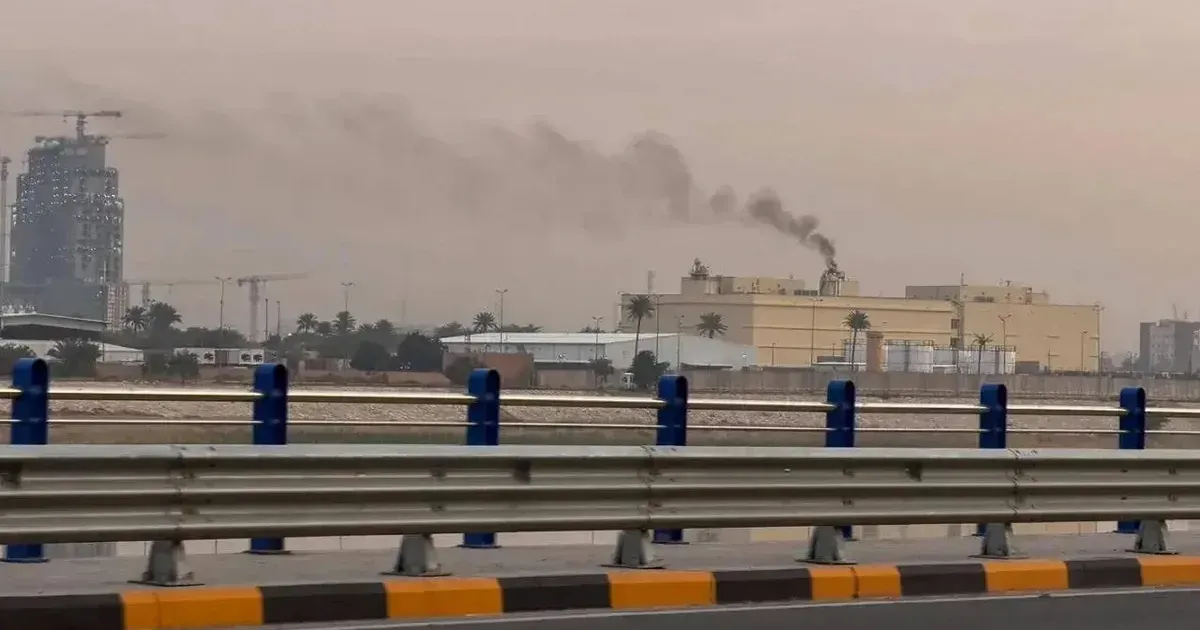
Baghdad shook early Saturday morning when Iranian missiles struck the perimeter of the United States embassy, marking a violent expansion of a conflict previously confined to regional proxies. Missiles hit U.S. and Gulf-linked targets as explosions echoed across the Green Zone as defense systems engaged multiple incoming projectiles launched from western Iran. Early reports from local authorities indicate serious structural damage to the outer fortifications of the diplomatic compound, though casualty figures remain unconfirmed by the State Department. Residents in the Iraqi capital described a sequence of thunderous impacts that shattered windows several blocks away from the Tigris River. Security forces immediately cordoned off the area to prevent civil unrest or secondary attacks. Iranian military commanders coordinated this strike alongside a simultaneous barrage targeting a critical energy hub in the United Arab Emirates. Satellite imagery confirms smoke rising from storage tanks near the coast, suggesting a breach in the local defense perimeter. Crude oil futures spiked on the news of the infrastructure hit, with traders anticipating prolonged disruptions to Gulf shipping lanes. Logistics firms have already issued rerouting orders for tankers now stationed in the Strait of Hormuz. Commercial activity at the port came to a standstill as emergency crews worked to contain localized fires.
The Embassy and oil-infrastructure strikes turned Gulf risk from a shipping story into a diplomatic emergency.
Embassy Attack Widens the War
Diplomatic tension between Washington and Tehran reached a new peak following the direct targeting of the embassy site. For years, the Green Zone served as a symbol of American influence in Iraq, but the latest strike proves those defenses are increasingly permeable. Intelligence officials suggest the missiles used were short-range ballistic variants capable of high-precision maneuvers. Such hardware allows operators to bypass traditional radar detection by flying at lower altitudes.
UAE Oil Sites Enter the Conflict
Energy security in the Persian Gulf faced its most severe test in decades as 1,800 Iranian projectiles targeted various sites across the Emirates. Defense systems managed to intercept the vast majority of these threats, yet several warheads reached their intended destinations. Dubai became an inadvertent theater of war when intercepted debris fell into residential districts twice in twenty-four hours. Traffic on major highways ground to a halt as citizens watched the sky fill with the light of kinetic interceptions. The psychological impact on the expatriate community has led to a surge in outbound flight bookings. Damage at the oil hub appears focused on storage and processing units rather than the extraction wells themselves. Engineering teams are now assessing the structural integrity of the pipeline network. Some analysts believe the strike was designed to maximize economic anxiety rather than cause a total collapse of production. This volume of fire suggests a manufacturing capacity that Western intelligence underestimated. Global markets reacted with instability as Brent crude surged past 110 dollars per barrel in early trading. Insurance premiums for maritime transit in the region have tripled overnight.
Abu Dhabi officials confirmed that their multi-layered missile defense system, which includes American-made batteries, performed at high efficiency. But the scale and saturation of the attack pushed the technology to its limits. One missile reportedly struck a desalination plant, threatening the local water supply for several hours. This proximity to civilian centers in Dubai forced the closure of international schools. Local hospitals reported dozens of injuries related to falling shrapnel and glass fragments from the blasts. Military cooperation between the Emirates and its Western allies has intensified to shore up the remaining gaps in the air defense umbrella.
Military officials in Tel Aviv confirmed that the Israeli Air Force conducted 400 waves of attacks on Iranian soil over the past two weeks. These operations targeted the deep interior of western Iran, specifically focusing on the production lines for the very missiles hitting Baghdad and Dubai. Pilots used advanced stealth platforms to avoid detection by aging Iranian radar systems. The Israeli Defense Forces released footage showing the destruction of hardened silos and research laboratories. According to military spokesmen, the goal is the total dismantling of the infrastructure supporting long-range fire units. The Israeli Air Force said it focused on dismantling infrastructure and targeting operatives tied to fire, defense, and production units in western Iran.
Israeli intelligence suggests that the Iranian production cycle for precision-guided munitions has been set back by at least six months. The IAF continues to fly sorties over the border to prevent the reconstitution of these facilities. Anti-aircraft batteries in Iran attempted to engage the incoming jets, but they scored no confirmed hits. Ground-based observers in the Iranian province of Kermanshah reported major secondary explosions lasting for hours after the initial strikes. These secondary blasts indicate that fuel depots or ammunition storage sites were successfully neutralized.
Israel also extended its reach into Lebanon and Iraq to strike at logistical nodes used by proxy forces. These auxiliary strikes aim to sever the supply lines that move drone components from the Iranian heartland to the Mediterranean coast. In particular, the Bekaa Valley saw heavy activity as Israeli drones targeted convoys moving under the cover of darkness. The regional war has now moved into a phase of high-intensity attrition. Defense analysts warn that the depletion of interceptor stockpiles could become a critical factor if the tempo of attacks remains this high.
President Recep Tayyip Erdogan announced that Turkey is monitoring the escalating situation with extreme caution. Ankara remains concerned that a total collapse of regional stability could trigger a new wave of refugees toward its southern borders. Turkish intelligence assets in northern Iraq have been placed on high alert to prevent the conflict from spilling into Kurdish-controlled areas. Erdogan warned all parties against provocations that could draw non-combatant nations into the fray. He emphasized that the Turkish military is prepared to defend its airspace against any stray projectiles.
Ankara refuses to pick a side. While Turkey maintains a security partnership with the United States, it also shares a complex energy and trade relationship with Tehran. The Turkish economy is now too fragile to withstand the shocks of a full-scale regional war. Diplomatic channels between Ankara and Tehran remain open, though the tone has become increasingly stern. Turkish officials have reportedly offered to host de-escalation talks, but neither Israel nor Iran has shown interest in a ceasefire. The Turkish Navy has increased patrols in the eastern Mediterranean to secure its own offshore energy assets.
Security at Turkish airbases housing American assets has been tightened sharply. The public sentiment in Turkey remains divided between those who fear Iranian expansionism and those who oppose Israeli military actions. Erdogan must balance these domestic pressures while maintaining a functional relationship with the NATO alliance. The prospect of a prolonged conflict poses a direct threat to the Middle East Transit Corridor, a project central to Turkey's long-term economic strategy. Military observers suggest that Ankara might establish a deeper buffer zone in northern Syria if the chaos continues to spread.
Direct Attacks Change the War
Waiting for a diplomatic breakthrough in the Middle East has become the geopolitical equivalent of staring at a dry well. The persistent belief that rational actors in Washington or Tehran will suddenly pivot toward peace ignores the cold reality of a region that has moved beyond the era of managed proxy wars. What we are seeing now is the collapse of the American deterrent, a process accelerated by years of inconsistent policy and a refusal to acknowledge that the old rules of engagement have burned to the ground.
Iran is no longer content with shadow boxing through militias; it is testing the boundaries of direct kinetic warfare against US assets and global energy nodes with an audacity that should terrify any investor. Meanwhile, the West remains trapped in a reactive loop, celebrating successful interceptions while the underlying threat continues to metastasize. Israel is the only actor operating with a clear strategic objective, yet its singular focus on dismantling Iranian infrastructure risks creating a vacuum that no one is prepared to fill.
If the United States continues to treat these embassy strikes as isolated incidents rather than a systemic challenge to its regional presence, it will find itself forced out of the Gulf not by a treaty, but by the rising cost of remaining there. The era of the American umbrella is over, and the rain is just beginning.