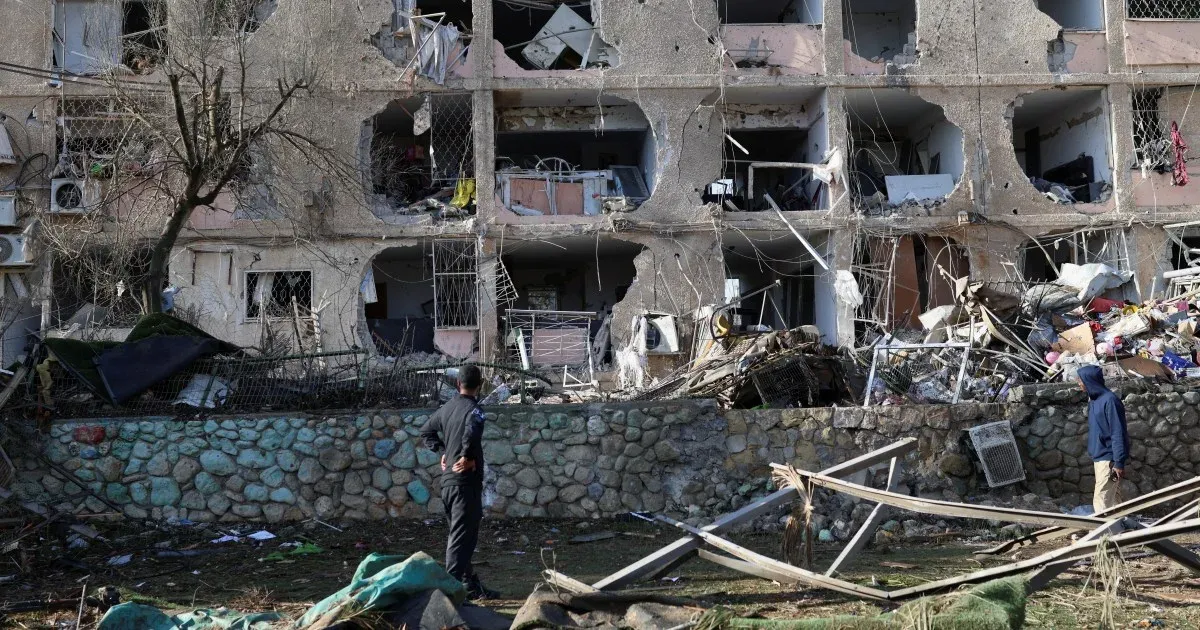
Donald Trump and Iranian military commanders traded threats of total war on March 22, 2026, after missile exchanges targeted nuclear sites in both countries. Israeli fighter jets recently struck a facility inside Iranian borders, which triggered a swift response from Tehran. Heavy damage is reported near the southern town of Arad. Violence has now gripped the Middle East for twenty-eight days. Missiles launched from Iranian territory streaked across the night sky before impacting near the Dimona nuclear facility. Authorities confirmed that the barrage resulted in significant casualties and infrastructure loss.
Emergency responders worked through the night to extract survivors from collapsed residential buildings. At least 170 people are receiving treatment for various injuries at regional hospitals. Doctors describe the scene as chaotic, with many victims suffering from blast-related trauma. Local residents fled to bomb shelters as sirens blared across the Negev desert for several hours.
Iranian Missile Barrage Hits Dimona Region
Tehran officials announced that the strike was a direct retaliation for an Israeli operation against an Iranian atomic site forty-eight hours prior. Military analysts noted that Iranian missiles managed to penetrate sophisticated defense layers. Charlie D'Agata, reporting from Arad, observed heavy destruction in the worst-hit residential neighborhoods. Shell-shocked civilians wandered through debris as dawn broke over the southern district. One resident reported hearing a series of thunderous explosions that shook the foundations of his home. Another witness described seeing a fireball erupt near the horizon toward the Dimona research complex.
Israeli defense officials stated that while several projectiles were intercepted, others successfully bypassed the Iron Dome. Surveillance footage from the area showed multiple impacts within the vicinity of the high-security zone. The Israeli military has not yet released a full damage assessment regarding the nuclear site itself. Security cordons now prevent journalists from approaching the Dimona perimeter. Army units are conducting sweeps for unexploded ordnance in the surrounding desert. This escalation marks a major broadening of the conflict beyond previous border skirmishes.
Waltz Affirms Military Options for Trump
United Nations Ambassador Mike Waltz spoke on national television to clarify the administration's stance on the deepening crisis. Waltz told Margaret Brennan on Face the Nation that the White House is weighing aggressive responses to Iranian aggression. He refused to exclude any military possibilities regarding the neutralization of Tehran's capabilities.
I would never take anything off the table for this president.
President Donald Trump has specifically mentioned the possibility of bombing Iranian power plants and civilian energy grids. Such a shift in targeting would represent a departure from previous tactical focuses on military hardware. Our earlier reporting on strategy of kinetic neutralization covered comparable developments.
Waltz emphasized that the president remains committed to preventing Iran from achieving nuclear dominance. Military planners at the Pentagon are reportedly drafting options for precision strikes on various energy sectors. Some advisors believe that crippling the Iranian electrical grid would force a cessation of hostilities. Others warn that such actions could lead to a humanitarian crisis within the civilian population. Intelligence reports suggest that Iran has already moved some of its critical infrastructure underground to avoid detection. Still, the threat of total energy disruption is still a central component of the current American strategy.
Waltz maintained that the responsibility for avoiding further escalation lies entirely with the leadership in Tehran. Recent rhetoric from the Oval Office suggests a growing impatience with traditional diplomatic channels. White House sources indicate that the president is reviewing target lists on a daily basis. Naval assets in the Persian Gulf have moved into strike positions.
Israel Targets Iranian Nuclear Infrastructure
Israeli air operations have focused on the degradation of Iranian atomic research for several weeks. Satellite imagery analyzed by independent researchers showed smoke rising from the Natanz facility following recent sorties. Jerusalem maintains that these strikes are necessary to prevent the assembly of a nuclear warhead. Iran has countered by declaring that its nuclear program is strictly for peaceful energy production. But the frequency of recent Israeli raids suggests a more urgent timeline. Pilots have conducted long-range missions involving mid-air refueling to reach distant targets in central Iran.
According to regional intelligence sources, these missions often involve electronic warfare to jam Iranian radar systems. Some reports indicate that Israeli special forces have also conducted ground sabotage operations within Iranian borders. Tehran has responded by increasing the readiness of its own surface-to-air missile batteries. Civil defense drills are now mandatory in several major Iranian cities. Food prices in Tehran have spiked as residents began stockpiling essential goods. The Iranian rial hit a record low against the dollar during Monday morning trading sessions.
Regional Conflict Spreads to Lebanon
Fighting has expanded to the northern border where Hezbollah launched a coordinated assault from southern Lebanon on Sunday. The militant group fired hundreds of rockets into northern Israel to support its Iranian patrons. Israeli artillery units responded by shelling launch sites in the Bekaa Valley and surrounding hillsides. Residents in the town of Kiryat Shmona have been ordered to remain in reinforced shelters. Meanwhile, Lebanese authorities reported that several villages have been nearly emptied as families flee north toward Beirut. International observers worry that the opening of a second front will strain Israeli resources.
Hezbollah leaders announced that their operations would continue as long as the assault on Iran persists. Yet Israeli commanders insist they can manage a multi-theater war simultaneously. In turn, the United States has dispatched additional carrier strike groups to the Mediterranean Sea. Defense Secretary Lloyd Austin remains in constant contact with his Israeli counterparts to coordinate logistics. Separately, the Lebanese government has called for an emergency meeting of the UN Security Council to address the border violence. Diplomats have so far failed to produce a ceasefire agreement.
To that end, the humanitarian corridor in southern Lebanon remains largely blocked by ongoing combat operations. Even so, small groups of aid workers are attempting to deliver medical supplies to frontline clinics. By contrast, the political atmosphere in the region remains increasingly hostile to mediation efforts. In fact, most local governments have abandoned hopes for a short-term peace. The conflict is currently entering its second month with no sign of de-escalation.
The Elite Tribune Perspective
Does the pursuit of total security inevitably lead to total destruction for those who hold the trigger? Washington and Jerusalem have spent decades treating the Iranian nuclear program as a singular existential threat, yet their current strategy of kinetic neutralization appears to be breeding the very catastrophe they sought to avoid. By targeting nuclear facilities and civilian power plants, the Trump administration is not merely dismantling infrastructure; it is dismantling the norms of proportional warfare. This scorched-earth realism suggests a terrifying new calculus where the distinction between military assets and civilian survival is intentionally blurred.
Iran's missile strike near Dimona was a predictable response to the violation of its own sovereign research sites, creating a cycle of retaliation that has no logical exit. We are watching the collapse of the containment doctrine in real-time as the White House adopts a stance that focuses on immediate tactical victories over long-term regional stability. The rhetoric from Mike Waltz confirms that the administration views the Middle East not as a complex web of nations, but as a target map.
If the goal is to prevent a nuclear conflict, the current path of bombing nuclear sites is a paradox of the highest order. It is an aggressive gamble that assumes the enemy will break before the world burns. History suggests that such assumptions are rarely correct.