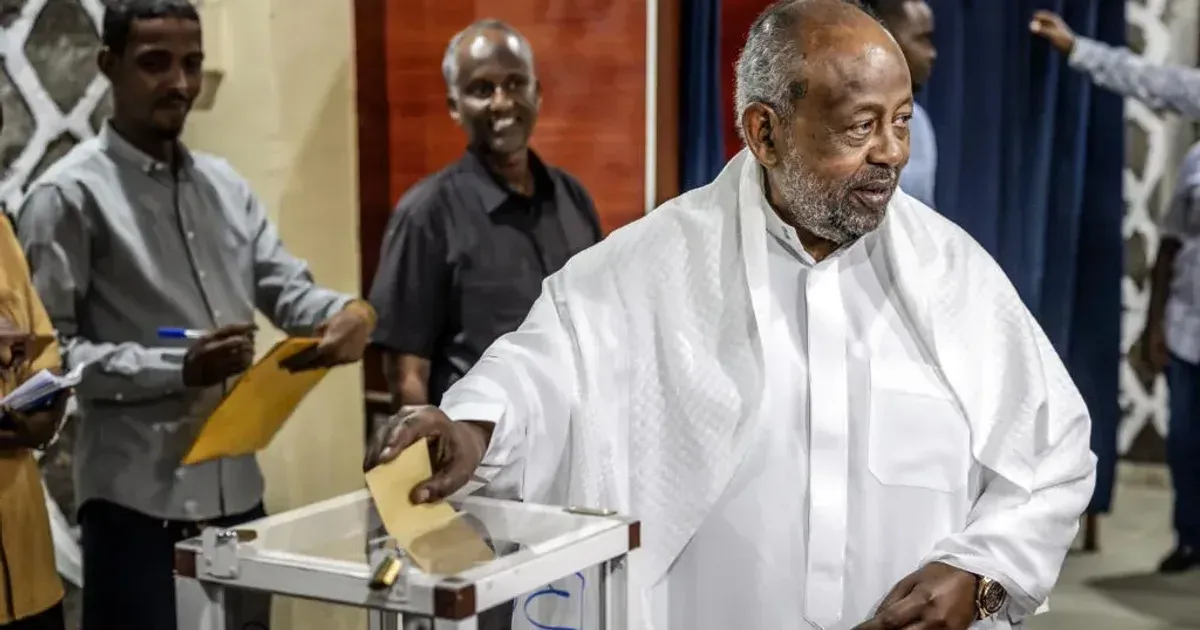
Djibouti's long-serving president Ismaïl Omar Guelleh secured another term in an election dominated by the ruling party. The outcome extends a presidency that began in 1999 and keeps a critical Horn of Africa hub under familiar control. Official results released on April 11, 2026, showed him taking nearly 98 percent of the vote in a contest with little organized opposition.
Voters across the coastal nation confirmed a mandate that extends his tenure toward three decades of continuous rule.
Official tallies released by government agencies placed his support at 97.81 percent, a figure consistent with previous election cycles in 2016 and 2021. The biggest polling stations in Djibouti City and the interior districts reported a high turnout, though specific participation rates varied by region. Critics within the exiled opposition communities argued that the lack of competitive candidates rendered the outcome a mathematical certainty long before the first ballot was cast. Only one other candidate, Zakaria Ismail Farah, appeared on the ballot as a challenger during the previous cycle, yet no serious rival emerged to contest this most recent vote.
Election Mechanics and Official Results Breakdown
Results processed on Saturday morning showed an overwhelming preference for the incumbent across all five administrative regions. The electoral commission reported that Ismaïl Omar Guelleh faced no organized opposition from the traditional blocs that previously boycotted the process. Because the primary opposition parties chose to abstain from the 2026 race, the path for the People's Rally for Progress (RPP) party remained unobstructed. The RPP maintains total control over the legislative and executive branches of the government.
Official tallies show President Ismaïl Omar Guelleh won 97.81 percent of the vote in the Friday election, a result that ensures the continuation of his 27-year leadership.
Interior Minister Moumin Ahmed Sheikh announced the results to the public, citing a peaceful voting process with no major security incidents reported at the 529 polling stations. Logistical support for the election involved thousands of security personnel and civilian volunteers. The government maintains that the overwhelming victory reflects public satisfaction with the infrastructure developments launched over the last decade. Official documents show that more than 215,000 citizens were registered to participate in the one-day event.
Strategic Importance of the Horn of Africa Nation
Djibouti occupies a unique position on the Horn of Africa, overlooking the Bab-el-Mandeb strait that is a gateway to the Suez Canal. This geographic reality has allowed Guelleh to transform the country into a global military and logistics hub. The United States maintains its only permanent African base, Camp Lemonnier, just miles from the international airport. Military officials from the Pentagon frequently interact with the Djiboutian presidency to coordinate counterterrorism operations in nearby Somalia and Yemen.
China, meanwhile, operates its first overseas naval base at the Doraleh port complex, which provides Beijing with a foothold in the Indian Ocean. The presence of multiple foreign militaries, including French, Japanese, and Italian contingents, provides the government with significant rental income and a layer of geopolitical insurance. Rental fees from these installations generate approximately $125 million in annual revenue for the treasury. This income stream persists regardless of the regional volatility affecting neighboring Ethiopia or the Red Sea shipping lanes.
Political analysts observe that the longevity of the Guelleh administration relies on a sophisticated internal security apparatus and a fragmented opposition. While some small groups attempted to organize protests in 2020, the subsequent years saw a tightening of media controls and assembly laws. The RPP party infrastructure reaches every village, providing a system of patronage that rewards loyalty to the presidency. Independent journalists often face hurdles when reporting on the internal dynamics of the ruling family or the selection of potential successors.
Instead of encouraging a diverse multi-party system, the state has focused on maintaining a singular vision of stability. The constitution was amended in 2010 to remove term limits, which allowed Guelleh to run for his third, fourth, fifth, and now sixth term. This legal framework has effectively barred any realistic challenge to the executive power within the current system. International human rights organizations have frequently noted the lack of space for civil society to influence policy decisions or hold officials accountable for financial transparency.
Economic growth in Djibouti centers almost entirely on the expansion of its port facilities and the multibillion-dollar railway link to Addis Ababa. The government has secured more than $2 billion in external financing, largely from Chinese state banks, to build the Doraleh Multi-Purpose Port and various free trade zones. These investments have turned Djibouti into the primary maritime outlet for landlocked Ethiopia, handling over 90 percent of its neighbor's international trade. Port revenues continue to be the primary engine of the national economy, though the benefits are unevenly distributed among the population of one million.
High unemployment rates among the youth contrast with the gleaming new infrastructure projects visible from the capital's shoreline. Despite the high GDP growth rates recorded before the pandemic, a significant part of the population lives below the poverty line. Small-scale fishing and nomadic livestock herding, which once formed the backbone of the local economy, have been marginalized in favor of large-scale logistics and military leasing. The government contends that the long-term benefits of becoming a regional trade hub will eventually reach the broader citizenry through job creation in the service sector.
Financial debt remains a point of concern for international lenders who track the nation's repayment capacity. Debt-to-GDP ratios have climbed as the country continues to borrow for large-scale energy and water projects, including a pipeline from Ethiopia. The International Monetary Fund has advised the administration to diversify the economy to reduce its dependence on port fees and foreign military spending. Guelleh has responded by initiating plans for digital transformation and green energy projects, including a large solar plant in the Grand Bara desert.
Stability in the presidency appears to be the primary selling point for the current administration when courting foreign investors. The continuity of the RPP leadership provides a predictable environment for multinational corporations and foreign defense departments. Most residents in Djibouti City spent Saturday evening in calm celebration or went about their daily business as the results were finalized. Security forces remained visible at major intersections to ensure the victory celebrations did not evolve into larger, unmanaged gatherings. The final results will be certified by the Constitutional Council within the next week.
The Succession Question
Rulers who anchor their legitimacy in 98 percent margins usually find the ground beneath them is less solid than the concrete of their shipping piers. Ismaïl Omar Guelleh has spent nearly thirty years turning a barren patch of volcanic rock into a high-priced parking lot for the world's most powerful militaries. While this landlord strategy has brought unprecedented capital into the treasury, it has simultaneously created a dangerous succession vacuum. By methodically hollowing out the political opposition and centralizing power within his own clan, Guelleh has ensured that his eventual departure will be a moment of extreme vulnerability rather than a scheduled transition. The international community, particularly Washington and Beijing, should be wary of the stability they are currently purchasing with their lease payments. Stability in Djibouti is not a product of democratic consensus but of a single man's ability to balance the competing interests of rival superpowers on a tiny piece of real estate. If the RPP fails to identify a credible successor before Guelleh's sixth term expires, the port of Djibouti could quickly transform from a strategic asset into a regional trigger point. The sheer mathematical absurdity of a 98 percent victory margin does not reflect popular adoration; it reflects an institutional inability to imagine a future without the man at the top. It is a fragile peace.