Israeli military officials confirmed that four soldiers died during a deepening ground offensive into southern Lebanon. Casualties occurred as combat units pushed further into rugged terrain to dismantle militant infrastructure near the border. On March 31, 2026, the casualties turned the south Lebanon push into a clearer test of Israel’s ground strategy. Hezbollah fighters engaged these units in close-quarters combat to increase the tactical cost of the invasion. Al Jazeera reports indicate that the militant group is focusing its efforts on making any territorial gains for the Israeli army unsustainable through attrition. Israel has expanded its operations despite international calls for a ceasefire, citing the need to secure its northern communities.
NDTV sources confirmed that several other personnel sustained injuries alongside the four soldiers killed in the latest exchange. Field reports suggest that the military has issued urgent evacuation orders for multiple villages across the southern districts. These orders often precede heavy artillery barrages and airstrikes designed to clear the path for infantry and armored divisions. Soldiers on the ground face a complex network of tunnels and fortified positions that have been prepared for years. Militants are using anti-tank guided missiles to harass advancing columns.
Israeli Defense Forces Deepen South Lebanon Offensive
Ground operations have moved beyond the immediate border fence into more densely populated areas. Israeli commanders state that the primary objective is the destruction of launch sites used by Hezbollah to target Galilee. Satellite imagery shows serious movement of heavy armor across the Blue Line into sovereign Lebanese territory. Combat engineers are currently clearing mines and improvised explosive devices left by retreating partisan units. Resistance remains fierce in the valleys where visibility is limited and traditional aerial superiority is less effective. The intensity of the fighting has forced thousands of civilians to flee toward Beirut.
Hezbollah fighters intend to turn the rugged hills of the south into a graveyard for armored divisions.
Logistical lines for the Israeli Defense Forces now stretch several kilometers into hostile territory. Maintaining these supply routes require constant vigilance against ambush and sniper fire from the surrounding heights. Military analysts point to the difficulty of holding territory in a region where the local population is deeply sympathetic to the resistance. Daily briefings from Tel Aviv emphasize that the operation will continue until the threat of cross-border raids is neutralized. Casualties on the Lebanese side, including both combatants and non-combatants, are rising as the theater of war expands. Urban centers in the south are now seeing the same level of destruction previously reserved for border outposts. Military command has continued to authorize the deployment of more troops into Southern Lebanon to bolster frontline positions.
Nadim Houry Details Reconfigured Lebanese Sovereignty
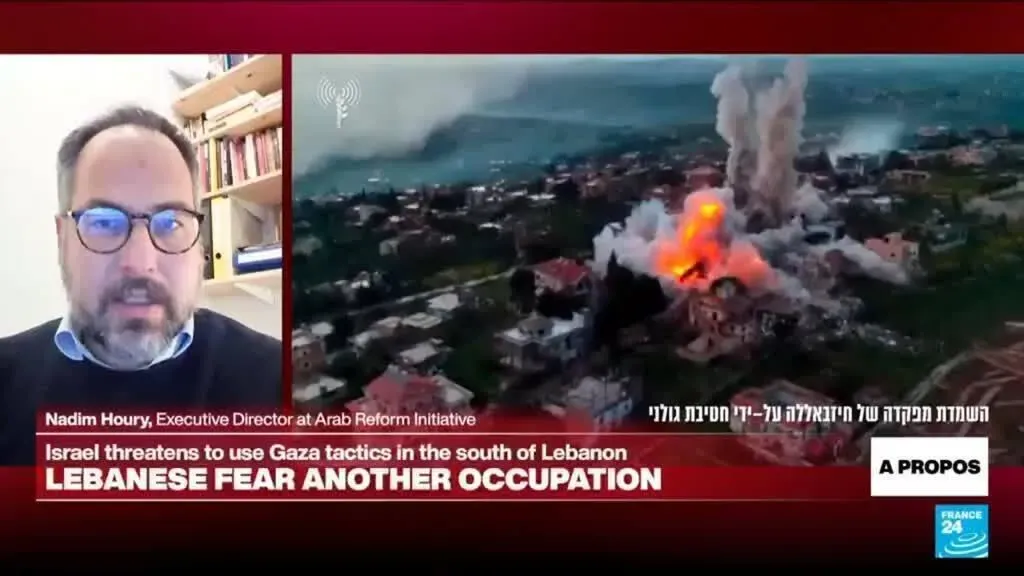
Nadim Houry, an analyst speaking with France 24, warns that the nature of the conflict has fundamentally changed. Israel is no longer targeting a specific militia but is effectively waging war on the entire nation of Lebanon. This shift reflects a deeper structural deadlock shaped by decades of unresolved regional tensions. Houry argues that the current military escalation is dismantling what is left of the Lebanese state's autonomy. The inability of the official Lebanese Armed Forces to intervene or protect the border highlights the total collapse of central authority. Strategic options for the government in Beirut are diminishing as foreign armies dictate the country's future.
"What is unfolding is not simply a confrontation between Israel and Hezbollah, but a broader reconfiguration of the Lebanese state’s sovereignty, legitimacy, and strategic options," Nadim Houry stated during a France 24 interview.Political leaders in Beirut find themselves sidelined as the kinetic conflict takes precedence over diplomatic channels. Internal factions are divided on how to respond to the violation of their borders, with some calling for national unity and others blaming the militia for inviting the invasion. Historically, the Lebanese state has struggled to maintain a monopoly on the use of force. Recent developments suggest that this struggle is nearing a terminal point where the state exists only on paper. Foreign powers continue to use the territory as a proxy battleground for broader geopolitical interests. International observers note that the damage to infrastructure will take decades to repair.
Hezbollah Resistance Strategies and Military Costs
Financial costs for the operation are mounting alongside the human toll. Each day of ground combat requires millions of dollars in munitions, fuel, and logistical support. Economists in Tel Aviv are already warning about the long-term impact on the national budget if the war persists through the summer. Similar pressures exist in Lebanon, where the economy was already in a state of freefall before the first tanks crossed the border. Markets in the Levant have reacted with extreme volatility, as the risk of a wider regional fire increases. Shipping through the Mediterranean is facing higher insurance premiums due to the proximity of the fighting to major ports.
Advanced drone technology has not replaced the need for infantry to clear tunnels by hand. Such work is slow and incredibly dangerous, as evidenced by the recent fatalities. Military medical teams have set up field hospitals near the border to treat the high volume of shrapnel and blast injuries. Despite the technological gap, the asymmetric nature of the conflict allows the smaller force to remain relevant. Total victory seems elusive for either side in a landscape defined by ideological fervor and historical grievances. The boundary known as the Blue Line has effectively ceased to exist as a functional border.
Evacuation orders add another layer of strain because they convert military pressure into civilian displacement. Families near the border have to make decisions before commanders can say how long the operation will last.
Security Fallout at the Border
The deaths underline how quickly a limited border operation can become a wider attrition fight. Each advance forces Israel to weigh tactical gains against casualties, displacement and diplomatic pressure.
Lebanon’s central problem is that sovereignty weakens when armed groups, foreign militaries and civilians are pulled into the same contested villages. The longer the operation lasts, the harder it becomes to separate military objectives from national damage.