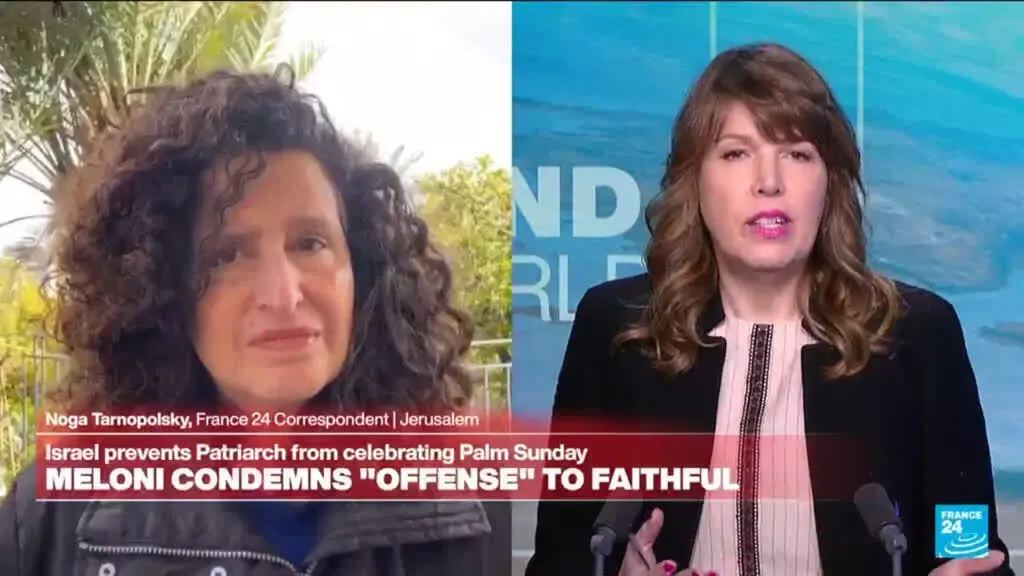
Israeli police barred senior Catholic leaders from entering the Church of the Holy Sepulchre for Palm Sunday Mass on March 29, 2026, turning a wartime security order into a diplomatic and religious flashpoint. Cardinal Pierbattista Pizzaballa, the Latin Patriarch of Jerusalem, and Franciscan Father Francesco Ielpo, the Custos of the Holy Land, were stopped while trying to reach one of Christianity's most sensitive sites.
Israeli authorities cited the Iran war and the risk of missile fire around Jerusalem's Old City. Large religious gatherings had already been restricted, and access to some holy sites was being shaped by crowd limits and shelter availability. The security concern was real. The dispute came from how broadly the order was applied.
The Service Was Not A Mass Crowd
The Latin Patriarchate and the Custody of the Holy Land said the two leaders were proceeding privately, without a public procession or ceremonial display. AP reported that the planned Mass would have involved fewer than 50 people, within the military guidelines then in place. That made the police decision difficult to defend as a simple crowd-control measure.
The distinction carries particular weight in Jerusalem. Access to holy places is governed not only by ordinary public-order decisions but also by fragile religious understandings, historic rights and institutional memory. The issue was not whether Israel could manage wartime danger. The issue was whether senior clergy could be treated as an uncontrolled crowd when a limited service was possible.
The Holy Sepulchre Carries Different Weight
The Church of the Holy Sepulchre is not an ordinary venue. For Christians, it is associated with the crucifixion, burial and resurrection of Jesus. For the Catholic institutions in Jerusalem, access during Holy Week is not a symbolic preference. It is part of the liturgical and historical order of the city.
The church bodies called the measure "grossly disproportionate."
That phrase captured the central objection. The Palm Sunday procession from the Mount of Olives had already been canceled because of the security situation. Catholic officials expected a limited Mass inside the church instead. When Pizzaballa and Ielpo were turned back, the service moved to St. Savior's Monastery, leaving the image of police barriers between local church leadership and the traditional start of Holy Week.
Backlash Forced A Repair Effort
The episode drew criticism from abroad. French President Emmanuel Macron and Italian Prime Minister Giorgia Meloni condemned the restriction, while U.S. Ambassador Mike Huckabee called it an unfortunate overreach. The wording varied, but the complaint was consistent: emergency rules cannot be allowed to erase historic religious access without a narrower, reviewable process.
Israel later tried to contain the damage. President Isaac Herzog spoke with Pizzaballa and expressed regret, and Israeli police said they had reached arrangements with the Patriarchate for limited prayer access at the Holy Sepulchre. That reduced the immediate crisis. It did not erase the warning created by the original refusal.
Security And Religious Rights Were Not Opposites
Israel had a legitimate duty to protect civilians from missile threats during the Iran war. It also had a duty to avoid unnecessary humiliation of local Christian leadership and unnecessary disruption of Holy Week worship. Those obligations were not mutually exclusive. A smaller, controlled service with defined access rules was the obvious space between them.
The police action failed because it collapsed the problem into a single command: no access. That command was easy to enforce, but politically and religiously reckless. In Jerusalem, indiscriminate security administration can become a sovereignty message even when officials insist it was only safety management.
The Precedent Is The Real Issue
The lasting issue extended beyond the relocation of one Palm Sunday Mass. It was whether holy-site access in Jerusalem can depend on ad hoc police judgment whenever a crisis intensifies. If emergency rules are not written with religious rights in mind from the start, they will keep producing confrontations that look less like protection and more like control.
Jerusalem cannot afford that ambiguity. The city works only when security, worship and historical custodianship are handled with precision. The Palm Sunday incident showed what happens when precision disappears. A real wartime threat was answered with a measure too indiscriminate for the place, the people and the week involved.