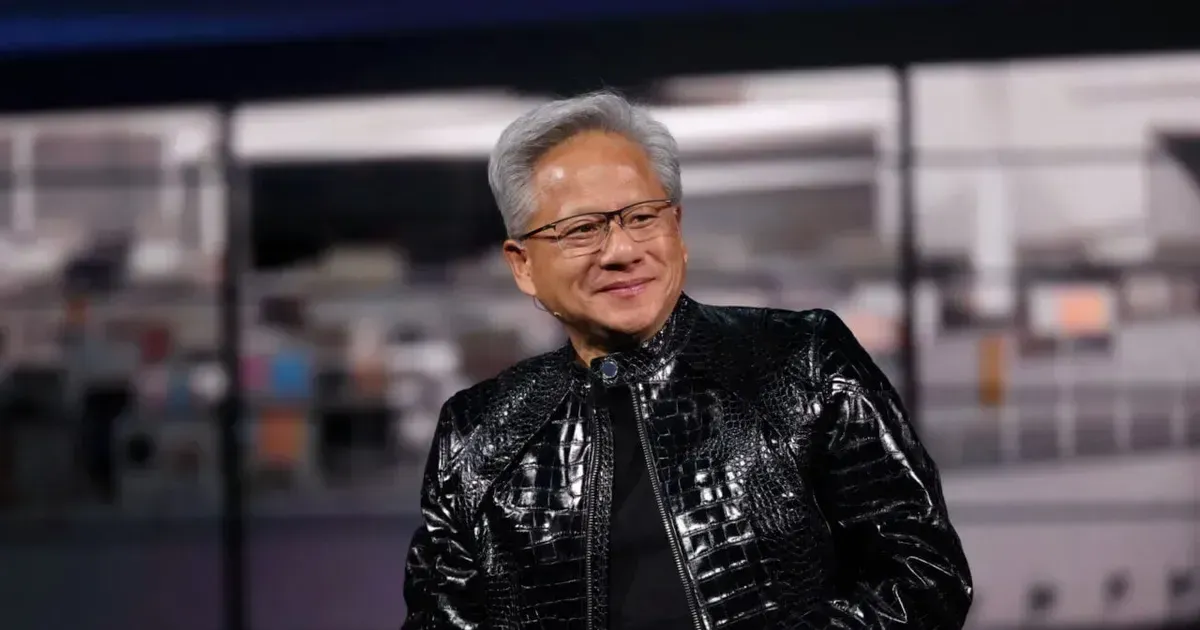
Jensen Huang stood before a capacity crowd in San Jose on Monday to detail how Nvidia will pivot toward autonomous agents to capture a $1 trillion market. The GTC 2026 keynote focused on physical AI advancements that move beyond simple text generation into the area of action and reasoning. Huang argued that the industry has reached a point where software no longer merely assists humans but operates independently across digital and physical environments. This shift forms the foundation of a massive financial projection that dwarfs the company's previous data center records.
Attendance at the SAP Center reflected the high stakes of these announcements, with thousands of developers and enterprise leaders watching the debut of the Vera CPU. This new hardware is designed specifically for inference-heavy workloads, addressing a bottleneck that has plagued the deployment of large-scale agentic models. Traditional architectures struggle with the low-latency requirements of autonomous agents that must make split-second decisions. Nvidia claims the Vera architecture delivers a three-fold increase in efficiency for these specific tasks.
Nvidia introduced NemoClaw as the primary software vehicle for this new era. NemoClaw functions as a development suite that allows companies to build and customize their own autonomous agents, which the company calls claws. These agents can handle complex software environments, manage supply chains, or even conduct scientific research with minimal human oversight. By simplifying the creation of these entities, Huang aims to democratize a technology that was previously the exclusive domain of elite research labs.
At its core, NemoClaw integrates with the OpenClaw partnership to ensure cross-platform compatibility. For one, this initiative seeks to prevent the fragmentation that often slows down the adoption of new computing standards. OpenClaw provides a standardized structure for how agents communicate with APIs and legacy software systems. Developers can now utilize pre-built templates to deploy agents that understand intent and execute multi-step workflows without constant prompting.
AI is moving from a tool that helps people think to a series of agents that help people act across every industrial sector.
Partners including major cloud providers and industrial conglomerates have already signed on to the OpenClaw initiative. According to Gizmodo, this strategic move is intended to cement Nvidia's position as the primary operating system for the agentic economy. To that end, the company is betting that the demand for inference chips will soon eclipse the current frenzy for training hardware. Training a model is a one-time cost, but running millions of autonomous agents requires continuous, high-performance compute cycles.
Nvidia NemoClaw and the Rise of OpenClaw Agents
Software development underwent a fundamental change with the release of the NemoClaw platform. In particular, the tool includes a feature called Agentic Reasoning Kernels that allows a claw to simulate various outcomes before taking an action. This reduces the risk of errors in sensitive environments like financial trading or healthcare management. For instance, a procurement agent can model the impact of a shipping delay across an entire manufacturing line before suggesting an alternative supplier. Such capabilities were previously hampered by the lack of dedicated reasoning hardware.
By contrast, previous iterations of AI were largely reactive. They waited for a user to provide a prompt and then generated a response based on historical data. NemoClaw agents are proactive, monitoring data streams in real-time to identify opportunities or threats before they manifest. Even so, the complexity of managing thousands of these agents simultaneously requires a massive leap in networking technology. Nvidia responded to this by upgrading its InfiniBand throughput to handle the unique chatter generated by agent-to-agent communication.
Separately, the OpenClaw standard has gained traction among open-source developers who fear the dominance of closed systems. Huang positioned Nvidia as a facilitator of this open standard, despite the company's history of proprietary hardware locks. The goal is to create a thriving marketplace where third-party developers can sell specialized claws for niche industries. The marketplace could eventually rival the traditional software-as-a-service model in terms of total addressable market size.
Vera CPU and DLSS 5 Architecture Performance
Hardware remains the foundation of the Nvidia strategy, and the Vera CPU is a departure from the Grace-Hopper legacy. Engineers designed Vera to work in a tightly coupled quad-chip configuration that minimizes the distance data must travel between the processor and memory. The reduction in physical distance is critical for agentic AI because these models require massive amounts of context to stay resident in high-speed RAM. The new architecture supports up to 4 terabytes of unified memory per node.
Gaming enthusiasts found their own reasons to celebrate with the unveiling of DLSS 5. According to CNET, this new version of Deep Learning Super Sampling moves beyond mere frame generation into what Nvidia calls Neural Scene Reconstruction. DLSS 5 uses an agentic model to predict not just the next frame, but the entire physics of the scene. It allows for hyper-realistic lighting and reflections that do not require traditional ray-tracing calculations. The result is a significant boost in frame rates on mid-range hardware that previously struggled with high-fidelity graphics.
In fact, the neural engine inside DLSS 5 is a direct descendant of the research used for the Vera CPU. By using a specialized agent to manage texture streaming, Nvidia has reduced the VRAM requirements for modern titles. In turn, developers can create more expansive worlds without hitting the memory limits of consumer-grade GPUs. The cross-pollination between enterprise AI and consumer gaming illustrates how Nvidia uses its scale to maintain dominance in both sectors.
Autonomous Vehicles Reach a ChatGPT Moment
Transportation technology saw perhaps the most dramatic reveal of the keynote. Huang described the latest version of the Drive Thor platform as a ChatGPT moment for self-driving cars. The analogy refers to the shift from rule-based driving logic to a purely end-to-end neural network that learns from human behavior. Instead of being programmed to stop at a red light, the car has watched millions of hours of video and understands the concept of traffic signals as part of a larger social contract.
Yet, the real breakthrough lies in the agentic nature of the vehicle. A car equipped with the new Drive Thor system doesn't just handle from point A to point B. It functions as a mobile assistant that can coordinate with smart city infrastructure to find parking or even pick up dry cleaning while the owner is at work. For one, the vehicle can communicate with other agents in a mesh network to improve traffic flow across an entire metropolitan area. The level of coordination is expected to reduce urban congestion by 30% in test cities.
Robotics also received a significant update through the Isaac Lab suite. These advancements allow humanoid robots to learn tasks in a simulated environment before being deployed in the real world. Still, the transition from simulation to reality remains a challenge for many manufacturers. Nvidia claims its new digital twin technology narrows this gap to less than a 1% error rate. Factories in East Asia are already testing these agent-driven robots for precision assembly tasks that were once thought to be too delicate for automation.
Revenue Projections for the Agentic AI Economy
Financial analysts focused heavily on the $1 trillion revenue projection mentioned during the closing segment. To reach such a figure, Nvidia must move beyond selling chips to selling outcomes. The company plans to take a percentage of the value created by the agents running on its hardware. If a NemoClaw agent saves a logistics company $10 million through better route optimization, Nvidia wants a seat at the table. The move into performance-based billing marks a significant evolution of its business model.
But the competition is not sitting still. Both AMD and Intel have announced their own agentic structures that emphasize lower licensing fees and more open hardware requirements. At its core, the battle for the next decade will be fought on the software layer. Nvidia's advantage lies in its massive installed base and the smooth integration between its software and hardware. Even so, the sheer scale of the $1 trillion target suggests that there will be room for multiple players in the market.
Investors reacted positively to the news, pushing Nvidia shares up 4.2% in after-hours trading. The company's market capitalization now exceeds that of several major world economies combined. Meanwhile, regulatory scrutiny is increasing in both the US and the EU over the potential for agentic AI to displace workers. Huang addressed these concerns by stating that agents will handle the drudgery, leaving humans to focus on higher-level creative and strategic work. The keynote concluded with a demonstration of a humanoid robot assisting a human surgeon in a complex procedure.
The Elite Tribune Perspective
Nvidia has officially abandoned its identity as a mere component manufacturer to become the architect of a sovereign digital workforce. The $1 trillion revenue claim for agentic AI is not just an ambitious target; it is a declaration of intent to tax every automated transaction of the 21st century. While the technical achievements of the Vera CPU and NemoClaw are formidable, they mask a deeper, more aggressive strategy to create an unbreakable dependency on the Nvidia system. By defining the standards for the OpenClaw initiative, Huang is effectively writing the laws of the agentic world while simultaneously selling the tools to follow them.
We should be skeptical of the sanitized vision presented on the San Jose stage. The promise of agents picking up dry cleaning or managing global supply chains ignores the reality of massive job displacement and the concentration of power into a single silicon valley office. It is not a democratized future. It is a proprietary one where the fundamental units of productivity are owned by a single corporation. The transition to inference-based revenue indicates a future where customers never stop paying for the intelligence they have deployed. If the agentic economy is indeed the next frontier, the gatekeeper has already arrived, and he is wearing a black leather jacket.