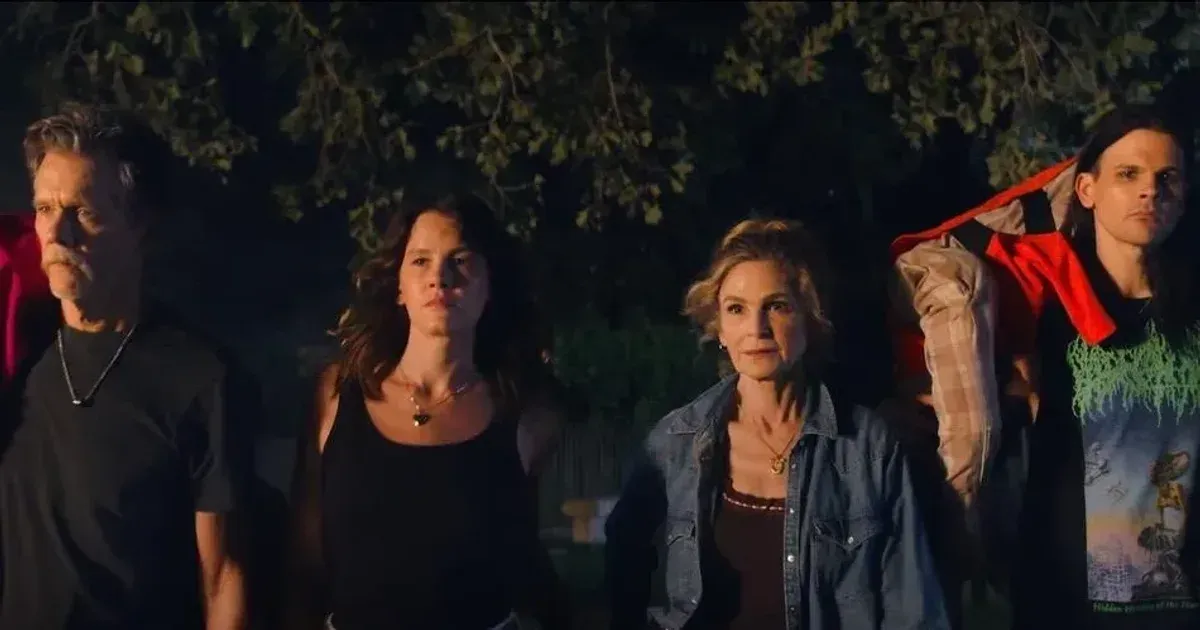
Austin's streets hummed with the kinetic energy of the South by Southwest festival on Friday night as a distinct shift toward meta-narratives and visceral horror gripped the film schedule. Audiences gathered for the debut of Family Movie, a project that blurs the boundaries between professional performance and domestic reality. Kevin Bacon and Kyra Sedgwick lead the production, assuming roles as both co-directors and stars alongside their children, Sosie Bacon and Travis Bacon. This collaborative effort within the Bacon-Sedgwick household is a venture into comedy-horror that leverages their real-world family dynamic for cinematic tension. The project earned significant applause during its initial screening in the Texas capital. Meanwhile, the production avoids traditional horror tropes by leaning into the self-referential nature of its cast. Kyra Sedgwick and her husband have spent decades in the public eye, yet this film marks their first major joint directorial effort involving their offspring. The script integrates elements of the family's public persona, creating a layered experience for viewers familiar with their history. Travis Bacon contributed to the atmospheric tension through his work on the score while Sosie Bacon delivered a performance that critics noted for its deadpan timing. The screening concluded with a standing ovation from the packed theater.
Genre boundaries were tested further as the narrative of the Bacon family project leaned into the absurdities of the film industry itself. Meta-commentary has become a staple of modern horror, but this specific iteration uses the internal chemistry of a Hollywood dynasty to anchor the stakes. Kevin Bacon portrays a version of a patriarch managing a collapsing film set, a role that mirrors the actual logistical hurdles of the production. Still, the levity of the comedy segments balances the darker, more unsettling sequences involving the characters' isolation. Industry analysts suggest the film could secure a major distribution deal before the festival concludes. The runtime of the movie is 94 minutes. But the festival programming did not stop with domestic meta-comedies. By contrast, the late-night slot featured a return to the high-stakes survival horror that defines current genre trends. Radio Silence, the filmmaking collective consisting of Matt Bettinelli-Olpin and Tyler Gillett, introduced their latest work with a blunt directive to the crowd.
Hope you guys have a fucking loud, weird ride.
And so began the premiere of Ready or Not 2, a sequel to the 2019 cult hit. Samara Weaving returns as the protagonist, Grace, who finds herself once again targeted by a wealthy family obsessed with occult rituals and lethal parlor games.
Ready or Not 2 Delivers Excessive Cinematic Violence
Gore and physical comedy dominated the screen as Grace moved through a new set of lethal traps. The directors maintained the satirical edge of the original film, mocking the eccentricities of the ultra-wealthy through increasingly creative methods of character expiration. Radio Silence used a larger budget to enhance the practical effects, resulting in several sequences involving exploding bodies and sacrificial altars. Critics in attendance noted the increased scale of the action compared to the first installment. For one, the sequel expands the lore of the devil-worshipping Le Domas family while introducing a new set of antagonists. The film relies heavily on Samara Weaving and her ability to anchor a chaotic environment with a gritty, physical performance.
Separately, the festival explored the boundaries of the surreal with Pizza Movie, a production that takes a different approach to meta-humor. Gaten Matarazzo, widely known for his work in Stranger Things, stars in this production described as a bad-trip comedy. Directors Brian McElhaney and Nick Kocher crafted a story that begins as a simple delivery mishap and descends into a frantic, disjointed exploration of cinematic structure. In fact, the directors include a scene where they appear at their own desks to discuss the shortcomings of the film's title. This specific sequence breaks the fourth wall entirely, forcing the audience to acknowledge the artifice of the story they are watching.
Pizza Movie Experiments With Fourth Wall Breaks
Structure and pacing in Pizza Movie reflect the chaotic nature of its premise. Gaten Matarazzo delivers a performance that shifts from goofy slapstick to genuine anxiety as the plot becomes increasingly incoherent by design. Critics from Variety observed that the haphazard nature of the storytelling is a deliberate choice intended to frustrate and entertain in equal measure. In particular, the use of visual distortion and rapid editing enhances the bad-trip atmosphere described by the filmmakers. The movie functions as a rejection of linear narrative, focusing instead on a series of escalating comedic set pieces. The production features a cameo from a prominent late-night host during the final act.
Even so, the levity of the comedy selections at SXSW stood in contrast to the somber investigative focus of the documentary section. My Brother's Killer, directed by Rachel Mason, shifts the festival's attention to a cold case from 1990. The film investigates the murder of William Arnold Newton, a young man who was active in the adult film industry under the pseudonym Billy London. Newton's body was discovered in a dumpster, and the case has remained unsolved for over three decades. Mason uses the documentary to probe the failures of the original investigation and the cultural climate surrounding the adult film industry in the early nineties. The footage includes interviews with Newton's surviving family members.
Documentary Probes Unsolved Billy London Murder
Investigative hurdles in the Billy London case highlight the difficulties of solving decades-old crimes involving marginalized figures. Rachel Mason handles the complexity of her subject's life, balancing the macabre details of the crime with a humanizing portrait of a man seeking fame in a stigmatized industry. William Arnold Newton was only 25 at the time of his death. The film suggests that his involvement in gay porn films may have contributed to the lack of urgency in the initial police response. To that end, the documentary serves as an indictment of past investigative priorities. The narrative follows a timeline of clues that lead to several dead ends in the 1990s. In turn, the documentary highlights the role of the victim's notoriety in the public's perception of the crime. The macabre nature of the disposal of the body drew significant attention at the time, yet the interest did not translate into an arrest. Rachel Mason presents new evidence that suggests potential witnesses were never properly interviewed by detectives in the Los Angeles area. By focusing on the personal loss suffered by Newton's brother, the film moves beyond the salacious details of the adult film world.
The production uses archival news footage to establish the setting of a city on edge during that era. The final scene features a call for any remaining witnesses to come forward with information regarding the 1990 case.
SXSW Lineup Needs More Than Shock
SXSW can sell this mix as range, but the stronger truth is harsher. Festivals increasingly rely on familiar names, domestic mythology and shock violence to hold attention in a crowded release market. The lineup works only if those films prove they are more than clever packaging around celebrity families and bloody genre mechanics.