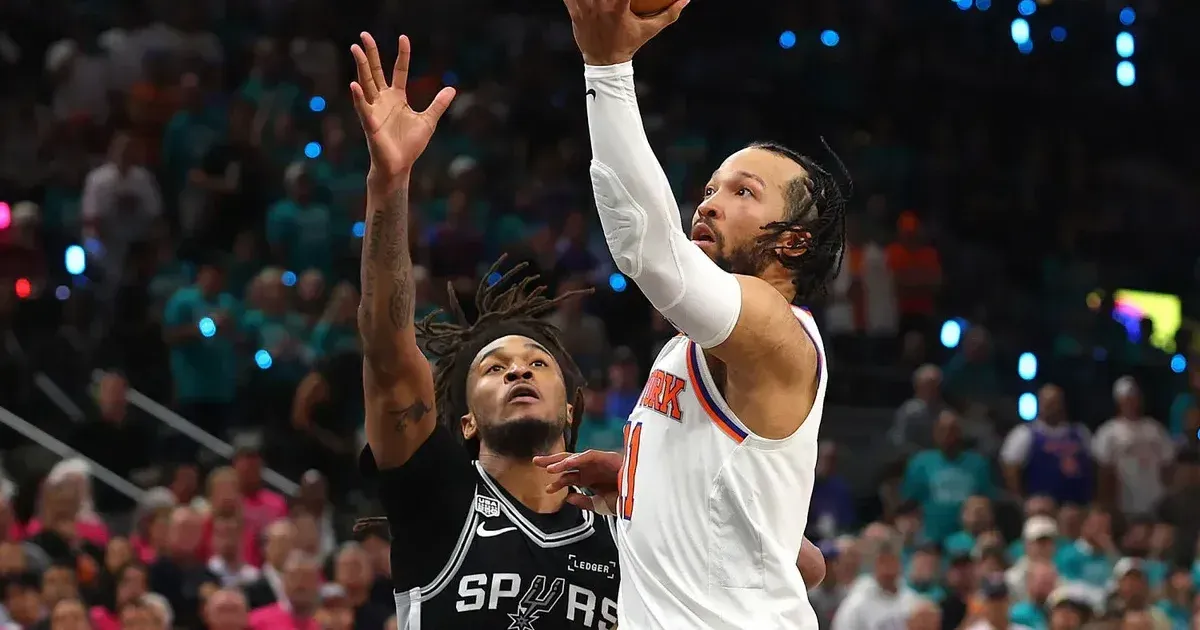
Jalen Brunson gave the New York Knicks the road start they needed in the NBA Finals, scoring 30 points as New York beat the San Antonio Spurs 105-95 in Game 1. The win came on June 3, 2026, at Frost Bank Center, where the Knicks erased a 14-point second-half deficit and closed the game with an 11-0 run.
The result gives New York a 1-0 lead before Game 2 in San Antonio. It also changes the pressure in a series that opened with the Spurs holding home-court advantage and the Knicks trying to win their first championship since the 1970s. For a franchise that has waited decades to return to this stage, the opener offered both a scoreboard edge and a test of late-game composure. New York did not need to settle the matchup in one night, but taking the first game on the road forces San Antonio to spend the next two days answering questions about closing execution, spacing and late-clock defense.
Brunson Controls the Closing Minutes
Brunson scored 13 of his 30 points in the fourth quarter, turning a difficult road opener into a composed finish for New York. The Knicks had trailed by 14 in the second half, but their guard kept finding space late in possessions and forced San Antonio to defend deeper into the shot clock.
The decisive stretch came after the Spurs appeared to have steadied the game. New York tightened its half-court defense, forced rushed possessions and then used Brunson’s shot creation to finish the night. The final 11-0 run gave the scoreline a wider margin than the game had carried for most of the second half.
Karl-Anthony Towns added 18 points and 12 rebounds, giving the Knicks a second scoring anchor and a needed presence on the glass. His work inside helped New York survive stretches when the offense slowed and San Antonio was able to push the pace after missed shots. The balance between Brunson’s perimeter control and Towns’ interior production kept the Knicks from becoming a one-option offense. It also gave the Knicks enough half-court variety to withstand the stretches when San Antonio’s defense pushed the ball away from Brunson and tried to make other players finish possessions.
That mattered because San Antonio had enough length to disrupt routine actions. New York still had to create clean possessions under pressure, especially when the Spurs tried to load defenders toward Brunson. The Knicks’ better moments came when the ball moved early, Towns occupied the middle of the floor and secondary scorers forced San Antonio to defend more than the first action.
Road Win Resets the Series
Winning Game 1 away from Madison Square Garden shifts the tactical burden toward San Antonio. The Spurs now need a cleaner offensive response in Game 2, especially after losing control of the closing minutes on their home floor. New York, by contrast, can play the next game with the confidence that its late-game structure traveled.
The Knicks did not win through one hot shooting burst alone. Their comeback depended on defensive stops, rebounding and Brunson’s ability to make decisions against pressure. That balance matters because San Antonio has the length and talent to adjust quickly if New York becomes too predictable.
For the Spurs, the loss is not a series verdict, but it does remove the margin that usually comes with opening at home. Game 2 now becomes a test of how quickly San Antonio can counter New York’s fourth-quarter spacing and prevent Brunson from dictating the final possessions again. The Knicks also have to expect a sharper response from a roster that spent the postseason proving it could solve difficult matchups.
In New York, the Game 1 result landed in front of a fan base that had spent the week preparing for watch parties around the city. Madison Square Garden sold out an indoor viewing event, while officials also reversed course and allowed a permitted outdoor gathering near the arena before the opener. That public energy has become part of the Finals backdrop, especially with the first New York home game still several days away. The longer the series stays close, the more that atmosphere will matter around Madison Square Garden, where every late possession is likely to feel amplified.
San Antonio Must Keep Brunson From Owning the Final Minutes
Game 2 keeps the series in San Antonio, giving the Spurs an immediate chance to answer before the Finals shift to New York. The biggest adjustment is clear: San Antonio must keep Brunson from controlling the final minutes while still accounting for Towns and the Knicks’ secondary scoring.
New York’s task is less dramatic but just as demanding. The Knicks have to treat the opener as a baseline rather than a finished statement, because the Spurs will have film, home crowd energy and urgency on their side. If New York’s defense holds its shape again, the series could arrive at Madison Square Garden with the Knicks in firm command. The win also gives New York a cleaner tactical baseline for Game 2, when San Antonio must adjust matchups before the series moves east to New York for Game 3.