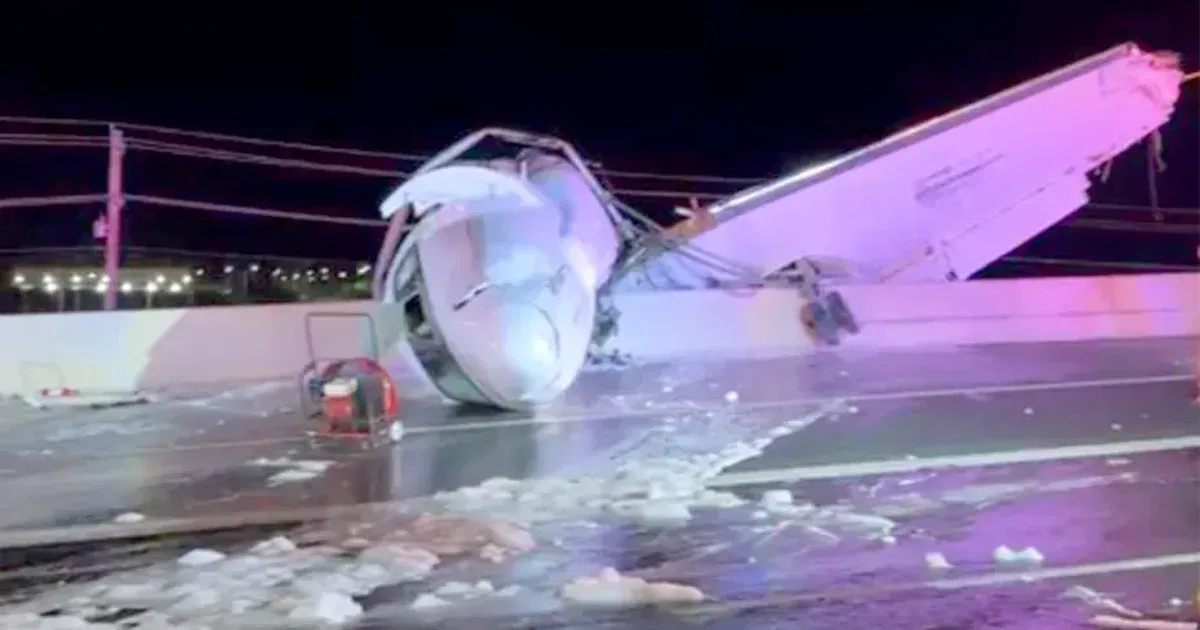
Laredo police investigators secured a wreckage-strewn section of Loop 20 after a business jet slammed into a highway barrier. The crash also forced investigators to separate highway risk from aviation risk. The aircraft went down on June 16, 2026, shortly after 10 p.m. local time, causing a fire and leaving one person dead. Emergency personnel arrived to find a scene described by onlookers as surreal, with the fuselage resting against the roadway divider. The twin-engine jet had been traveling from Mexico before the impact occurred near the U.S.-Mexico border.
Flight records indicate the aircraft was a Cessna Citation Latitude, a popular midsize business jet. Data from FlightAware shows the plane departed from Los Cabos International Airport in Mexico at 6:19 p.m. earlier that evening. NetJets, a private aviation company that operates the world's largest fractional ownership fleet, confirmed the crash involved one of its planes. Executives from the firm stated they are currently working with local and federal authorities to determine what led to the fatal incident.
Footage captured by witnesses near the scene shows the tail section of the aircraft completely separated from the main fuselage. Firefighters spent considerable time battling a blaze that erupted after the plane struck a highway barrier and potentially a vehicle on the ground. One person was confirmed dead at the scene, though police have not yet specified whether the individual was inside the aircraft or the struck vehicle. Highway traffic was diverted as Loop 20 remained closed through Wednesday morning to allow for a full debris recovery.
Rescue Operations and Officer Injuries
Five police officers required immediate medical attention after they rushed toward the burning wreckage to search for survivors. José Baeza, an investigator with the Laredo Police Department, confirmed that the officers were transported to a local hospital for smoke inhalation. These first responders encountered heavy black smoke and intense heat as they approached the crash site. Their current conditions have been described as stable by department officials.
Witnesses who were driving on the highway at the time of the crash described a chaotic and terrifying sequence of events. One observer noted that the sudden appearance of a jet on the roadway felt like a staged production rather than a real accident. The debris field stretched across several lanes, forcing drivers to swerve to avoid secondary collisions with aircraft parts.
"It looked like part of a movie. I was in shock," according to a witness interviewed by the New York Post at the scene.
Rescue teams found the aircraft on its side, with the interior cabin heavily compromised by the force of the collision. Six people were reportedly aboard the jet at the time of the flight, though the exact status of each passenger and crew member has not been finalized in official reports. Medical helicopters were seen landing near the highway to enable the transport of the injured to specialized trauma centers in the region.
Operational Timeline and Safety Scrutiny
Investigators are now focusing on the final minutes of the flight path as the jet approached Laredo. The city, situated about 140 miles southwest of San Antonio, is a major hub for cross-border travel and commerce. Local police emphasized that the crash site is a heavily trafficked corridor, making the timing of the accident particularly dangerous for ground commuters. National Transportation Safety Board officials are expected to arrive on site to take over the lead in the technical investigation.
A vehicle on the highway was caught in the path of the descending jet, according to initial police reports. Damage to the car was extensive, though the number of occupants inside that vehicle has not been disclosed. This specific detail remains a primary focus for the Laredo Police Department as it attempts to reconcile the list of casualties. The impact occurred with enough force to breach the reinforced highway barriers designed to stop heavy trucks.
Maintenance records for the Cessna jet will likely be subpoenaed by federal regulators during the coming days. Cessna Citation Latitude models are known for their advanced avionics and safety features, making an accident of this nature rare for the airframe. The investigation will examine engine performance, fuel levels, and the weather conditions at the time of the 10 p.m. crash.
Flight Recorders and Debris Will Shape the Inquiry
Federal aviation investigators will likely spend the next several days mapping the debris field to reconstruct the final moments before impact. These experts will analyze the flight data recorder and cockpit voice recorder to understand if the pilots reported any mechanical failures or emergencies to air traffic control. The National Transportation Safety Board typically issues a preliminary report within two to three weeks, providing a factual timeline without determining a final cause.
Safety protocols for business jets operating in metropolitan areas could face renewed scrutiny if mechanical failure is identified as a factor. Industry analysts will watch closely to see if this incident prompts new maintenance directives for the Cessna Citation Latitude fleet. Fractional ownership companies like NetJets maintain rigorous safety standards, yet high-cycle operational schedules often require more frequent inspections than standard private aircraft.
Laredo city officials must also evaluate the structural integrity of the highway barriers and pavement on Loop 20 before fully reopening the route. Heat from the jet fuel fire can weaken asphalt and concrete, requiring emergency repairs that could extend traffic delays into the weekend. This incident highlights the inherent risks of major airports being situated in close proximity to dense urban transit infrastructure.