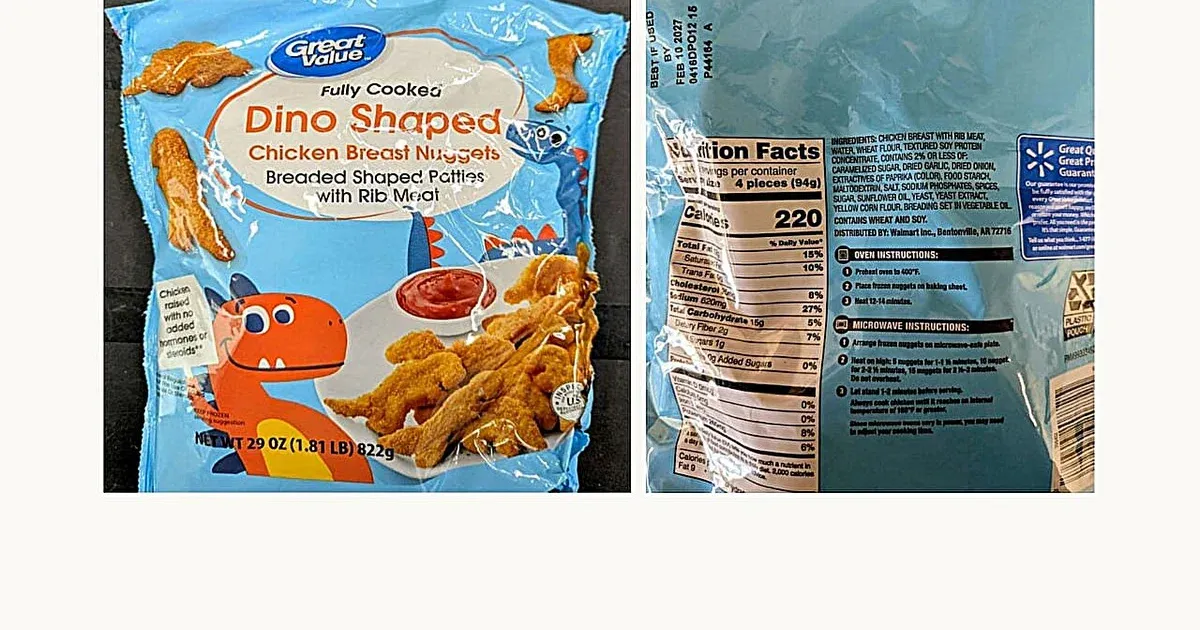
Two food-safety notices issued in early April 2026 ended with different official conclusions. The US Department of Agriculture withdrew a public health alert for Great Value dinosaur-shaped chicken nuggets after confirming that the initial lead result was a laboratory false positive. A separate company recall of peeled garlic sold at Tops Markets has been completed and terminated by the Food and Drug Administration.
The distinction matters because an initial warning is not always the final finding. The chicken products were never recalled, and follow-up testing cleared them. The garlic recall did concern inadequate temperature control and possible Clostridium botulinum contamination, but it covered named products sold by one supermarket chain in three states, not an unidentified national supply.
Product identifiers, dates and later agency updates determine what a food-safety notice means. Without them, a report can leave readers unable to identify an affected package or continue presenting a preliminary hazard after regulators have withdrawn it.
The Chicken-Nugget Alert Was Retracted
On April 1, USDA's Food Safety and Inspection Service issued a public health alert for 29 oz bags of Great Value Fully Cooked Dino Shaped Chicken Breast Nuggets. The identified packages carried a “Best If Used By” date of February 10, 2027, lot code 0416DPO1215 and establishment number P44164. Dorada Foods produced the lot on February 10, 2026, and it was shipped to Walmart stores nationwide.
FSIS did not request a recall because the product was no longer available for purchase. The agency issued the alert because some bags might have remained in home freezers after routine surveillance sampling by a New York state laboratory indicated elevated trace levels of lead.
On April 6, FSIS retracted the alert. The New York State Department of Health and Dorada Foods tested the identified lot and additional lots. All follow-up testing found no elevated lead. After reviewing the laboratory data, regulators concluded that sporadic lead contamination during the original laboratory analysis had produced a false positive.
FSIS said the nuggets did not pose a public health concern. That conclusion supersedes the preliminary alert. Claims that the product contained lead several times above a safety level, that an ingredient in the breading caused contamination or that children who ate the nuggets required special monitoring are not supported by the final investigation.
The Garlic Recall Had a Three-State Retail Scope
Tops Friendly Markets announced the peeled-garlic recall on April 1 after a routine store inspection found that the products had not been held at temperatures sufficient to control the botulism hazard. FDA posted the company announcement and now marks the recall as completed and terminated.
The action covered all code dates of Christopher Ranch Peeled Garlic in 6 oz plastic bags with UPC 74574-10852. It also covered all code dates of Garland Fresh Peeled Garlic in 6 oz bags with UPC 71894-00000 or 68826-75340. Distribution was limited to Tops Markets in New York, Pennsylvania and Vermont.
The announcement warned that Clostridium botulinum can cause life-threatening illness and that contaminated food may not look or smell spoiled. At the time of the recall, consumers were told not to eat the identified garlic and could return it to Tops for a refund. The company reported no known illnesses.
The notice did not report an outbreak, suspicious cases, a processing-plant power failure or millions of pounds of affected garlic. It did not say hospitals were preparing for patients. Those details cannot be inferred from a temperature-control failure observed during a store inspection.
Botulism Reporting Requires Exact Instructions
FDA listed general weakness, dizziness, double vision and difficulty speaking or swallowing among possible symptoms of botulism. Difficulty breathing, weakness of other muscles, abdominal swelling and constipation can also occur. These are serious warning signs, but the recall notice did not establish that anyone developed them from the garlic.
Food-safety instructions must follow the agency notice rather than improvised preparation advice. The active recall told consumers not to consume the product even when it appeared normal. It did not advise buyers to make the garlic safe by reheating it, checking its smell or using a particular cooking temperature.
The FDA page's terminated status records that the recall process has ended. It does not erase why the original action was taken. The accurate historical account is that inadequate refrigeration created a potential botulism risk, the two products were recalled, no illnesses were known and the recall was later completed.
Corrections Are Part of the Safety Record
The nugget and garlic actions should not be collapsed into a single story of contaminated food moving through a failed national system. One was a precautionary USDA alert based on a test result later disproved. The other was a geographically limited company recall based on observed temperature control, with no reported illness.
Rapid warnings protect consumers when evidence is incomplete, but their credibility also depends on visible corrections. FSIS did the necessary second step: it retested the product, identified laboratory contamination and withdrew the alert when the evidence changed. Continuing to call the nuggets lead-contaminated after that retraction would turn a safety precaution into misinformation.
The garlic record shows the complementary rule. A useful recall report names the brand, package size, UPC, code range, retailer and states involved, then repeats the agency's instruction without inventing an outbreak or a home remedy. Alarm without identifiers is not stronger reporting. It is less actionable and more likely to mislead.