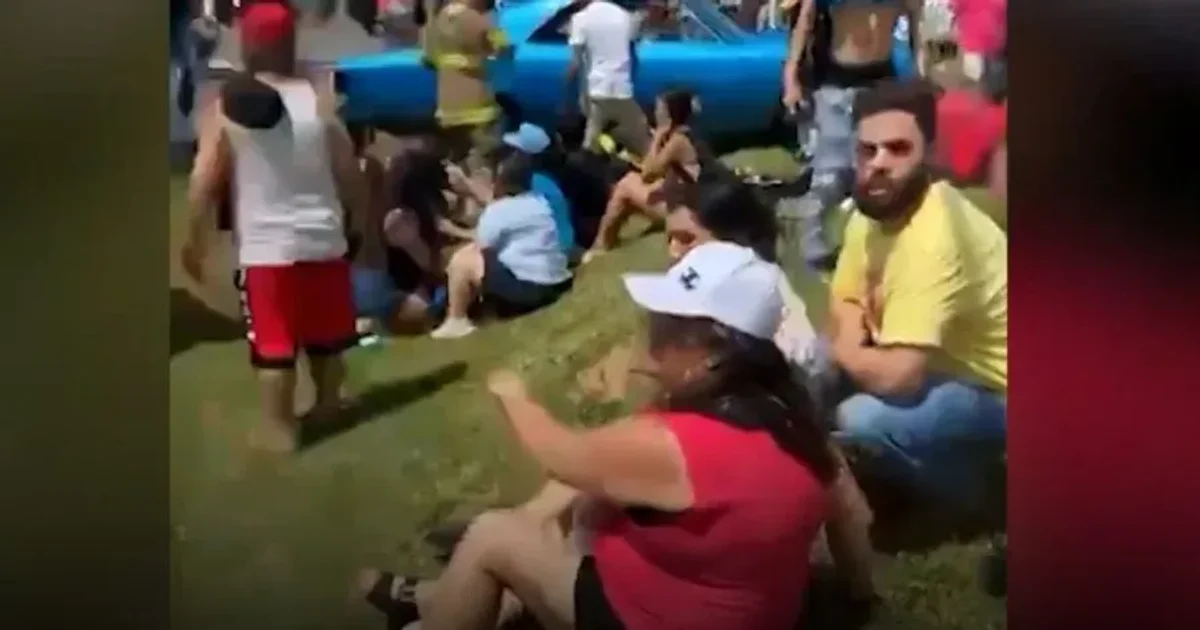
Louisiana investigators initiated a comprehensive review on April 5, 2026, after a vehicle breached a secure perimeter and struck multiple participants during a local parade on Saturday evening. Medical crews arrived at the scene within minutes of the impact to treat several individuals who sustained injuries varying in severity. Local law enforcement officials immediately cordoned off the parade route to preserve physical evidence and interview witnesses who observed the driver steer into the crowd. Initial reports from the scene indicate that the vehicle maintained a consistent speed upon entry into the pedestrian zone. Officers established a hard perimeter around the incident site.
Emergency Response at the Louisiana Parade
Ambulances and first responders transitioned the street from a celebratory environment to a triage center shortly after the collision. Paramedics focused on stabilizing participants who were directly hit by the vehicle before transporting them to regional trauma centers. Witnesses described a chaotic scene where bystanders attempted to assist the injured while police sought to detain the driver. Hospital officials confirmed that at least $2.5 million in emergency resources were mobilized across the region to handle the sudden influx of patients. Medical teams prioritized patients with serious orthopedic injuries.
First responders faced meaningful logistical challenges due to the dense crowds gathered along the parade route. Standard emergency protocols require clear access lanes, but the sudden nature of the vehicle strike meant that equipment had to be carried manually through narrow spaces. Local police managed to clear a secondary path for emergency vehicles within ten minutes of the first distress call. Despite the congestion, the medical evacuation process proceeded without further incident. These efforts relied on a pre-existing coordination plan developed by the Louisiana Police and local fire departments.
Louisiana state law mandates specific safety barriers for public gatherings, yet the vehicle managed to bypass these obstacles at a designated crossing point. Investigative teams are now examining whether the barriers were improperly secured or if the driver exploited a specific gap in the security design. Mechanical inspectors took custody of the vehicle to determine if hardware failure contributed to the loss of control or if the acceleration was intentional. Data from the vehicle’s internal computer system will provide a timeline of the driver’s actions in the seconds leading up to the impact. Technicians began the data extraction process late Sunday night.
Investigative Focus on Vehicle Safety Protocols
Police interviewed the driver for several hours on April 5, 2026, to determine a motive for the collision. Investigators have not released the identity of the individual, though they confirmed that the driver remains in custody without bond. While some early theories focused on mechanical malfunction, the lack of brake marks at the scene suggests a different sequence of events. Authorities are also reviewing surveillance footage from nearby businesses to track the vehicle’s movements before it reached the parade route. Preliminary video evidence shows the car idling near the entrance for several minutes. This incident draws parallels to how local law enforcement and agencies manage protective security protocols for public figures.
"The vehicle struck multiple participants before the driver could be apprehended by officers stationed nearby," a spokesperson for the local police department said.
Public safety records indicate that parade organizers followed the standard permitting process required by the municipality. These permits include requirements for dedicated security personnel and physical barricades at every intersection. Louisiana officials are comparing these requirements against the actual implementation on the day of the event. Discrepancies in the number of personnel present could lead to a broader review of city oversight for public festivities. The city attorney’s office has already requested copies of all deployment logs.
This incident has prompted other municipalities in the region to reevaluate their own security measures for upcoming spring festivals. Safety experts argue that the reliance on plastic or lightweight metal barriers is insufficient to stop a modern passenger vehicle. Many jurisdictions are now considering the use of heavy concrete bollards or water-filled barriers that offer greater resistance to impact. Implementation of these measures often carries a high cost that smaller towns struggle to fund. Budgetary constraints often dictate the level of physical security available at community events.
Public Safety Records in Louisiana Municipalities
Records from the past decade show a slight increase in vehicle-related incidents at public gatherings across the southern United States. While most events conclude without injury, the occasional breach of security highlights the difficulty of protecting thousands of people in an open-air environment. Insurance underwriters for large-scale events have begun demanding more rigorous safety audits before issuing coverage. These audits often include a requirement for professional security contractors to supplement local police forces. Some organizers have cancelled events rather than pay the rising premiums.
48 hours after the event, the focus has shifted to the long-term recovery of the injured participants. Doctors report that three individuals remain in critical condition while others have been discharged to continue recovery at home. Support groups for parade participants have organized to provide mental health resources to those who witnessed the strike. The psychological impact on a community can persist long after the physical debris is cleared from the streets. Local clergy held a brief vigil near the site of the crash on Sunday morning.
Legal experts suggest that the municipality could face civil litigation if investigators find evidence of negligence in the security perimeter. Sovereign immunity laws in Louisiana often protect cities from certain types of lawsuits, but exceptions exist for gross negligence or failure to follow established safety codes. Plaintiffs would need to prove that the city was aware of a specific vulnerability and failed to act. Law firms in the region have already begun reviewing the city’s parade safety ordinances. The legal process for such cases typically lasts several years.
The Elite Tribune Strategic Analysis
Parades are essentially anachronistic security nightmares that modern law enforcement is increasingly ill-equipped to handle. The romanticized notion of an open-access street celebration is fundamentally at odds with the reality of vehicle-borne threats. We see a recurring pattern where local governments prioritize the aesthetics of a community gathering over the harsh physics of a two-ton vehicle. Relying on volunteers and plastic sawhorses to protect families is not a security strategy. It is a gamble that depends entirely on the goodwill of every driver in the vicinity.
Municipalities that refuse to invest in hardened infrastructure, such as retractable bollards or permanent heavy barriers, are essentially accepting a certain level of casualty risk. The argument that such measures are too expensive or too intrusive fails to account for the enormous legal and medical costs that follow a single strike. This tragedy in Louisiana was not an act of God. It was a failure of spatial management. Until cities treat parade routes with the same security intensity as airport tarmacs, these headlines will continue to appear with rhythmic regularity.
Bureaucrats will likely respond with a flurry of new committees and minor ordinance tweaks that do nothing to change the physical vulnerability of the next crowd. True safety requires a rejection of the open-street model in favor of strictly controlled, fortified zones. If a city cannot afford to secure a route properly, it should not host the event. Civil liability is the only language that will eventually force this change. The age of the open parade is over.