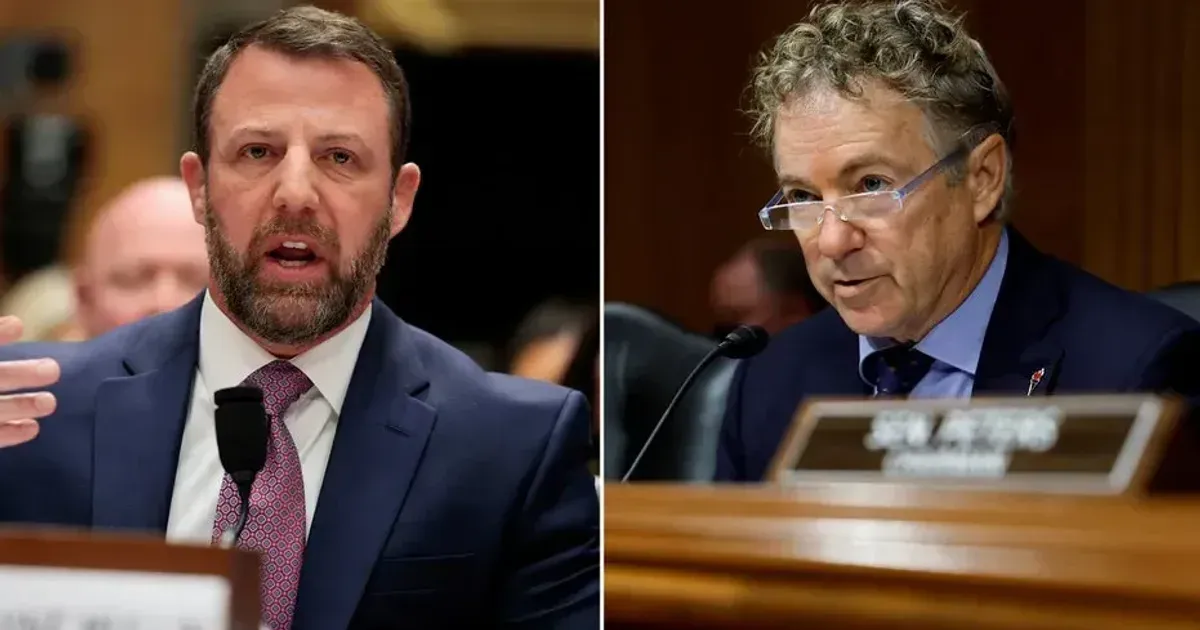
Senator Markwayne Mullin sat before the Senate Committee on Homeland Security and Governmental Affairs on Wednesday to defend his nomination as the next Secretary of Homeland Security. Political tensions surfaced immediately as the committee chair, Senator Rand Paul, redirected the focus from national security policy to a long-standing personal grievance. Paul opened the proceedings by recounting a 2017 physical assault by a neighbor that left him with six broken ribs and a damaged lung. He accused Mullin of previously stating that he understood why the attacker acted in such a manner. Paul looked directly at the nominee and challenged him to repeat those sentiments during the televised hearing.
Mullin, an Oklahoma Republican, chose to address the chairman off the cuff rather than sticking to his prepared opening statement. He acknowledged telling Paul in a private conversation years ago that he could understand why a neighbor might react violently to Paul’s behavior. The nominee further admitted to calling Paul a snake in the grass during past interactions. Still, Mullin maintained that his directness is a core personality trait rather than an endorsement of political violence. He told the committee that he preferred to speak to people directly to their faces rather than through intermediaries. Mullin refused to issue a formal apology for his past remarks about the 2017 incident.
Rand Paul Grills Mullin Over History of Personal Attacks
Chairman Paul characterized the nominee’s past statements as an excuse for physical violence. He claimed that Mullin never had the courage to look him in the eye and justify the assault until the threat of a stalled confirmation loomed. According to the hearing transcript, Paul described the 2017 attack as a heinous act that nearly cost him his life. He expressed disbelief that a potential member of the presidential cabinet would find such an event understandable. The two men have a documented history of friction dating back to Mullin’s tenure in the House of Representatives.
Mullin counter-attacked by suggesting that Paul often focuses more on fighting fellow Republicans than working toward legislative solutions. He argued that his work within the party demonstrates a commitment to solving problems rather than creating obstacles. To that end, Mullin cited his recent efforts to coordinate with more than 40 House Republicans who have endorsed his bid for the top DHS post. These supporters view Mullin as a critical figure for implementing stricter border security measures. But the personal nature of the exchange with Paul overshadowed much of the early testimony regarding agency management.
I said I could understand because of the behavior you were having, that I could understand why your neighbor did what he did.In fact, the nomination comes at a time when the Department of Homeland Security is struggling with multiple internal investigations. Mullin is scheduled to succeed Kristi Noem if the full Senate votes in his favor. For one, his ability to manage the massive federal bureaucracy depends heavily on his relationship with the very committee members who are now questioning his temperament. Paul’s leadership of the committee gives him significant power over the timing and success of the vote.
DHS Policy Tensions Rise Over Minnesota Shooting Investigations
Separately, the hearing shifted toward recent enforcement actions in Minnesota that resulted in the deaths of two American citizens. Senator Gary Peters, a Michigan Democrat, questioned Mullin about his public labeling of Alex Pretti as deranged following a fatal encounter with federal agents in January. Pretti was killed by immigration enforcement officers during a localized operation. Mullin conceded during the hearing that he should not have used that specific language to describe the deceased. He admitted that the comment was a mistake while stopping short of a full apology to the family.
And the nominee faced further scrutiny regarding Renee Good, another citizen killed by immigration agents in Minnesota earlier this year. Mullin had previously stated that the agents involved were justified in their use of force to defend themselves. Senator Richard Blumenthal noted that the administration is currently blocking local and state inquiries into the shooting. Mullin refused to retract his defense of the agents. He told the committee he would wait for the conclusion of a federal investigation before commenting further on the legal specifics. This focus on pending investigations allowed Mullin to avoid definitive commitments on police reform. By contrast, the nominee emphasized that federal agents must have the authority to protect themselves while on duty. He argued that the current security climate requires a DHS secretary who will not second-guess officers in the field. This approach aligns with the broader Republican platform of prioritizing law enforcement autonomy. Yet, Democrats on the committee raised concerns that such a stance might impede transparency in cases of potential misconduct. The tension between officer safety and public accountability was still a recurring theme throughout the afternoon.
Senate Confirmation Odds for Mullin Remain High
Meanwhile, Senate Majority Leader John Thune expressed confidence that the nomination will proceed despite the friction in the committee room. Thune dismissed the exchange between Paul and Mullin as personal history that does not reflect on Mullin’s qualifications for the job. He told reporters after the session that Mullin remains the right person to lead the department. The Republican leadership appears unified in their desire to fill the vacancy quickly to begin new border initiatives. Thune’s public support suggests that the party is willing to overlook the personal animosity between the two senators.
At the same time, the path to confirmation may rely on support from across the aisle. Senator John Fetterman of Pennsylvania has become a potential swing vote for the nominee. Fetterman told the press that he is approaching the nomination with an open mind and has not seen any disqualifying moments in the testimony so far. He noted that the heated exchanges between Paul and Mullin did not fundamentally change his assessment of the candidate. If Mullin secures even a few Democratic votes, Paul’s potential opposition may become irrelevant to the final outcome.
For instance, the committee has scheduled a formal vote on the nomination for Thursday morning. This timeline suggests that the GOP leadership is moving aggressively to prevent the personal dispute from derailing the legislative calendar. Mullin’s team spent much of the week meeting with individual senators to shore up support. Records show that more than 40 House Republicans have signed a letter urging the Senate to confirm Mullin without delay. They describe the current moment as a critical juncture for border security policy. The hearing was a venue for grievances that have simmered within the Republican party for nearly a decade. Paul’s decision to air these issues publicly highlights the fractures that exist between different wings of the Republican Party. Even so, the institutional momentum behind Mullin appears strong enough to withstand the criticism. The committee will meet again tomorrow to finalize their recommendation to the full Senate body. Mullin is expected to be present for the final tally.
The Confirmation Hearing as a Governing Signal
Mullin’s performance before the committee reveals a troubling trend where personal brawling replaces serious policy debate. Watching two United States senators litigate a decade-old neighborhood dispute while the Department of Homeland Security sits without a permanent leader is an exercise in futility. It is irrelevant whether Mullin thinks Paul is a snake or if Paul believes the assault was justified. What matters is the management of a $11 billion agency that oversees the safety of millions. Mullin’s refusal to apologize for his comments about the Minnesota shootings is particularly telling of a candidate who prizes personal stubbornness over administrative transparency.
We are seeing a shift toward a cabinet of loyalists who are selected for their combativeness rather than their competence. If the Senate confirms a man who openly admits to understanding why a colleague was violently attacked, it sends a message that the rule of law is secondary to political tribalism. The Republican leadership seems more interested in a quick victory than in vetting the character of the man who will control the nation’s borders and federal law enforcement. The confirmation process is less of a hearing and more of a formality for a predetermined outcome.