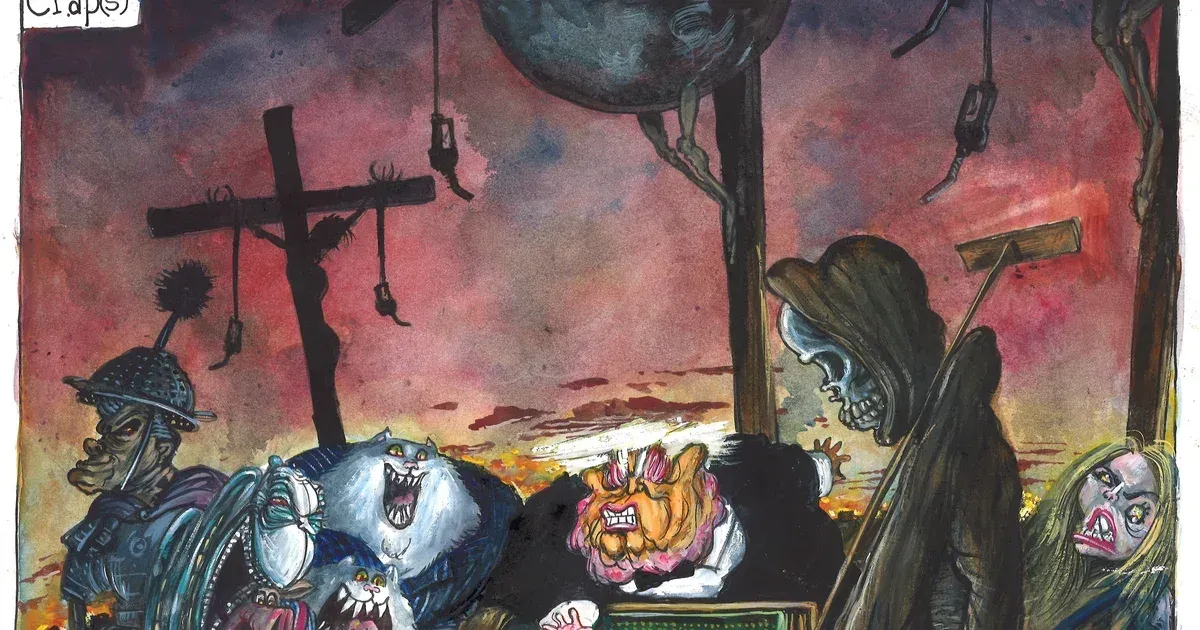
Martin Rowson released a searing visual critique targeting the intersection of religious tradition and modern geopolitical violence. Easter celebrations across the Western world collided with grim realities of defense spending and fractured supply chains on April 3, 2026. Rowson used his signature ink-heavy style to expose the contradictions between symbols of rebirth and the mechanics of destruction. Graphic depictions of ordnance and suffering replaced the pastoral imagery typically associated with the spring holiday.
Satire serves a specific function during periods of systemic stress. Rowson's latest work follows a long tradition of British caricaturists who view their pens as scalpels rather than brushes. Market participants often overlook how cultural sentiment, captured by artists like Rowson, precedes shifts in consumer confidence. Volatility in the Black Sea and ongoing tensions in the Middle East provided the immediate backdrop for this specific illustration. The cartoon placed Easter imagery inside a wider argument about war, money and public grief.
Global instability has reached a point where even the most sacred observations cannot escape the gravity of current events. Defying the convention of lighthearted seasonal content, Martin Rowson produced an image that demands a confrontation with uncomfortable truths. Analysts at various financial institutions suggest that public perception of global risk is at its highest point in a decade. Disruption in major trade routes continues to drive inflation, a theme Rowson often embeds in the background of his works.
Martin Rowson Highlights Economic Consequences of Conflict
British satirical history relies on the ability to humiliate the powerful while highlighting the plight of the vulnerable. Rowson follows in the footsteps of James Gillray, using distorted anatomy and grotesque detail to make a point. His work on April 3, 2026, does more than mock leaders; it illustrates the human cost of $2.4 trillion in global military expenditures. Figures in the cartoon appear weighed down by the heavy machinery of war, a literal representation of national budgets being diverted from social services.
Defense stocks have seen a sharp rise, yet the broader economy faces headwinds from rising energy costs. Rowson's choice of colors, heavy on blacks and deep reds, mirrors the mood of an electorate weary of perpetual crisis. Critics of the artist often point to his cynicism, but his defenders see a necessary mirror. Public discussion requires these abrasive interpretations to break through the sanitized narratives of official press releases.
Economic data from the first quarter of 2026 indicates a slowdown in discretionary spending. Easter usually provides a temporary boost to the retail sector through gift-giving and travel. Instead, the current climate reflects a population focused on essentials as the shadow of conflict grows. Rowson captures this shift by replacing chocolate eggs with darker, more industrial symbols of the current age.
Global Instability and the Resilience of Political Art
Visual commentary often survives long after the headlines that inspired it have faded. Rowson's Easter sketch is a piece of historical record as much as it is an editorial. Projections show that the long-term impact of current conflicts will reshape international trade for years. Art provides a way for the public to process these large shifts without the filter of academic jargon or financial modeling.
The role of the cartoonist is to be the grit in the oyster, ensuring that the comfortable remain bothered by the reality of the world they help create, according to a recent profile of Rowson.
Investors frequently ignore the cultural undercurrents that drive political volatility. Rowson's work acts as a leading indicator of populist frustration, which often translates into sudden policy changes or electoral upsets. Markets hate uncertainty, and his cartoons are the ultimate expression of the unknown. Every ink stroke is a challenge to the status quo.
Institutional trust has declined as global organizations struggle to mediate ongoing disputes. Rowson's illustration depicts these institutions as frail or decaying structures. The visual metaphor aligns with recent polling data showing a lack of confidence in international diplomacy. Wealth inequality persists as a recurring theme in his portfolio, manifesting here through the contrast between opulence and ruin.
Artistic Resistance in a Volatile Global Economy
Media organizations continue to rely on provocative voices like Rowson to maintain reader engagement in a crowded digital space. His ability to synthesize complex geopolitical events into a single frame is a rare skill. Martin Rowson has spent decades refining a style that is immediately recognizable and difficult to ignore. The April 3, 2026, cartoon is an example of how traditional media can still command attention through high-impact visual storytelling.
Corporate interests often find themselves the target of Rowson's most vicious caricatures. He views the commercialization of holidays like Easter as a distraction from deeper structural issues. The latest work is no exception, stripping away the commercial veneer to reveal a world in turmoil. Financial centers in London and New York are not immune to the critiques leveled by his pen.
Public reaction to the piece has been divided along predictable ideological lines. However, the sheer volume of social media engagement proves the relevance of his medium. Satire is still one of the most effective tools for challenging authority in a democratic society. Rowson maintains his position as one of the most influential critics of the modern era.
Cultural commentators believe the dark tone of 2026 art reflects a broader pessimism. The mood is not confined to the United Kingdom but is a worldwide phenomenon. Rowson's Easter depiction is a specific instance of a much larger trend. It is a world where the symbols of hope are increasingly obscured by the reality of war.
Rowson Sketch Turns Easter Into Political Witness
History suggests that when the court jesters stop laughing and start snarling, the throne is in genuine trouble. Martin Rowson is no longer just a satirist; he has become a chronicler of a decaying global order that prioritizes kinetic conflict over fiscal stability. The decision to mar the imagery of Easter with the viscera of modern warfare is a calculated strike against the complacency of the Western consumer. We are looking at a market that has priced in perpetual war, yet remains utterly shocked when the cultural costs are tallied in ink and blood.
Rowson's work is a warning to the C-suite that the social contract is fraying. When the symbols of rebirth are replaced by the tools of death, the underlying economic engine is clearly misfiring. Traditional financial models fail to account for the sheer visceral anger reflected in this sketch. It is a data point that no Bloomberg terminal can quantify.
The era of sanitized corporate neutralism is over. Every major brand and institution is now a target in a landscape where there is no neutral ground. Rowson has accurately diagnosed a global fever that will not be broken by minor interest rate adjustments or diplomatic platitudes. The ink is dry, but the fire is just beginning. Prepare for impact.