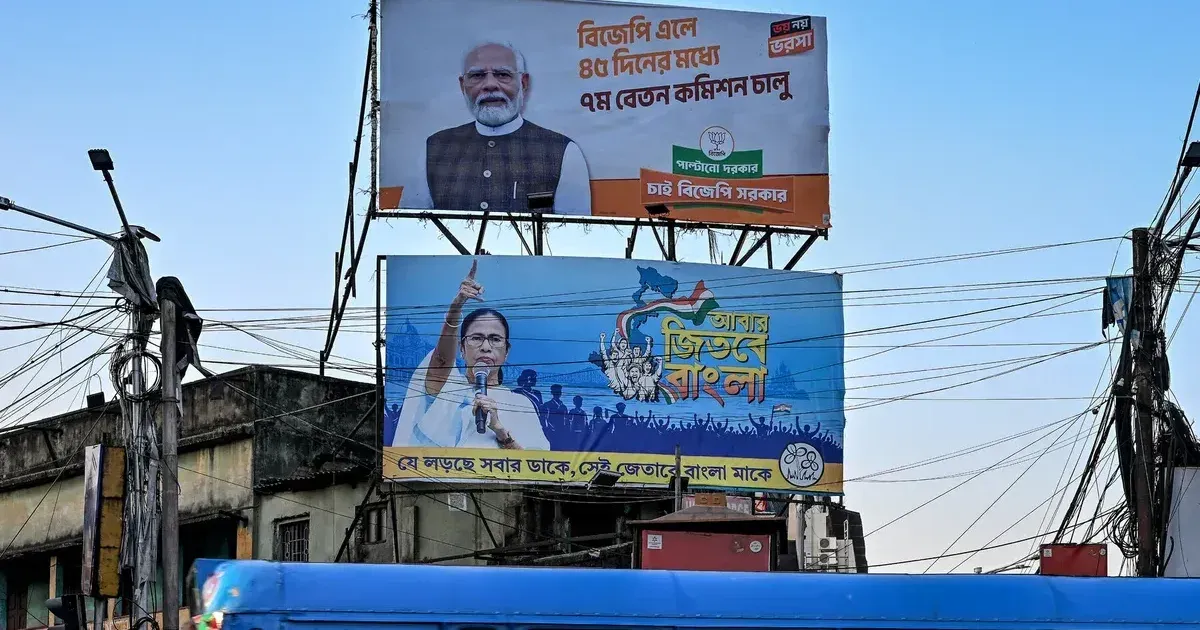
Narendra Modi intensified his electoral campaign across West Bengal on April 24, 2026, as he sought to dismantle the political fortress of Chief Minister Mamata Banerjee. Clashes between the two leaders have become a defining feature of the national political landscape, with the state acting as the final frontier for the Hindu right-wing expansion. Tensions escalated recently when an administrative audit resulted in the removal of 9 million people from the voter rolls, sparking widespread allegations of systematic disenfranchisement. Opposition leaders claim the deletions targeted specific demographics to weaken the Trinamool Congress base ahead of the polls.
Projections from local monitoring groups suggest that a significant part of the removed names belong to the Muslim minority. West Bengal maintains a unique demographic profile where nearly thirty percent of the population identifies as Muslim, a factor that has historically cushioned the state against the saffron wave seen in northern India. Bharatiya Janata Party officials defended the audit as a routine cleanup of the National Register of Citizens to identify illegal residents. Critics, however, argue the timing is calculated to suppress votes in districts where Banerjee commands the electorate.
West Bengal Voter Roll Audit and Demographic Impact
Data released by the Election Commission indicates the scale of the roll purge is record-setting in Indian provincial history. Officials in Kolkata have been flooded with petitions from residents who found their names missing despite possessing valid identification documents. These citizens often lack the specialized legal assistance required to navigate the appeal process. Many affected individuals reside in border districts like Malda and Murshidabad, where the line between citizenship and migration has been a point of contention for decades. Administrative errors in these regions frequently lead to the exclusion of legitimate voters who lack the means to fight back.
Legal challenges to the audit have reached the state high court. Lawyers representing civil society groups presented evidence that the criteria for removal were applied inconsistently across different voting blocs. Reports from ground-level observers suggest that Hindu voters with similar documentation discrepancies were often given a grace period to rectify their records. Muslim residents reported receiving no such warnings before their names disappeared from the digital registries. This discrepancy has fueled a narrative of religious bias that the Bharatiya Janata Party denies. Central authorities insist the process was entirely automated and based on verified residency data.
"The audit ensures electoral purity by removing duplicate entries and illegal residents who have no standing in our democratic process," said a senior spokesperson for the Election Commission of India.
Voters in rural belts expressed confusion and fear during recent town hall meetings. Many families have lived in the same villages for generations yet find themselves labeled as doubtful voters. Bureaucratic hurdles often prevent these individuals from re-enrolling before the registration deadlines pass. Banerjee has capitalized on this anxiety, portraying herself as the sole protector of Bengali culture and rights against an intrusive central government. Her speeches often focus on the threat to regional identity posed by New Delhi's policies.
Modi and the Hindu Right Strategy in the East
Hindu nationalist groups have spent years building a grassroots network in Bengal to counter the influence of the Trinamool Congress. Earlier efforts were hindered by the state's long history of Marxist governance, which prioritized class over religion. The decline of the Left Front created a vacuum that both Banerjee and the BJP have competed to fill. Modi has personally led rallies in the industrial outskirts of Kolkata, promising economic revitalization and an end to what he describes as the corruption of the TMC era. His rhetoric emphasizes a unified Hindu identity that goes beyond caste and language barriers.
Success for the BJP in this heartland would validate its claim to be the undisputed voice of India. West Bengal represents the second largest number of parliamentary seats among states not controlled by the ruling party. Capturing this territory requires more than economic promises; it requires a fundamental reordering of the state's social fabric. RSS cadres have increased their presence in primary schools and local community centers to promote a cultural narrative that aligns with the BJP vision. These efforts have yielded gains in the northern tea-growing regions and the western tribal belts.
Conflict persists over the implementation of the Citizenship Amendment Act. Banerjee refuses to allow the act's provisions to be enacted within state borders, setting up a constitutional showdown with the central government. Modi uses this resistance to paint the Chief Minister as an advocate for illegal immigrants at the expense of national security. Polarization has deepened as both sides use social media to amplify their respective messages. Violent skirmishes between party workers have become common occurrences during the campaign cycle.
Banerjee Resistance and Bengali Identity Politics
Mamata Banerjee, frequently referred to as Didi by her supporters, relies on a combination of populist welfare schemes and regional pride to maintain her grip. Her government launched several initiatives providing direct cash transfers to women and subsidized healthcare to the poor. These programs have built a loyal following that views the BJP as an outsider party. Banerjee often speaks in colloquial Bengali to emphasize her connection to the soil, contrasting her style with the Hindi-centric approach of the national leadership. This cultural defense is a powerful tool in a state that takes immense pride in its literary and artistic heritage.
Local activists argue that the fight is about the very nature of Indian federalism. If the central government can use voter audits to reshape the electorate of a state, the autonomy of all provincial governments is at risk. Bengali intellectuals have signed petitions decrying what they call the weaponization of the bureaucracy. They point to the historical role of Bengal as a center of pluralism and intellectual dissent. The current struggle is not just an election; it is a debate over whether India can accommodate regional exceptions to its national identity.
Election security has become a primary concern for the Ministry of Home Affairs. Thousands of paramilitary troops were deployed to polling stations to prevent the voter intimidation that marred previous cycles. Despite these measures, reports of booth capturing and electronic voting machine malfunctions continue to surface. International observers have noted the decline in democratic indicators within the region. The outcome of this contest will determine the trajectory of Indian politics for the next decade. Every vote cast in the upcoming weeks carries the weight of this ideological battle.
Voter Purge Raises Stakes of Bengal Identity Politics
Does the pursuit of a monolithic national identity justify the erasure of nine million voices from the democratic ledger? The BJP is doing more than contesting an election in West Bengal; it is conducting a surgical operation on the electorate to ensure that its majoritarian vision remains unchallenged by regional anomalies. By framing the voter audit as a matter of national security and purity, the Modi administration has created a mechanism where dissent is synonymous with illegality. This strategy bypasses the traditional debate of policy and moves directly into the territory of demographic engineering, a move that should alarm any observer of global democratic health.
Banerjee is no saint, yet her resistance represents the final substantial obstacle to a centralized, singular India. Her reliance on Bengali exceptionalism is a desperate but effective shield against a movement that views regionalism as a threat to unity. The tragedy of this conflict is that the individual citizen is reduced to a data point in a grander ideological war. When millions are told they no longer exist in the eyes of the state, the legitimacy of the entire system begins to fracture. Bengal has always been the graveyard of empires, and it may yet prove to be the breaking point for the current political order. The outcome will be final.