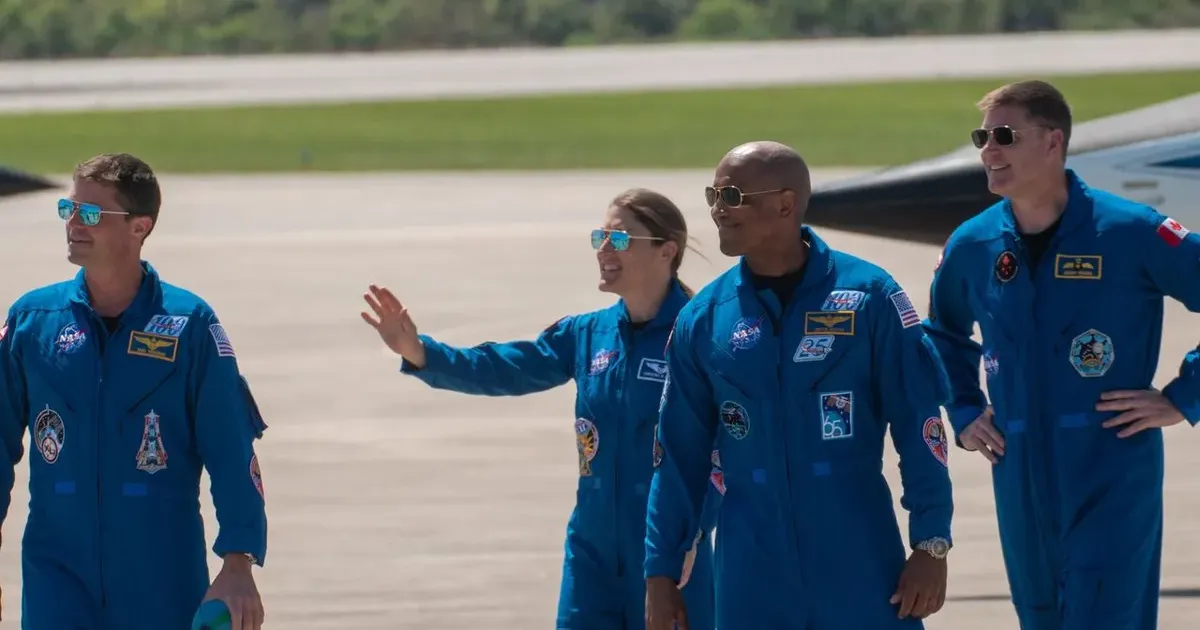
NASA officials confirmed that the Artemis II crew will proceed with their scheduled launch to the moon despite concerns over intensifying space weather. On April 1, 2026, NASA’s clearance moved Artemis II closer to its crewed lunar flyby. Engineers completed final diagnostic checks on the Space Launch System rocket at Kennedy Space Center under a cloudless Florida sky. Success for this mission would mark the first time humans have traveled beyond low Earth orbit since the Apollo program concluded in 1972. Mission managers spent several hours debating the optics of a launch but ultimately determined that technical readiness outweighed any potential for public relations confusion. Weather reports currently indicate a 80 percent probability of favorable conditions.
Radiation experts at the agency have spent years modeling the impact of solar particle events on human tissue. Solar flares represent a meaningful hazard to the four astronauts who will spend approximately ten days inside the Orion spacecraft. While modern sensors can detect flares within minutes, the energetic particles that follow can arrive at nearly the speed of light. Protective measures for the crew include repositioning the vehicle to use the service module as a shield. Recent data from the Space Weather Prediction Center suggest that an X-class solar flare is not currently expected to disrupt the flight path. Current solar cycle activity has reached a peak that requires constant monitoring from ground stations in Goldstone and Madrid.
Space Weather Threats and Radiation Shielding
Solar storms pose the single greatest environmental threat to the structural and biological integrity of the mission. High-energy protons can penetrate the aluminum hull of the Orion capsule, potentially causing radiation sickness or long-term genetic damage to the crew. Research conducted by Scientific American indicates that these events are unpredictable and can escalate within hours. NASA reduces this risk by employing a series of deep-space satellites that provide early warning of coronal mass ejections. Technicians have installed specialized polyethylene shielding in the most vulnerable areas of the crew cabin to dampen the impact of cosmic rays. Primary shielding focuses on the sleeping quarters and avionics bays.
Projections from the flight dynamics team show that the trajectory will take the crew 6,400 miles beyond the far side of the moon. This flight path exposes the spacecraft to the full force of the solar wind without the protection of the magnetosphere of Earth. Solar activity levels often fluctuate, making the timing of the launch a critical variable in mission planning. Historical records from the Apollo era show that the 1972 missions narrowly avoided one of the largest solar storms ever recorded. Modern instruments provide far better resolution and warning times than the technology available five decades ago. Monitoring stations will track the sun every second of the flight.
Crew Safety Protocols in Orion Capsule
Safety procedures inside the capsule are designed to be implemented within seconds of a radiation alert. Crew members will have to maneuver into heavily shielded zones if a major solar event occurs during the transit. Storage bays filled with food, water, and equipment serve as makeshift bunkers due to the density of the materials stored within them. Heavier objects provide better protection against high-energy particles that would otherwise pass through thin hull plating. Mission controllers in Houston have rehearsed these emergency maneuvers dozens of times in high-fidelity simulators. Specific instructions for the crew involve huddling in the lowest part of the spacecraft.
If an event is particularly bad, there are some places in the capsule, such as storage bays and down by the toilet, that the crew can go to.
Astronauts will use the mass of the life support system to absorb incoming radiation. Provisions including water tanks and waste storage units act as a physical barrier between the crew and the vacuum of space. Every pound of equipment has been strategically placed to maximize the safety of the interior volume. Spacecraft designers used modular architecture to ensure that the living area remains habitable even during extreme solar events. NASA continues to refine these protocols based on real-time data from the Artemis I uncrewed flight. Radiation sensors located throughout the cabin will provide instantaneous feedback to both the crew and ground control.
Launch Conditions and Meteorological Forecasts
Meteorologists at the Cape Canaveral Space Force Station confirmed that wind speeds and cloud cover are within acceptable limits for a safe ascent. Launch weather officer projections suggest that the morning window remains the most stable period for the Artemis II flight. Low-level wind shear was a concern earlier in the week, but those conditions have dissipated as a high-pressure system moved over the Atlantic. Space Launch System rockets require specific thermal and wind parameters to ensure the structural integrity of the solid rocket boosters. Ground crews are currently fueling the core stage with liquid hydrogen and oxygen. Flight controllers will monitor the liquid oxygen temperatures until the final seconds of the countdown.
Upper-level winds are being measured every hour using weather balloons released from the launch site. These measurements allow engineers to calculate the precise stress on the airframe as it breaks the sound barrier. Turbulence during the first two minutes of flight can cause serious vibrations that might affect sensitive guidance systems. Computer models show that the current atmospheric profile is one of the clearest seen in recent months. Recovery teams are already positioned in the Atlantic Ocean to handle any potential abort scenarios. Surface sea states near the designated abort zones are currently reported as moderate. Total visibility at the launch pad is currently ten miles.
NASA will also use the mission to test how ground teams communicate risk as conditions change close to launch.
Crew Safety Before the Moon Mission
Artemis II is not only a symbolic return toward the Moon. It is a full-system test of Orion, life support, radiation planning and crew procedures before NASA attempts a later landing mission.
That makes the clearance important but not final proof. Space weather, launch conditions and capsule performance will still determine whether the mission can proceed safely on schedule.