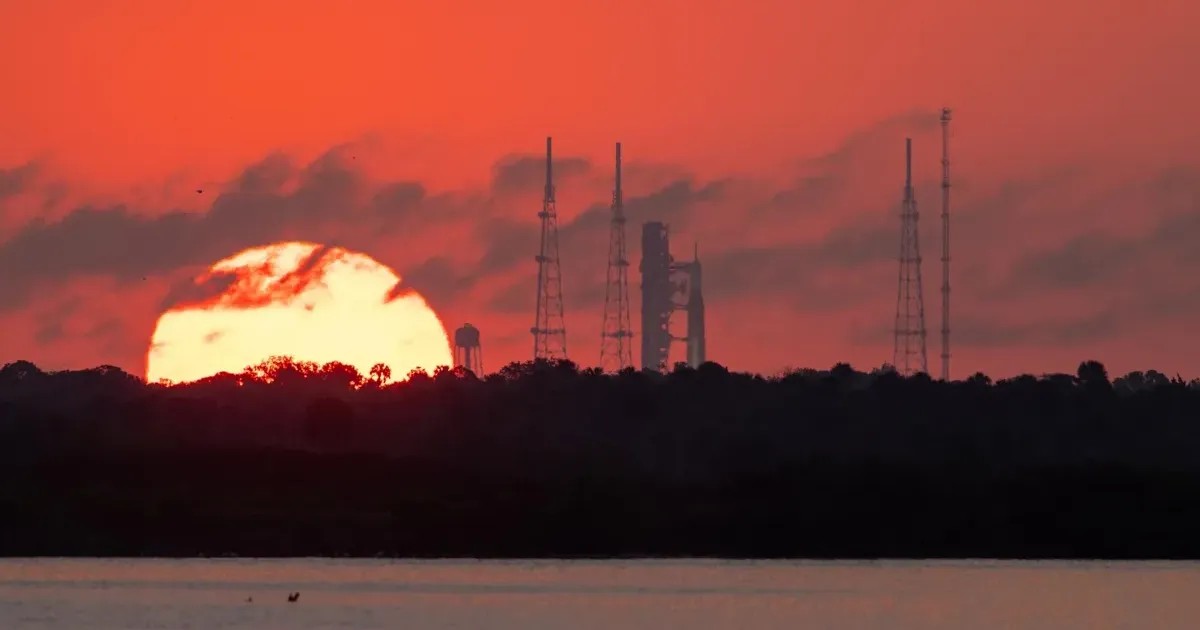
NASA officials confirmed on March 29, 2026, that the Artemis 2 crew has entered the final phase of pre-launch preparations for their journey to the lunar vicinity. Four astronauts sit atop the most powerful rocket ever built, awaiting an ignition sequence that will end a fifty-four-year hiatus of human deep-space exploration. Kennedy Space Center personnel report all systems remain nominal for the four-day countdown. Ground crews at Cape Canaveral completed the final structural inspections of the launch platform early this morning. Engineers have verified the telemetry links between the Orion spacecraft and the global deep-space network.
Propulsion systems must function without error to ensure the crew reaches the Moon. Security protocols around the launch site have been tightened as international media arrives at the Florida coast. Technicians are currently monitoring the pressurized environment inside the crew module for any trace of atmospheric leakage.
Reid Wiseman commands the mission, leading a group that breaks several demographic barriers for the American space agency and its international partners. Joining him are Victor Glover, the first person of color to fly a lunar mission, and Christina Koch, the first woman assigned to a Moon-bound flight. Jeremy Hansen, representing the Canadian Space Agency, becomes the first non-American to venture beyond low Earth orbit. National pride hinges on the structural integrity of the Orion spacecraft during its high-velocity return.
Each individual underwent thousands of hours of simulation training in Houston to prepare for the specific orbital mechanics of a lunar flyby. Physical endurance remains a critical metric as the team will inhabit a space roughly the size of a professional SUV for ten days. Mission controllers emphasize that the crew operates as a singular unit despite their diverse professional backgrounds. Training cycles focused heavily on emergency egress and manual navigation overrides. Public interest in the mission has reached levels not seen since the 1960s.
Technical difficulties during the ten-day flight will funnel directly to Eduardo García Llama at the Johnson Space Center. As the chief of engineering flight controllers for guidance and control, he oversees a team of seventy specialists in Houston. Their responsibility covers the complex maneuvers required for proximity operations and eventual docking procedures. Johnson Space Center staff remains on high alert for any deviation in the spacecraft’s trajectory. García Llama noted that the flight includes phases where communication delays make real-time intervention impossible. Guidance software must execute maneuvers with millisecond precision to avoid burning excess fuel.
Houston-based engineers have developed contingency plans for every imaginable subsystem failure. Controllers monitor the status of over one thousand individual sensors embedded in the rocket and capsule. Data streams from the Space Launch System provide a detailed map of the vehicle's health during the initial ascent.
Flight controllers anticipate two specific moments where physical risks reach their peak. García Llama noted that these events cause even the most veteran engineers to hold their breath. Direct communication with the crew remains a priority, yet the physics of lunar orbital mechanics dictates periods of inevitable silence. Success depends on the precise execution of the trans-lunar injection burn. Failure to spark the upper stage at the correct window would result in a mission abort. Sensors on the Orion heat shield must withstand temperatures exceeding five thousand degrees Fahrenheit during atmospheric reentry.
Physics dictates that any error in the angle of attack will either cause the capsule to bounce off the atmosphere or burn up entirely. Recovery teams in the Pacific Ocean are already positioning naval assets near the projected splashdown zone. Naval divers have conducted multiple rehearsals for the extraction of the four-bodied crew from the rolling surf.
NASA Artemis 2 Engineering and Safety Protocols
Space Launch System (SLS) technology is the primary lift vehicle for this venture into the deep-space environment. Engines at the base of the core stage generate nearly nine million pounds of thrust during the first two minutes of flight. Testing has confirmed that the twin solid rocket boosters provide the necessary acceleration to escape Earth's gravity well. Liquid hydrogen and liquid oxygen fuel the central core, powering four RS-25 engines salvaged from the shuttle era. Redundancy exists within the guidance computers to ensure the rocket maintains its flight path even if one unit fails.
Engineers estimate that the vibration levels during ascent will be the most intense any human has ever survived. Sensors throughout the fuselage monitor structural stress to prevent catastrophic airframe failure. Launch abort systems remain armed until the vehicle clears the upper atmosphere. This fail-safe mechanism can pull the crew capsule away from a failing booster in less than two seconds.
Orion acts as both the habitat and the escape vehicle for the four-person team throughout the mission. Solar arrays mounted on the service module provide the electrical power necessary for life support and navigation. Redundant guidance arrays allow for manual steering if the primary automated systems encounter a software glitch. Lockheed Martin engineers designed the pressure vessel to withstand impacts from micrometeoroids traveling at twenty thousand miles per hour. Oxygen levels and carbon dioxide scrubbing systems are monitored by dedicated teams in Texas. Internal cameras provide the public with high-definition views of the cabin environment and the lunar surface.
Water supplies are recycled through a sophisticated filtration system to maximize the limited storage space. Storage lockers contain specialized medical kits for treating injuries in a microgravity environment. Each astronaut has been fitted with a custom-built flight suit designed for the specific pressures of the Orion cabin.
Global Competition and Lunar Geopolitics
Beijing continues to accelerate its own lunar program, placing meaningful pressure on the American timeline for a permanent Moon base. American leadership in space is no longer an unchallenged assumption as the China National Space Administration moves toward its own crewed landings. Lunar resources, including water ice at the southern pole, represent the next frontier of territorial and economic competition. Critics highlight the huge expenditure required to maintain the Artemis program during a period of domestic fiscal constraint. Congressional funding remains tied to the successful completion of this specific flyby mission.
Private industry partners, including SpaceX and Boeing, watch the Artemis 2 launch for data that will influence their own commercial lander designs. Artemis Accords signed by dozens of nations attempt to establish a legal framework for space exploration. Geopolitical friction on Earth often spills over into the allocation of satellite orbits and lunar landing sites. Diplomacy in Washington revolves around maintaining a coalition of spacefaring nations to counter Chinese influence.
There are two moments in which we will have our hearts in our mouths.
Eduardo García Llama clarified that the most dangerous phases involve the transition between Earth and lunar gravity. Deep-space radiation remains a lingering concern for the long-term health of the four crew members. Scientists expect the mission to provide historic data on the effects of cosmic rays on human DNA outside the protection of the Van Allen belts. Shielding within the Orion capsule has been reinforced specifically to reduce this threat during solar flares. Monitoring equipment will record radiation dosage in real-time to adjust flight plans if a solar event occurs.
Communication lags of several seconds will test the autonomy of the crew as they distance themselves from Earth. History suggests that the psychological impact of seeing the entire planet as a small blue marble is deep. Researchers in Houston will study the team’s cognitive performance throughout the high-stress flight profile. Each second of the ten-day voyage is choreographed to maximize the scientific output of the mission.
Critical Flight Phases and Technical Risks
Reentry speeds will reach approximately eleven miles per second when the capsule hits the upper atmosphere. Atmospheric friction converts the vehicle’s enormous kinetic energy into heat, requiring the shield to perform without a single microscopic fracture. Success in this phase is the final hurdle before the mission can be declared a total triumph for NASA. Parachute deployment must occur at precisely the right altitude to slow the capsule for a safe water landing. Naval vessels from the San Diego harbor are currently steaming toward the recovery site.
Aerial assets will provide a constant visual of the capsule once it enters the lower atmosphere. Software logic in the descent computers manages the orientation of the vehicle to ensure the heat shield faces the direction of travel. Decision making during the final minutes rests with the onboard computers and the pilot, Victor Glover. One specific technical failure could end the mission in a matter of seconds.
Houston staff will maintain a twenty-four-hour watch on the mission control dashboard until the crew is safely aboard the recovery ship. Leadership styles within the flight control room emphasize calm under pressure and rapid data synthesis. Decisions regarding mission extensions or early returns are made through a hierarchical chain of command ending with the mission director. Real-time analysis of the propulsion systems allows engineers to predict fuel consumption with extreme accuracy. Public interest remains high as the launch window approaches its final hours.
Success here opens the door for the Artemis 3 mission, which aims to land humans on the lunar surface. Future outposts on the Moon depend entirely on the reliability of the hardware being tested next week. Mission controllers are confident but remain wary of the inherent unpredictability of the space environment. Testing has reached its conclusion and the countdown continues.
The Elite Tribune Strategic Analysis
NASA’s return to the Moon is less an act of curiosity and more a calculated scramble for territorial relevance in an increasingly crowded solar system. While the agency frames Artemis 2 as a voyage of discovery for all humanity, the underlying motivation is the preservation of American orbital hegemony against a surging Chinese space program. This mission is a legacy architecture approach that prioritizes political optics over fiscal efficiency. The Space Launch System is a multi-billion dollar Frankenstein of shuttle-era hardware that lacks the reusable innovation of private-sector competitors.
Washington continues to pour resources into a non-reusable platform while firms like SpaceX demonstrate that the future belongs to rapidly deployable, low-cost systems. By tethering the lunar program to the SLS, the government has essentially subsidized an outdated aerospace lobby at the expense of genuine technological disruption. The inclusion of diverse crew members is a necessary correction for a historical imbalance, yet it also is a potent public relations tool to mask the enormous costs of the venture.
If the United States wants to maintain its lead, it must transition from symbolic flybys to a solid, permanent infrastructure that treats the Moon as a strategic asset rather than a backdrop for high-stakes photography.