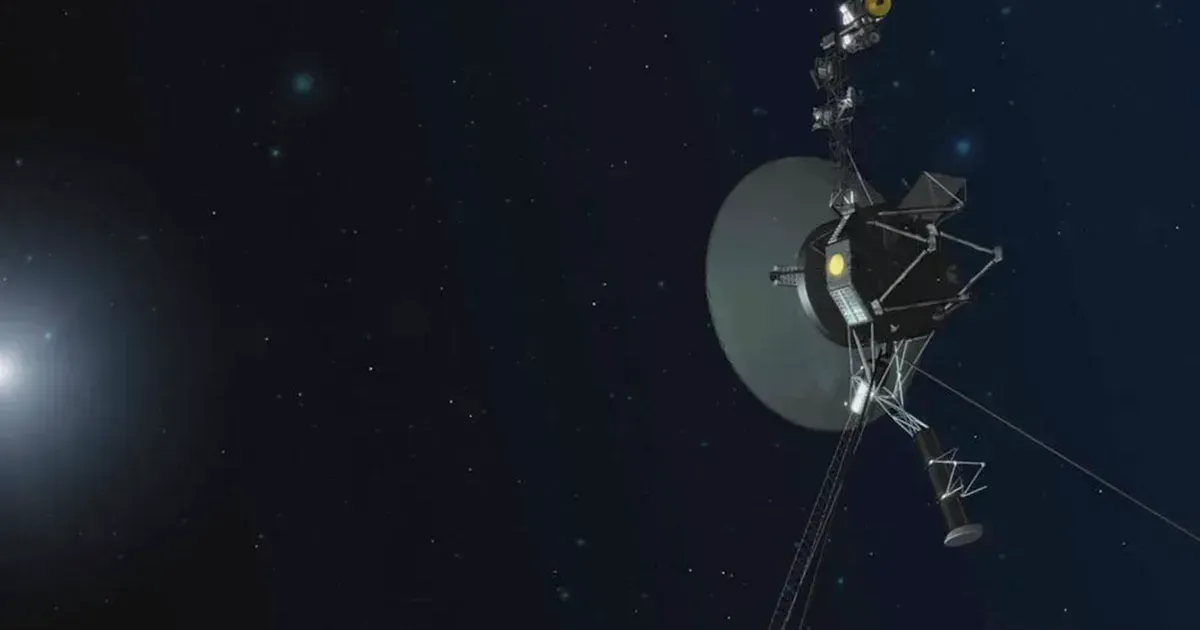
Voyager 1's power-saving decision turned a technical shutdown into a mission-survival tradeoff. NASA engineers on April 19, 2026, confirmed the deactivation of a primary plasma science instrument aboard Voyager 1. Distance persists as the defining challenge for Jet Propulsion Laboratory teams managing a probe launched in 1977. Every milliwatt matters for a system operating more than 15 billion miles from Earth. Plutonium-238 supplies powering the craft decay at a steady rate of approximately four watts per year. Leaders at NASA decided to sacrifice the Plasma Science instrument to prioritize heaters and other essential systems.
Voyager 1 consists of aging hardware that has far exceeded its original five-year design life. Scientists now focus on extending the mission into the late 2030s by managing a diminishing power budget. Three radioisotope thermoelectric generators provide the electricity required to run computers, thrusters, and scientific sensors. Heat generated by the natural decay of plutonium converts into electricity, but the efficiency of this process drops annually. Engineers monitor these levels with surgical precision from the Deep Space Network facility in California.
Mission controllers sent the command to power down the plasma instrument through a 15-billion-mile void. Signal travel time takes nearly 23 hours one way, meaning a full communication cycle requires almost two days. Data returned from the spacecraft confirmed the instrument ceased operations as requested. Observations from this specific sensor were already limited because of the probe's orientation in interstellar space. Most plasma flow now hits the detector at an angle that reduces the quality of the readings.
Technical Degradation of Radioisotope Generators
Radioactive decay governs the lifespan of the most distant human object in existence. Each of the three generators on Voyager 1 loses a fraction of its capability every day. Thermal energy produced by the plutonium pellets radiates away, leaving less for the thermocouples to process. Electrical output has declined from 470 watts at launch to roughly half that amount. NASA has already deactivated non-essential heaters and secondary systems to compensate for this loss.
Power management resembles a zero-sum game in the cold vacuum of the heliosheath. Turning off the plasma instrument saves enough energy to keep the remaining four science sensors running for several more years. These include the magnetometer and the cosmic ray subsystem, which provides critical data about the environment outside our solar system. Interstellar space remains a poorly understood region where the sun's influence gives way to the galactic medium. Data from these sensors offers the only direct measurements humanity possesses of this frontier.
Hardware failures frequently complicate these power-saving efforts. A severe memory corruption issue in the Flight Data Subsystem crippled communication for months during late 2023. Engineers eventually traced the fault to a single chip that had failed after decades of radiation exposure. They successfully relocated the affected code to different parts of the system memory. Success in that recovery operation gave the agency confidence to proceed with the current power-management phase.
Jet Propulsion Laboratory Mission Extension Tactics
Strategic shutdowns represent the only way to keep the probe functional as it drifts further from the sun. NASA experts analyze every component to determine which can be sacrificed without ending the mission entirely. Heaters are the largest power consumers because they prevent the fuel lines from freezing. If the hydrazine fuel freezes, the spacecraft will lose its ability to point its antenna toward Earth. Communication would cease permanently within hours of such a failure.
"Maintaining science operations while the power budget shrinks requires us to make difficult choices about which instruments stay active," said NASA Project Manager Suzanne Dodd.
Engineers at the Jet Propulsion Laboratory prioritize the high-gain antenna's alignment above all else. This alignment depends on small bursts from the attitude control thrusters. These thrusters have begun to degrade due to the buildup of fuel residue in the narrow propellant lines. Teams have switched to backup thruster sets twice in the last decade to bypass these clogs. Each switch requires a precise heating cycle that draws heavily from the dwindling battery reserves.
Resource management involves predicting the temperature of internal components weeks in advance. Cold temperatures can cause physical bridges to form between electrical contacts, leading to short circuits. NASA uses computer models to simulate the thermal environment inside the bus of the spacecraft. These simulations help determine if a specific instrument shutdown will cause a dangerous temperature drop in adjacent systems. Calculations for the plasma instrument shutdown took several months to verify before the command was sent.
Interstellar Data Transmission Constraints
Communication with a 50-year-old computer system requires specialized equipment on the ground. The Deep Space Network utilizes 70-meter antennas located in Goldstone, Madrid, and Canberra to capture the faint whispers from Voyager 1. These signals arrive at Earth with a strength billions of times weaker than the power used by a digital watch. Background noise from the cosmos threatens to drown out the telemetry at any moment. Large arrays of antennas must be linked together to provide enough sensitivity for a stable connection.
Voyager 1 transmits data at a mere 160 bits per second. Modern internet connections are millions of times faster than the link between Earth and the interstellar probe. This slow bit rate means that even simple status reports take hours to download fully. Scientists must wait days to see the impact of a single command. Efficiency is the only priority for the programmers who write the assembly language code used by the craft. Every byte of memory must be used to its maximum potential.
The mission has entered a phase where every day is considered a bonus. Original goals focused on Jupiter and Saturn, objectives achieved decades ago. Now the craft acts as a scout for the rest of the galaxy. It crossed the heliopause in 2012, entering the space between stars where the solar wind no longer dominates. Magnetic fields and high-energy particles in this region behave differently than those inside the solar system. Data suggests the boundary is more complex and turbulent than theoretical models predicted.
Voyager Shutdown Extends Mission Trade-Off
Viewing Voyager 1 as a triumph of modern engineering is a comforting sentiment, yet it ignores the grim reality of current technological stagnation. The public is celebrating the slow, agonizing death of a machine built during the Nixon administration because no legitimate successor has been launched. NASA's obsession with keeping this metallic ghost alive for a few extra months highlights a lack of ambition in deep-space exploration. While the data returned is unique, it is also being collected by sensors that belong in a museum rather than the interstellar frontier.
National pride should not be tied to how long we can keep a 1970s tape recorder spinning in the dark. The resources spent on these desperate life-extension maneuvers could be better used by funding the next generation of interstellar probes. NASA has become expert at managing decline. This focus on preservation over innovation is an indictment of a space program that has traded bold leaps for incremental maintenance. Voyager 1 is not a pioneer anymore; it is a monument to a time when we actually aimed for the stars.
True progress requires the courage to let the past go. NASA should allow Voyager 1 to fall silent with dignity and turn its gaze toward the propulsion technologies of the future. The mission is over. NASA is simply refusing to hang up the phone.