Humanity Rewrites the Solar System Map
NASA researchers are currently analyzing data that suggests human activity has officially altered the geography of the solar system. New findings from the Double Asteroid Redirection Test, known as DART, confirm that a deliberate spacecraft collision did not merely crater a moonlet. It physically moved a massive pair of celestial bodies into a new path around the Sun. While the initial impact focused on the smaller asteroid Dimorphos, the energy transferred was significant enough to nudge the entire binary system, including its larger partner Didymos. Detailed observations show that the kinetic force of the hit was amplified by a massive plume of debris. This ejected material acted as a thruster, pushing the asteroid even further than the spacecraft alone could manage. The resulting change in the orbital period was measurable and permanent.
Engineers at the Johns Hopkins Applied Physics Laboratory confirmed that the debris cloud doubled the total momentum of the impact. Such a revelation changes the calculus for future planetary defense. If a hazardous object were ever discovered on a collision course with Earth, the physics of ejecta would play a primary role in how much force is required to deflect it. These results prove that a relatively small kinetic impactor can achieve outsized effects through the chaotic spray of rock and dust. But the sheer scale of the shift surprised many in the scientific community who expected a localized orbital change rather than a systemic solar trajectory adjustment.
Space remains a volatile environment where even calculated moves carry heavy weight.
While DART redefined how we protect the planet, another piece of hardware is preparing for a final descent. NASA officials are tracking a 1,300-pound Van Allen Probe currently spiraling toward the atmosphere. Part of a mission launched to study the intense radiation belts surrounding Earth, the spacecraft has completed its scientific lifespan. It is now falling back to the world it once observed from a distance. Much of the titanium and aluminum structure is expected to vaporize during the high-speed transit through the upper atmosphere. Experts indicate that most components will melt under the extreme thermal loads generated by friction at orbital velocities.
Still, some dense materials might survive the heat. NASA maintains that the risk of a person being struck by any surviving fragments remains remarkably low. Re-entry trajectories are generally calculated to occur over the vast, uninhabited stretches of the Pacific Ocean. Still, the descent of a 1,300-pound satellite is logistical challenge for orbital traffic controllers. Ground-based radar systems are currently pinging the probe to refine the impact window and ensure that air traffic and maritime shipping are kept clear of the potential debris field. The agency emphasizes that this disposal method is a standard end-of-life procedure for satellites in highly elliptical orbits.
James Webb Unlocks Jovian Secrets
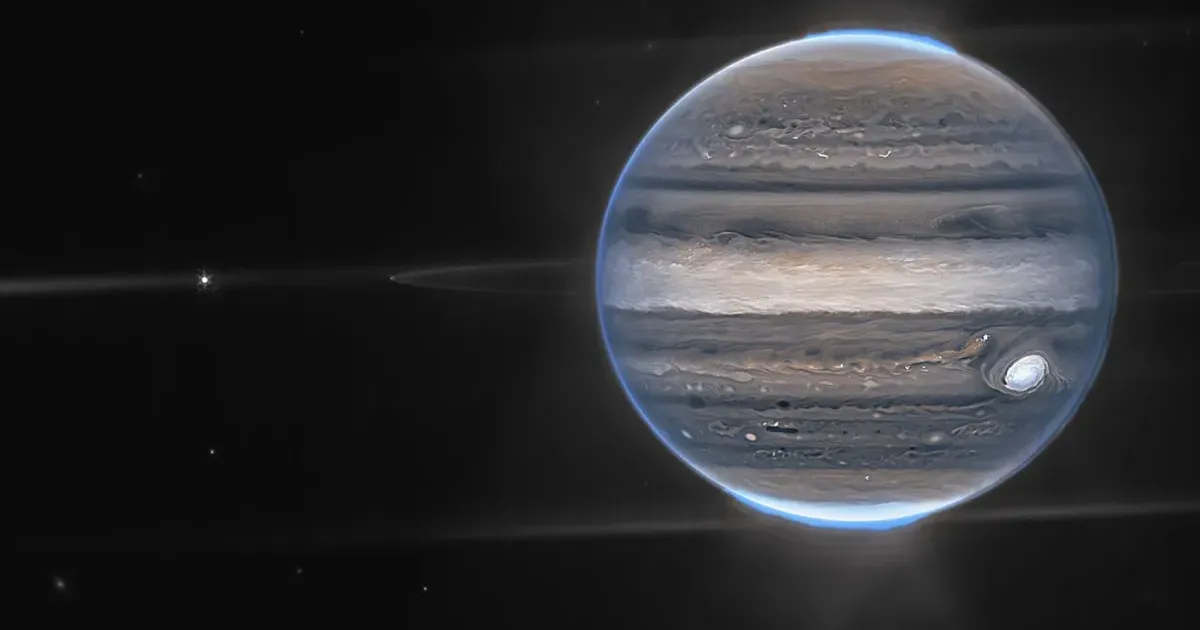
Distant giants like Jupiter are also yielding new secrets to the James Webb Space Telescope. Recent data reveals that Jupiter's moons leave cold footprints in the planet's intense auroras. These footprints were previously detected but never understood with this level of granularity. New measurements of ion density and temperature suggest that the interactions between the moons and the Jovian magnetosphere are far more complex than earlier models predicted. The moons Io, Ganymede, and Callisto essentially act as electrical conductors that channel energy into Jupiter's polar regions. This creates localized spots of cooling and increased ion density within the shimmering curtains of light that crown the planet.
Data from the telescope's infrared instruments shows that these footprints are not uniform. Each moon creates a unique signature based on its distance from the planet and its internal composition. Io, being the most volcanic body in the solar system, pumps vast amounts of sulfur and oxygen into space, which fuels a massive plasma torus. This plasma eventually funnels down the magnetic field lines, crashing into the atmosphere to create the auroral spots. Ganymede, the only moon with its own magnetic field, creates a different kind of disturbance. Scientists are finding that the magnetic interaction between Ganymede and Jupiter creates a complex series of nested auroral rings that were previously invisible to less sensitive telescopes.
Jupiter remains the ultimate laboratory for high-energy physics in our backyard.
One major discovery involves the specific temperature drops found within these moon-induced auroral spots. While the surrounding atmosphere is heated to hundreds of degrees by magnetic friction, the center of the footprints appears sharply colder. That contradiction suggests that the moons are stripping ions from certain layers of the atmosphere or perhaps shielding those layers from the broader magnetospheric heating. James Webb's ability to see in the mid-infrared spectrum allowed researchers to peer through the haze that blocked previous missions. It has fundamentally changed the way astrophysicists view the exchange of energy between a giant planet and its satellites.
Detailed mapping of these ion densities provides a window into the electrical circuit of the Jovian system. Scientists are essentially looking at a giant power plant where the moons are the batteries and the planet is the conductor. Such a system is not static. It pulses and fluctuates based on the moons' orbital positions and the solar wind. Understanding these dynamics is important for future missions like the Europa Clipper, which will have to navigate these intense radiation environments. If we can predict where the energy flows, we can better protect our electronics from the frying effects of Jupiter's magnetic fields.
Refining the Science of Orbital Mechanics
The convergence of these three narratives highlights a new era of precision in space exploration. We are no longer passive observers of the cosmos. By shifting asteroids, we have become active participants in the solar system's evolution. By tracking the decay of our own satellites, we manage the footprint of our technological expansion. And by analyzing the auroras of gas giants, we prepare for the day when human-made probes will explore the icy oceans of distant moons. Each discovery builds a bridge between theoretical physics and practical application. The DART mission, in particular, has validated the kinetic impactor theory that was once relegated to science fiction movies. Now, it is a proven tool in the planetary defense toolkit.
However, the environmental impact of space debris remains a point of contention among international space agencies. The Van Allen Probe re-entry is a controlled event, but the sheer volume of retired hardware in low Earth orbit is growing. Every re-entry that results in surviving debris adds to the complexity of global space law. Who is responsible if a piece of a probe lands on a merchant vessel? While NASA's risk assessment is mathematically sound, the increasing frequency of these events may eventually necessitate new disposal technologies. Some suggest using laser de-orbiting or space tugs to move retired satellites into graveyard orbits instead of letting them fall back to Earth.
Deep space missions like James Webb are also pushing the limits of data processing. The volume of information coming back from the Jovian system requires supercomputers to model the magnetic interactions in real-time. Each moon footprint is a data set containing millions of individual data points regarding temperature, pressure, and chemical composition. As our instruments become more sensitive, the universe appears more crowded and interconnected. The space between the planets is not a vacuum but a complex web of magnetic fields and plasma streams. managing this web requires a level of sophistication that was unimaginable just twenty years ago.
The Elite Tribune Perspective
Asking whether humanity should play billiards with asteroids remains the most urgent question of the decade. The DART mission is being hailed as a triumph of planetary defense, but we must acknowledge the terrifying implications of our own success. If we can move an asteroid out of harm's way, we can theoretically move one into it. That technology is a dual-use weapon of cosmic proportions, and the international community is nowhere near ready to regulate the redirection of celestial bodies. We are cheering for the ability to alter the solar system without a single treaty governing who gets to decide which rock goes where. The hubris required to nudge a moonlet out of its ancient path is staggering. Still, the casual dismissal of re-entering space debris as a low-risk event reflects a growing complacency in our management of the orbital commons. We treat the atmosphere as a celestial incinerator, yet we remain surprised when the math of probability eventually fails. Scientists are obsessed with the footprints moons leave on Jupiter, yet they seem blind to the permanent scars we are leaving on our own orbital environment. It is time to stop celebrating every successful impact and start questioning the long-term cost of our cosmic meddling.