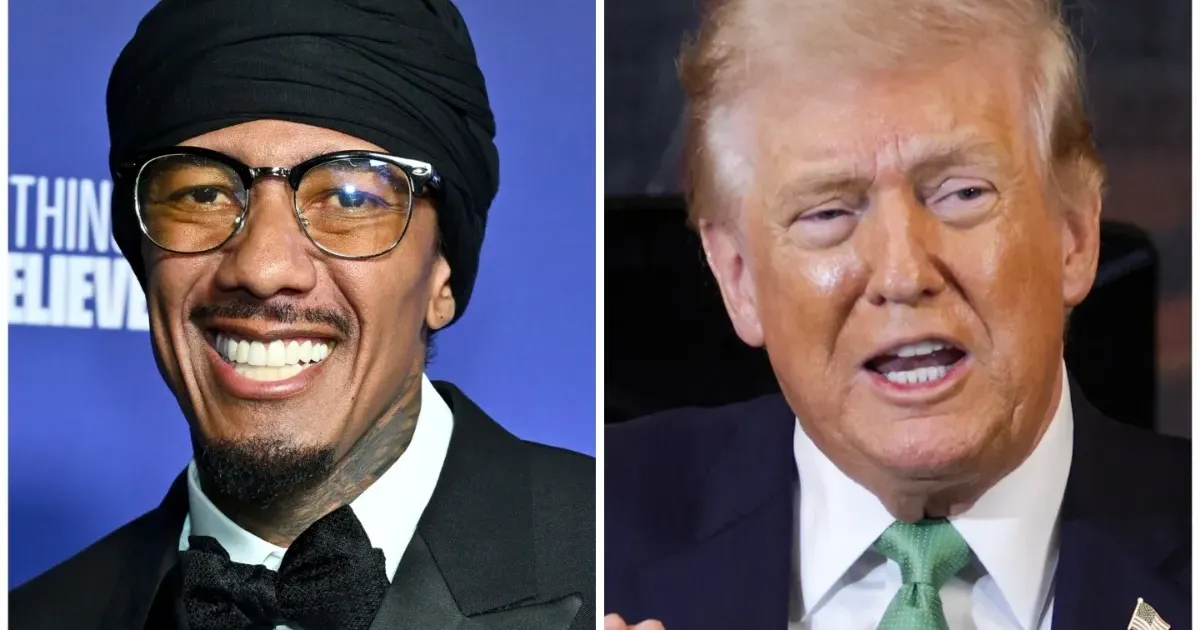
Nick Cannon declared his support for Donald Trump on March 28, 2026, during a recorded interview on his digital series, Big Drive. Sitting behind the wheel for a segment that has gained traction on social media, Cannon engaged in a blunt exchange with model Amber Rose regarding the current state of American politics. His comments included a direct condemnation of the Democratic Party, which he labeled the party of the KKK.
Conversation shifted toward partisan loyalty when Rose asserted that Democrats do not prioritize the interests of people of color. Cannon quickly signaled his agreement, extending the critique to include historical associations between the Democratic platform and the Ku Klux Klan. This rhetorical strategy mirrors arguments often used by conservative activists to detach Black voters from their traditional alignment with the left.
Democrats don’t care about people of color and the Republicans do.
Rose delivered these words with conviction, prompting Cannon to confirm his own growing preference for the Republican frontrunner. Cannon explicitly stated that he aligns with Trump, using profanity to emphasize his sincerity. His vocal endorsement marks a departure from his previous public personas, which frequently touched on social justice and systemic inequality from a different ideological vantage point.
Historical Revisionism and the Democratic Party
Cannon based his critique on the historical reality of the nineteenth and early twentieth centuries. During that period, the Democratic Party in the Southern United States was indeed the primary vehicle for segregationist policies and white supremacist organizations. Critics of the modern party frequently point to this era to argue that the organization has not truly changed its core nature. Professional historians, however, typically cite the realignment of the mid-twentieth century as a counterpoint to such claims.
Presidents Harry Truman and Lyndon B. Johnson oversaw a period where the party championed civil rights legislation. The Civil Rights Act of 1964 and the Voting Rights Act of 1965 alienated white Southern conservatives, who subsequently migrated to the Republican Party. Cannon appears to reject this narrative of a Great Realignment, choosing instead to focus on the origins of the organizations. His stance suggests a belief that historical labels carry more weight than contemporary policy shifts.
Historical records often serve as the primary ammunition for such rhetorical attacks.
Political analysts note that focusing on the Klan association targets the emotional core of the Black electorate. By framing the Democratic platform as inherently racist, Cannon attempts to invalidate decades of partisan loyalty. His rhetoric suggests that current Democratic policies are merely a modern extension of historical oppression. Such arguments have gained a foothold in digital spaces where traditional media gatekeeping is less effective.
Amber Rose Influence on Celebrity Political Shifts
Amber Rose played a central role in enabling Cannon’s public declaration. Since her appearance at the Republican National Convention, Rose has become a vocal advocate for conservative causes within the entertainment industry. Her presence on Big Drive provided a comfortable environment for Cannon to express views that might face heavier scrutiny in more traditional interview formats. Rose has consistently argued that the cultural expectations placed on Black celebrities to support Democrats are restrictive and outdated.
Her influence reflects a broader trend of alternative media personalities challenging the political status quo. Rose utilizes her sizable social media following to broadcast these shifts to a demographic that may not engage with standard political news cycles. In the Big drives episode, she acted as both a catalyst and a validator for Cannon’s assertions. The chemistry between the two entertainers created a sense of consensus that connected with their shared audience.
Celebrity endorsements often act as a permission structure for fans who harbor similar private views. When Cannon confirms Rose’s perspective, he signals to his followers that supporting a Republican candidate is socially acceptable. This dynamic bypasses policy debates in favor of cultural identification. Rose has successfully transitioned from a fashion icon to a political influencer, proving that personal brand can be a powerful tool in partisan mobilization.
Strategic Messaging in Big Drive Interview
Big Drive is a unique platform for high-level figures to share unscripted thoughts. The casual nature of the show, which features Cannon driving while conversing with guests, lowers the defensive barriers of the participants. Unlike a sit-down studio interview, the motion and environment of a vehicle encourage a more conversational and less guarded tone. Cannon leverages this intimacy to deliver his most controversial political takes.
Production choices, such as the use of multiple interior cameras and high-fidelity audio, ensure that every detail of the conversation is captured for social media distribution. Clips of the exchange were distributed via TMZ and other outlets within hours of the episode airing. This rapid spread ensures that Cannon’s message reaches millions of viewers beyond his immediate subscriber base. The viral nature of the content is a deliberate aspect of the show’s growth strategy.
Cannon's alignment with Trump is a departure from his previous political stances.
Media observers suggest that the timing of this episode is marked. As the election cycle enters a more aggressive phase, high-profile endorsements carry extra weight in shaping public perception. Cannon’s decision to air these views now suggests a desire to impact the national conversation during a critical period. The production quality of Big Drive gives his political shift a polished, professional veneer that enhances its credibility among his target demographic.
Black Conservative Movements and Election Impact
Data regarding the voting habits of Black men indicate a steady, if slow, shift toward the right. Recent polls suggest that younger Black voters are more likely to express openness to Republican candidates than their parents or grandparents. Cannon belongs to a generation of entertainers who see themselves as independent thinkers who are not beholden to any single party. His rhetoric taps into a growing frustration with the perceived lack of progress under Democratic leadership in urban centers.
Republican strategists have increased their outreach efforts to this specific demographic. By emphasizing entrepreneurship, school choice, and criminal justice reform, the party seeks to create a new coalition. Trump frequently cites the First Step Act and funding for Historically Black Colleges and Universities as proof of his commitment. Cannon’s endorsement provides a cultural bridge that policy papers alone cannot achieve.
Economic concerns often dominate these political shifts. Many voters in Cannon’s circle prioritize wealth creation and deregulation, areas where Republican platforms typically align with the interests of high-net-worth individuals. Cannon has built a sizable business empire, and his political views may reflect a desire for a more favorable tax and regulatory environment. The intersection of celebrity wealth and conservative politics is becoming increasingly common in the modern era.
The Elite Tribune Strategic Analysis
Why should the public care about the political musings of a television host and a model behind the wheel of a luxury car? The answer lies in the total collapse of traditional political gatekeeping and the rise of the influencer-industrial complex. Nick Cannon is not just a celebrity; he is a media conglomerate who understands that controversy is the only reliable currency in the digital age. By labeling the Democratic Party as the party of the KKK, he is not conducting a history lesson. He is performing a surgical strike on the branding of the left.
Critics will argue that Cannon is ignoring the modern realities of the Republican platform, but that critique misses the point of his performance. It is not a debate about policy or legislative records. It is a debate about identity and the right to deviate from expected cultural scripts. Cannon is betting that his audience values rebellion against the establishment more than they value consistency or historical accuracy. He is positioning himself as a truth-teller at a time where facts are secondary to vibes.
Establishment Democrats ignore this shift at their own peril. When figures like Cannon and Rose align themselves with Trump, they make it permissible for their millions of followers to do the same. It is not a fringe movement; it is a calculated repositioning of the Black celebrity elite who are finding more common ground with the populist right than the progressive left. The era of the monolithic Black voting block is ending, and Nick Cannon is driving the getaway car.