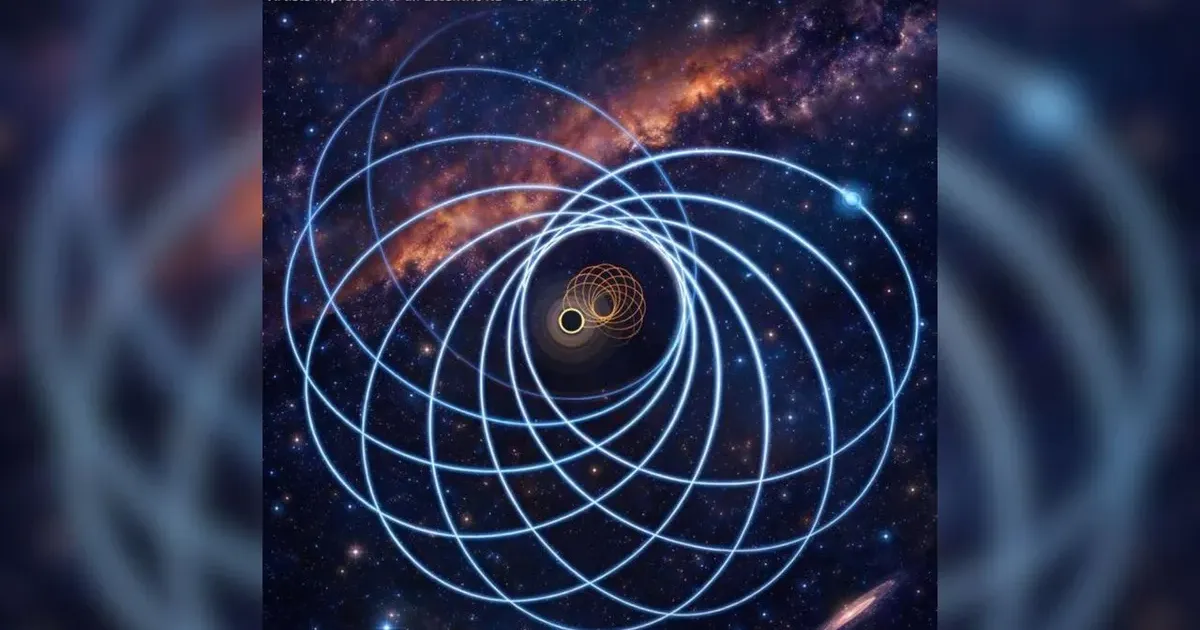
Evidence of oval orbits in compact-object mergers is forcing astrophysicists to rethink how black holes, neutron stars and gravitational waves fit together.
Cosmic Ripples Reveal Unexpected Stellar Choreography
Deep within the data streams of gravitational wave observatories, a strange signature has emerged that threatens to rewrite the textbooks on stellar evolution. Researchers spent decades assuming that when a black hole and a neutron star finally met, they did so in a predictable, circular spiral. New analysis of these celestial heavyweights suggests they were actually locked in an oval orbit just moments before they vanished into one another. Such eccentricity contradicts every major simulation of binary systems previously accepted by the scientific community. The report was published March 11, 2026, as the issue drew renewed attention. Gravity waves recorded by global sensors last year have finally yielded their most disruptive secret. Most theoretical models predicted that tidal forces would smooth out any orbital irregularities long before the final merger. Calculations simply did not account for such extreme paths. Instead, the universe appears far more chaotic than the sterile math of the 20th century suggested. While Live Science reports that these ripples could upend a major theory about extreme pairs, Phys.org sources highlight that this is the first strong evidence of non-circular crashing. Instruments across the LIGO, Virgo, and KAGRA collaborations captured the event, which sent shivers through the astrophysical community. Mergers of this magnitude produce literal distortions in the fabric of space-time. Usually, these signals hum with a steady, increasing frequency known as a chirp. But this specific signal possessed a jagged quality. It wobbled. That wobble indicates an orbit stretched into an ellipse, a shape that requires a completely different set of initial conditions to form. The math doesn't add up for traditional binary evolution.
Rethinking How Monsters Are Born
Binary systems usually form from two massive stars that lived and died together. Over millions of years, their orbits should circularize due to the constant drain of energy through gravitational radiation. Seeing an oval orbit at the moment of impact suggests these two objects did not grow up together. Rather, they likely met in the crowded, frantic environment of a dense star cluster. One object likely captured the other in a gravitational snare, forcing a frantic, eccentric dance that ended almost as soon as it began.
Researchers at several leading astrophysics labs now believe the discovery forces a total re-evaluation of how many black holes are wandering the universe. If these captures are more common than binary evolution, our census of the cosmos is fundamentally flawed. Astronomers traditionally looked for pairs that looked like the ones we already knew. Now, they must look for the outliers. Such a shift in focus could lead to the discovery of hidden populations of stellar-mass black holes that have previously gone undetected because they don't fit the expected mold.
Success in this field often depends on the precision of the templates used to scan data. For years, these templates were tuned exclusively for circular paths. Once the team applied new, eccentric models to the archived data, the oval pattern leaped out. It was hiding in plain sight. This discovery suggests that dozens of other recorded events might be misclassified.
Re-analyzing the last decade of gravitational wave data has now become a top priority for international teams. The universe is more chaotic than we dared to admit.
Einstein's general relativity predicted the existence of these waves, but even he might have been surprised by the messy reality of 2026 findings. Detecting an eccentric orbit requires sharply more computational power than tracking a circle. Every deviation from a perfect sphere adds layers of complexity to the waveform. High-resolution imagery and simulation data from Live Science show that the neutron star was likely stretched and distorted by the black hole's gravity in ways that a circular orbit would never allow. This stretching creates a secondary signal, a sort of gravitational echo, that provided the definitive proof of the oval path.
Astrophysicists are now debating what this means for the internal structure of neutron stars. If an oval orbit allows for different tidal interactions, we might finally be able to peek inside these ultra-dense husks of dead suns. Some believe the neutron star may have been partially torn apart before the final plunge, a process called tidal disruption. If true, the debris from that destruction would emit a flash of light that telescopes could see. Yet, in this case, the event remained dark, suggesting the black hole swallowed the neutron star whole, despite the erratic approach.
Current consensus among the research teams suggests that 2026 will be remembered as the year the circular dogma died. But some skeptics remain. A few researchers argue that the signal distortion could be an artifact of the detectors themselves. These critics point out that the KAGRA facility in Japan has faced calibration challenges in the past. Still, the fact that the same oval signature appeared in three independent data sets makes the detection nearly impossible to dismiss.
Nature rarely adheres to our desire for symmetry.
Why Messy Orbits Matter
Scientists often fall in love with the elegance of their own equations. For decades, the astrophysical establishment clung to the circular orbit model because it was mathematically convenient, not because it was the only possibility. This latest revelation about oval-shaped mergers is an indictment of a scientific culture that prioritizes tidy models over messy realities. We have spent billions on gravitational wave detectors only to filter out any data that didn't fit our preconceived notions of how a merger should look.