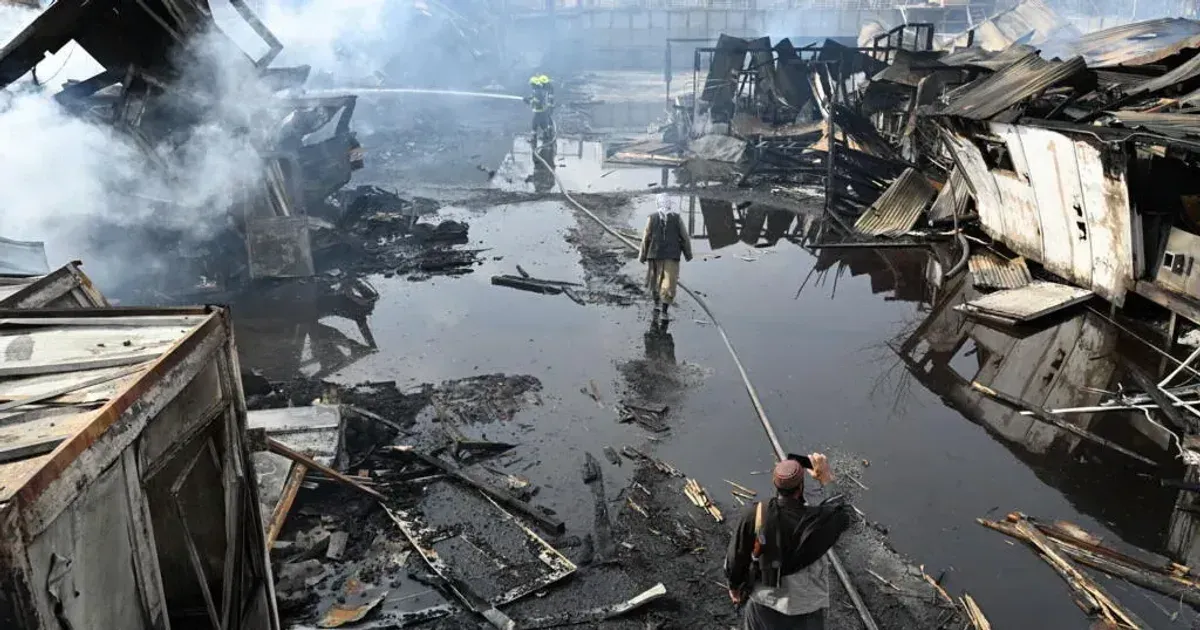
Kabul residents woke to the smell of cordite and scorched earth on Tuesday morning after a Pakistani air strike leveled a drug rehabilitation center. Reports from the Taliban government indicate that at least 400 people were killed in the late-night bombardment of the treatment facility. Islamabad officials immediately rejected these casualty figures, asserting their aircraft only targeted specific military infrastructure used by insurgent groups. Smoke continued to rise from the rubble hours after the last jet departed Afghan airspace.
Recovery efforts began in the early hours as local volunteers dug through concrete slabs with their bare hands. Kabul emergency services struggled to manage the volume of wounded victims arriving at overstretched local hospitals. According to France 24, the strike left more than 250 people wounded, many with life-altering injuries. Medical staff described the scene at the rehab center as reminiscent of doomsday. Blood soaked the dust of the courtyard where dozens of stretchers waited for transport.
Witnesses at the site watched as rescue workers carried more than 30 bodies out on stretchers in just one hour. The facility, which housed hundreds of patients seeking treatment for opioid addiction, now exists only as a skeleton of twisted rebar and ash. While Bloomberg and other outlets have monitored the rising tensions between the two nations, the scale of this specific loss of life is a notable escalation in cross-border hostilities. Search teams found personal belongings, including prayer beads and medical records, scattered among the craters.
Rescue Operations at Kabul Treatment Facility
Emergency crews focused their attention on the central dormitory where most of the victims were sleeping when the missiles struck. Survivors described a series of massive explosions that collapsed the roof within seconds. In fact, the intensity of the heat from the blast fused metal components of the building together. Many of the dead remained trapped under several tons of debris as heavy machinery was unavailable to assist the recovery teams. Taliban health officials confirmed that the majority of those killed were patients undergoing a mandatory detoxification program. These individuals were often confined to the facility during the initial stages of their recovery, making escape impossible during the air strike. Meanwhile, families gathered at the perimeter of the cordoned area, shouting the names of missing relatives into the smoke. Identification of the remains has proven difficult due to the severity of the fire that followed the impact.
The devastation is total, with the facility reduced to a smoldering ruin where hundreds of vulnerable people were seeking help.
Separately, the BBC reported seeing dozens of bodies being removed from the site as the morning sun broke through the haze. Local residents told reporters that the drug rehabilitation center was well-known in the neighborhood and had no visible military presence. But the Pakistani Ministry of Foreign Affairs issued a statement claiming the site served as a hideout for the Tehrik-i-Taliban Pakistan. No evidence of weaponry or military equipment has been produced by the investigators on the ground.
Pakistan Military Strategy and Border Tensions
Islamabad launched its military operation against Afghanistan last month after accusing the Kabul government of providing sanctuary to extremist groups. This offensive has seen a sharp increase in drone strikes and conventional aerial sorties across the border regions. Pakistani generals argued that these measures are necessary to curb the flow of militants into their territory. Still, the targeting of a civilian health facility in the heart of the capital suggests a shift toward more aggressive tactics. Military analysts in the region noted that the flight paths used by the jets indicate they originated from bases in the Punjab province.
Government spokespeople in Pakistan insisted that their intelligence identified the rehabilitation center as a command-and-control node. They claimed that high-level targets were present at the location at the time of the strike. Yet, the high number of civilian casualties has drawn immediate condemnation from international human rights organizations. For one, the use of heavy ordnance in a densely populated urban area frequently leads to such collateral damage. Satellite imagery from the previous week showed only transport vans and civilian vehicles at the site.
Islamabad maintains that the site was a command-and-control node for the TTP. Border skirmishes between the two countries have increased in frequency over the last six months. Both sides have deployed additional heavy weaponry to the Durand Line, the porous boundary that has long been a source of friction. In turn, the Taliban administration has threatened to retaliate for the strike, though their air defense capabilities remain limited. The current conflict stems from disagreements over border security and the management of militant groups that operate in the mountainous terrain between the two nations.
Regional Reactions to Afghan Casualty Reports
News of the 400 deaths spread quickly through Kabul, sparking protests in several districts near the blast site. Demonstrators burned flags and called for an end to Pakistani interference in Afghan domestic affairs. At the same time, the Taliban Ministry of Foreign Affairs summoned the Pakistani charge d’affaires to lodge a formal protest. They demanded an immediate apology and compensation for the families of the victims. Islamabad has yet to respond to these specific demands, maintaining that the operation was a matter of national security.
Al Jazeera reported that families are still searching the ruins for any sign of their loved ones. Some survivors were found in the basement levels, protected by reinforced concrete, but their numbers are small. In particular, the psychiatric wing of the center took a direct hit from a precision-guided munition. Witnesses reported that the sound of the jets was audible for several minutes before the first explosion occurred. Local mosques have begun organizing mass funerals for those identified so far. Geopolitical tensions in South Asia have spiked as neighboring countries monitor the situation for signs of broader instability. For instance, the Iranian government expressed concern over the escalation and urged both sides to show restraint. By contrast, the Pakistani military appears committed to continuing its campaign until it achieves its stated objective of neutralizing border threats. The death toll from this single strike surpasses the total number of civilian casualties from all other cross-border incidents this year combined.
Civilian Casualty Claims Demand More Than Denial
The casualty claim now demands verification, humanitarian access and evidence strong enough to withstand propaganda from both sides. Pakistan cannot answer a report of hundreds dead at a treatment facility with a bare assertion that the target was military. If the site truly housed a command node, Islamabad must show more than language. If it cannot, the strike will be remembered as a massacre wrapped in counterterrorism vocabulary.
The Taliban also has every incentive to maximize outrage, which is why independent access matters. But uncertainty is not a shield against responsibility. A rehabilitation center full of confined patients is one of the worst possible places for a disputed air strike. The moral burden now sits with the force that dropped the bombs. Regional politics will harden around the images from Kabul long before any formal investigation catches up.