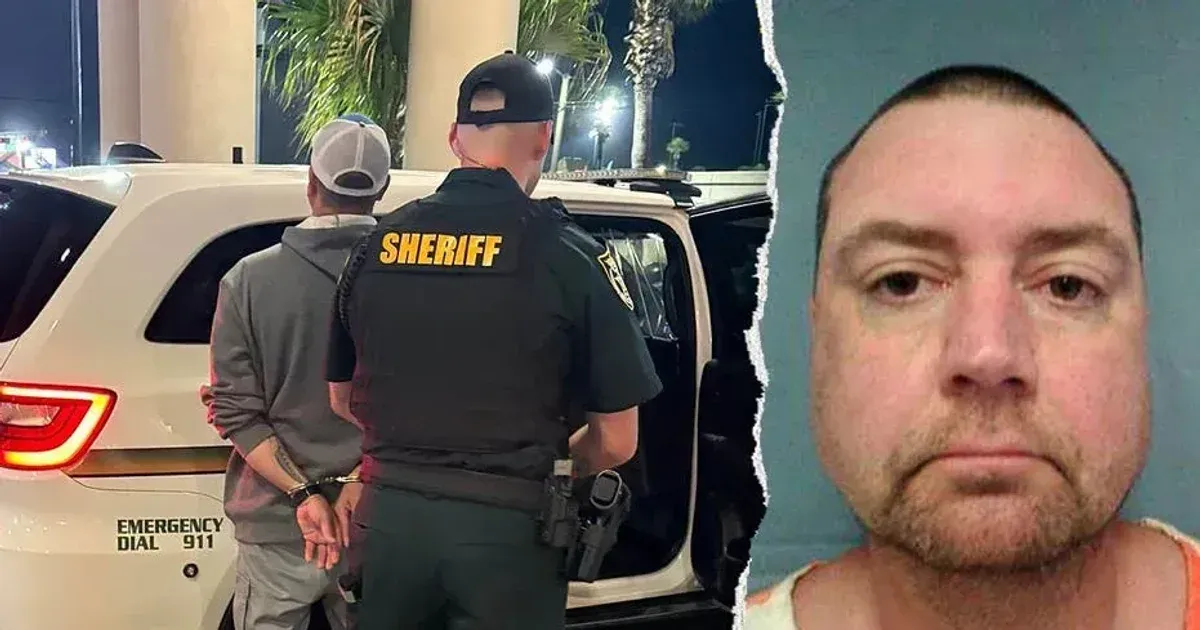
Christopher Gillum sat in an Okaloosa County jail cell on April 24, 2026, after investigators linked the former North Carolina police officer to a planned mass shooting in New Orleans. Florida law enforcement officials apprehended the 45-year-old suspect at a hotel in Destin following a multi-state alert regarding his intent to target a music festival. Christopher Gillum, who previously was a sworn officer in Chapel Hill, now faces charges related to terroristic threats and the possession of weapons intended for a mass casualty event.
Okaloosa County Sheriff’s Office deputies initiated surveillance on Gillum on Wednesday evening after receiving intelligence from North Carolina authorities. He had checked into a hotel along the Emerald Coast, where officers eventually moved in to make the arrest at approximately 6:40 p.m. Search teams discovered a handgun and approximately 200 rounds of ammunition inside his hotel room. Investigators believe the cache was intended for use against attendees at a major cultural gathering in Louisiana.
Florida Surveillance and Hotel Room Evidence
Detection of the threat began when family members in North Carolina reported Gillum missing on Tuesday. Relatives informed the Burlington Police Department that the former officer had a history of self-harm and had explicitly expressed a desire to harm Black people. This information triggered an immediate bulletin across Southern law enforcement networks. Okaloosa County deputies actually encountered Gillum earlier on Wednesday during a routine stop but lacked the legal grounds to detain him at that moment.
Evidence gathered by the Okaloosa County Sheriff’s Office suggests Gillum was in the final stages of preparation. The recovery of 200 rounds of ammunition alongside a concealable firearm indicates a level of intent that moved beyond verbal threats. Florida authorities maintained a visual on the suspect while Louisiana officials finalized a warrant for terroristic threats. Once the warrant appeared in the national database, the tactical team moved to secure the suspect without further incident.
North Carolina Police History and Mental Health Alerts
Gillum possessed a background that makes the allegations particularly striking to his former colleagues. Records indicate he was a distinguished member of the Orange County Sheriff’s Office in North Carolina, even earning the title of Officer of the Month in June 2025. His transition from a celebrated public servant to a suspected domestic terrorist occurred over a period marked by mental health struggles. Family members stated they tried to intervene before his departure from the state. The FBI New Orleans field office is actively involved in preventing mass violence at regional public events.
Lieutenant Clint Lyons of the Alamance County Sheriff’s Office noted that Gillum fled North Carolina before an involuntary commitment could be executed. State law requires specific criteria for the seizure of an individual for mental health evaluation, and Gillum moved across state lines before local deputies could satisfy those requirements. His status as a former officer likely provided him with technical knowledge regarding police response times and surveillance techniques. The Orange County Sheriff’s Office has not yet released his full personnel file to the public.
Failed Interventions and New Orleans Festival Security
Law enforcement officials in Florida faced a complex legal situation during their initial contact with Gillum on Wednesday morning. Because no active warrant existed at that hour, and the suspect did not meet the criteria for an emergency psychological hold under Florida law, he was allowed to proceed to his hotel. Coordination between the Louisiana State Police and the FBI eventually provided the necessary legal leverage for the evening arrest. The delay highlights the friction between preemptive public safety and individual civil liberties.
New Orleans is currently hosting the New Orleans Jazz & Heritage Festival, an event that draws hundreds of thousands of visitors to the Fair Grounds Race Course. While authorities have not named a specific target, the timing of Gillum’s travel and the nature of his threats align with the festival’s schedule. Louisiana State Police have increased their visible presence at the venue while maintaining that no active threats persist against the public. Security cordons at the festival entrance now include enhanced screening for firearms and explosive materials.
"Louisiana State Police said there are no known direct threats to any festivals in the state."
Legal Charges and Extradition Proceedings
Prosecutors in Louisiana are preparing to charge Gillum with making terroristic threats, a felony that carries substantial prison time. The suspect remains in Florida pending a formal extradition hearing, which usually occurs within 30 days unless the defendant waives his right to contest the transfer. Louisiana Governor’s Office representatives confirmed they are working with Florida Governor Ron DeSantis to speed up the process. Legal experts suggest the presence of 200 rounds of ammunition will be a central piece of evidence in proving the "intent" element of the crime.
Federal agencies may also intervene if the investigation uncovers evidence of a hate crime under US statutes. Because Gillum reportedly targeted a specific racial group, the Department of Justice could file additional charges that carry mandatory minimum sentences. Investigators are currently scrubbing his digital footprint and social media accounts to determine if he acted alone or was part of a wider extremist network. The FBI's New Orleans field office is leading the forensic analysis of his mobile devices found in the hotel room.
Public Safety Case
The failure to intercept Christopher Gillum before he reached Florida reveals a catastrophic gap in the American psychiatric and judicial systems. We are looking at a man who was literally a poster child for law enforcement just ten months ago, yet the very institutions he served were powerless to stop his cross-country trek toward a potential massacre. This case dismantles the comfortable myth that police officers are inherently the "good guys with guns" who act as the final defense against chaos. Instead, the training and prestige afforded to Gillum likely were a cloak, allowing him to evade scrutiny longer than a civilian would have.
North Carolina authorities knew he was a danger, yet the rigid adherence to involuntary commitment timelines allowed a radicalized, armed individual to drive through three states. The legal threshold for detention continues to prioritize the theoretical rights of the potentially violent over the actual lives of those at Jazz Fest. If a decorated ex-cop can vanish with 200 rounds and a racial vendetta, the current surveillance states are failing their most basic utility. We must stop treating law enforcement background as a character reference and start viewing it as a high-risk factor for specialized violence. New Orleans escaped a bloodbath by the narrowest of bureaucratic margins.