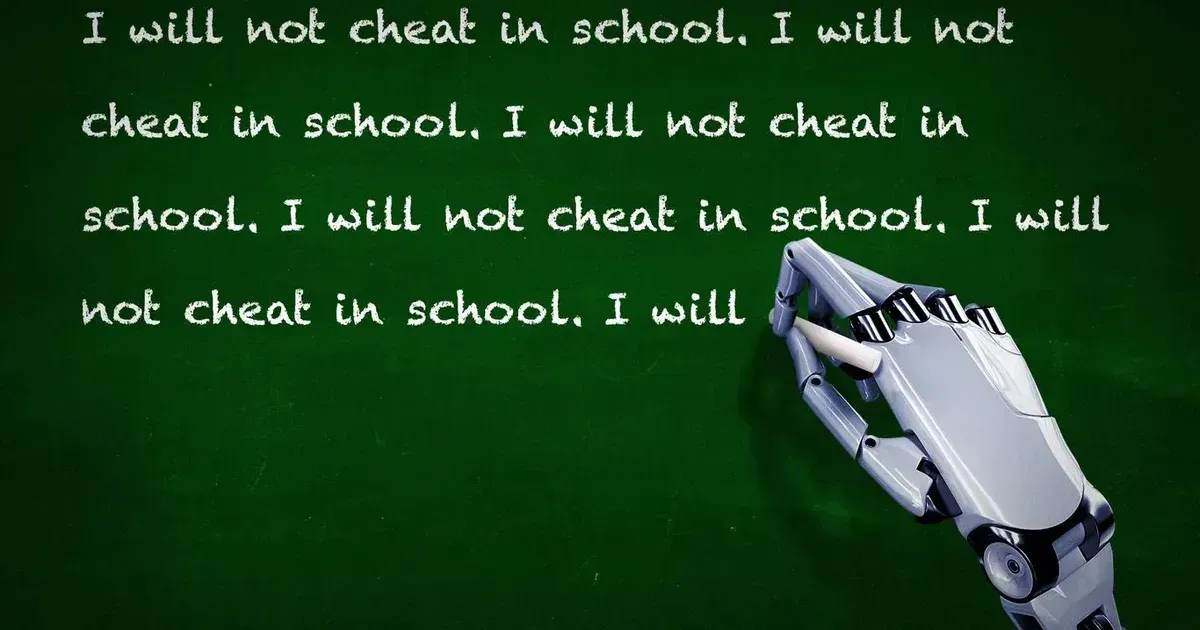
Students at University of California, Davis find themselves clutching ballpoint pens instead of keyboards this spring. Lecture halls that once hummed with the quiet clatter of MacBooks now echo with the rhythmic scratching of ink on pulp paper. This shift marks a return to the classic blue exam booklet, a staple of twentieth-century education that many thought had been permanently retired by the digital revolution. Professors are reviving pen-and-paper exams because generative AI has made take-home writing harder to verify. Professors are increasingly viewing these analog tools as the only foolproof method to ensure student work remains their own. Digital tools offered by OpenAI and other tech giants have complicated the traditional essay assignment. Since the public release of ChatGPT in 2022, the barrier between a student's own thoughts and an algorithm's generated text has effectively vanished. Paper remains the only firewall against the instant generation of a philosophy essay.
Blue Books Return to Lecture Halls
Dan Melzer, a professor at the University of California, Davis, observes that the siege of generative technology has left faculty with few options. Traditional take-home essays are now vulnerable to complex prompts that can mimic a freshman's tone or a senior's analytical depth. The blue book requires an immediate, physical performance of knowledge that no wearable device or hidden window can easily replicate. Faculty members argue that seeing the physical evolution of a sentence provides a level of certainty that digital submissions lack. Critics of the revival argue that forcing students back to the pen is akin to demanding they use stone tablets. One particularly vocal detractor mocked the move by asking why colleges do not simply issue chisels and hammers to students. Such a return to the past ignores the way modern professional environments function. Employers rarely demand handwritten memos in the modern office. The reliance on handwritten testing creates a serious divide between academic evaluation and career preparation. While universities focus on preventing automated assistance, the private sector is investing over $10 billion annually into integrating these very tools. Students who spend their college years mastering the art of the timed long-form essay may find themselves ill-equipped for a workforce that prizes prompt engineering and rapid digital synthesis.
Accessibility and Fairness Complicate the Shift
Hand-written exams introduce a host of logistical and ethical hurdles that digital platforms had previously solved. Multilingual writers often find the pressure of timed, physical writing to be an unfair burden compared to their native-English peers. Performing the physical act of writing quickly can also be a barrier for students with motor disabilities or chronic conditions like carpal tunnel syndrome. Digital exams allowed for screen readers, spell-check, and adjustable fonts that leveled the playing field for many. Deciphering poor penmanship has become a primary complaint for teaching assistants and professors alike. Steven Krause, a professor at Eastern Michigan University, notes that grading hundreds of handwritten booklets is a physical and mental strain. Poor handwriting can lead to lower grades not because the content is lacking, but because the grader simply cannot read the argument. The subjective nature of evaluating messy ink blots complicates the goal of fair assessment.
Writing is naturally an iterative process involving drafting, editing, and restructuring. Timed blue book sessions force a one-shot approach that values speed and memory over the actual craft of writing. The ability to vomit facts onto a page in fifty minutes is a poor proxy for the ability to construct a persuasive, researched argument. Educators worry they are no longer grading skills, but rather the ability to perform under particular, outdated constraints.
AI Detection Remains Unreliable
Resistance to technology often manifests as a retreat into the tactile. Some experts believe the panic over widespread academic dishonesty is overblown. Krause, who reviews roughly 1,500 pages of student work every semester, maintains that the human element of teaching remains the best defense. Experienced educators can typically spot the stylistic inconsistencies of a machine-generated paper without the need for specialized software. AI writing just sounds off.
Most students who turn to automated tools do so out of desperation rather than a desire to deceive for the sake of it. Krause suggests that those who rely on generative text are often already failing or struggling sharply with the course material. For instance, a student who has not attended a single lecture will struggle to prompt a machine to produce a layered critique of particular classroom discussions. Detection relies on the relationship between the teacher and the learner.
A growing industry of "humanizers" is working to make detection even more difficult. Startups now offer tools designed to inject human-like errors and varied sentence structures into AI outputs to bypass standard filters. This realization is what drives many departments back to the simplicity of the blue book. Universities must eventually decide whether their role is to police students or to prepare them. The current friction between analog testing and digital reality suggests a lack of consensus on what a college degree should represent. Some institutions are choosing to lean into the technology by teaching students how to cite and verify AI-generated data. Others view any use of the technology as a fundamental violation of academic integrity.
Modern classrooms are increasingly asynchronous, with more than half of all students taking at least one course online. Forcing these students onto a physical campus for a pen-and-paper exam is often impractical and expensive. Large lecture halls with hundreds of students make proctoring such exams a logistical nightmare for faculty. At the same time, the cost of printing and processing physical booklets adds a layer of administrative overhead that digital portals had eliminated.
Educational policy will likely continue to swing between these two extremes as the technology matures. Even as some professors cling to the blue book, the pressure from the job market to produce tech-fluent graduates will grow. The future of the university depends on finding a middle ground that maintains rigor without regressing into obsolescence.
Assessment Needs a Better Middle Ground
Academic traditionalists are now losing a war they refuse to acknowledge by retreating into the safety of the blue book. This obsession with "pure" handwritten thought is a performance of integrity that serves the ego of the institution more than the needs of the student. By stripping away the tools of the modern age during the most critical moments of evaluation, universities are effectively certifying that a graduate can function in 1950. It is a regressive tax on the time and potential of a generation that will never be asked to write a long-form essay by hand again after graduation.
Skepticism toward automation is healthy, but the current reaction feels more like a Luddite tantrum than a serious pedagogical shift. If a professor's curriculum is so easily mimicked by a chatbot, the fault lies not with the software, but with a stale approach to instruction. We should be demanding assignments that require local context, personal experience, and complex synthesis that machines cannot yet reach. Instead, we are asking students to prove their intelligence by how fast they can move a pen across a page. It is a pathetic standard for an era defined by the largest technological leap in a century.