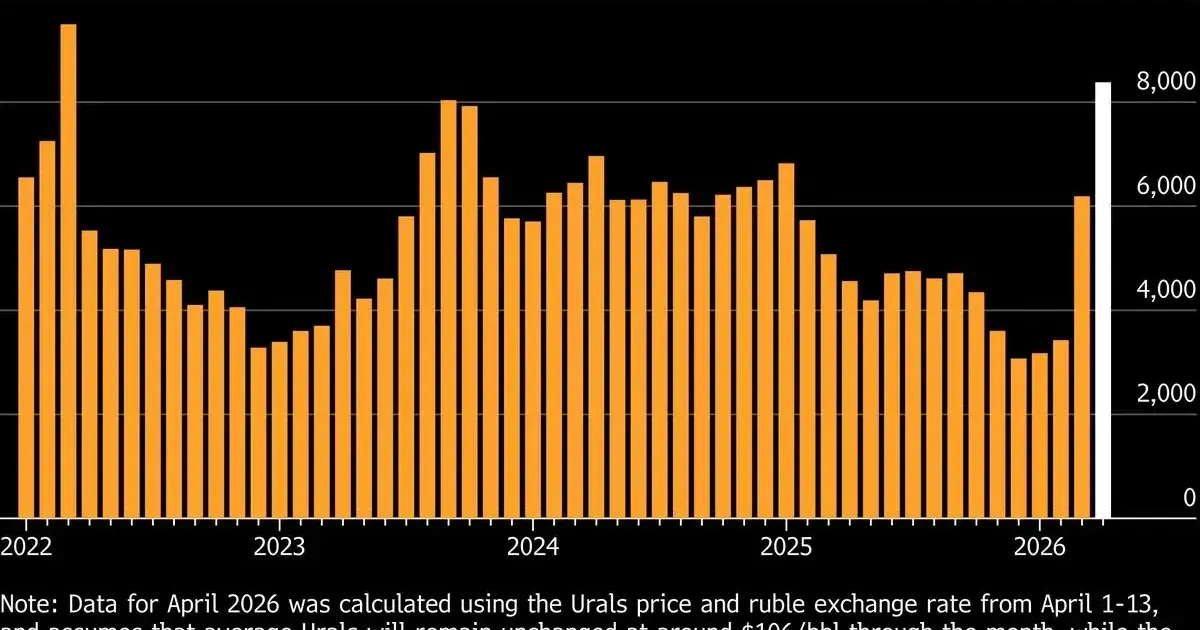
Russia’s oil windfall is colliding with labor shortages, sanctions and borrowing costs that energy revenue alone cannot repair. Vladimir Putin on April 22, 2026, received internal assessments showing that surging global energy prices are failing to reverse a deepening contraction in the Russian Federation’s industrial core. While oil prices climbed toward $100 per barrel due to sustained volatility in the Middle East, the revenue influx has hit a wall of domestic structural failures. Bloomberg Economics reports that Moscow’s wartime economy is currently teetering on the edge of a technical recession despite the nominal increases in petrodollar liquidity. Production capacity remains bottlenecked by a severe lack of qualified personnel and the high cost of black-market technology imports.
Energy markets typically provide a lifeline for the Kremlin during periods of geopolitical friction. Rising tensions across the Persian Gulf have traditionally acted as a catalyst for Russian fiscal expansion, yet the current cycle differs because of Western-led price caps and shipping restrictions. Moscow must now sell its Urals grade at serious discounts to Asian buyers to circumvent primary sanctions. Logistics costs for the so-called shadow fleet have tripled over the last twelve months. Higher insurance premiums for aging tankers further erode the net profit margins of state-owned enterprises like Rosneft.
Middle East Conflict Boosts Russian Oil Prices
Violence in the Levant and the Red Sea has removed millions of barrels from the daily global supply chain. Traders responded by pushing benchmarks higher, providing a theoretical windfall for major exporters. Vladimir Putin relies on these funds to finance the ongoing military operations in Ukraine and to subsidize a growing domestic security apparatus. Reports indicate that federal tax receipts from energy increased by 14 percent in the first quarter. Despite this surge, the purchasing power of these rubles is declining rapidly against the Chinese yuan and the Indian rupee.
Economic growth that is fueled by the production of tanks and artillery shells creates a statistical illusion of health while ignoring the depletion of the nation’s capital stock, according to Bloomberg Economics analysts.
Inflation in the consumer sector continues to outpace official government projections. Food prices in major urban centers like Moscow and Saint Petersburg rose by 9.2 percent in March alone. Central Bank officials have struggled to contain the volatility despite repeated interventions in the currency markets. The state’s insistence on fixed exchange rates for essential imports has created a growing parallel market. Importers often pay a 20 percent premium to secure the hard currency necessary for electronics and medical supplies.
Central Bank Tightening Limits Domestic Expansion
Elvira Nabiullina, head of the Central Bank of Russia, has maintained a hawkish stance to prevent a total collapse of the ruble. Interest rates were held at 16 percent during the most recent policy meeting, a level that makes private-sector borrowing nearly impossible. Small and medium-sized enterprises find themselves unable to refinance existing debt or invest in new equipment. Corporate bankruptcies in the retail sector jumped by 12 percent compared to the previous year. Most available credit is now diverted toward state-directed defense projects under government guarantees. The recent surge in global energy prices reflects broader market volatility driven by the regional unrest.
Monetary policy alone cannot solve the underlying lack of labor participation. Over 800,000 workers have left the country or joined the military since 2022. Factories specializing in civilian goods like textiles and appliances are operating at 40 percent capacity because they cannot compete with military wages. Wage-push inflation is now a permanent feature of the Russian labor market. Competitiveness in the non-energy export sector has vanished as a direct result of these imbalances.
Defense Spending Crowds Out Private-sector Investment
Federal budget allocations for defense and national security now exceed 10 percent of the nation’s gross domestic product. This large injection of capital into the military-industrial complex creates a lopsided growth pattern where shell production rises while housing starts crater. Construction firms report a 30 percent shortage of skilled masons and engineers. Public infrastructure projects including bridge repairs and hospital expansions have been deferred indefinitely to prioritize the manufacturing of ballistic missiles. The Ministry of Finance reported a budget deficit of 1.5 trillion rubles in early April.
Sanctions have successfully cut off the Russian banking system from the global financial architecture known as SWIFT. Cross-border payments with Turkey and the United Arab Emirates have become increasingly erratic as local banks fear secondary sanctions from the United States Treasury. Transaction fees for moving money out of the country now reach as high as 7 percent. Wealthy individuals have accelerated their efforts to move assets into physical gold or localized real estate. Domestic investment into research and development has fallen to its lowest level in two decades.
Demographics and Labor Crises Halt Industrial Growth
Population decline has accelerated as a byproduct of both wartime casualties and the mass exodus of the tech-savvy middle class. Projections from the Ministry of Labor suggest a shortfall of 2.5 million workers by the end of the decade. Companies are being forced to automate processes using substandard domestic software because they lack access to Western alternatives. Productivity per worker decreased by 1.8 percent across the manufacturing sector last year. Many automated assembly lines in the automotive industry remain idle due to a lack of specialized microchips.
Regional governors have voiced concerns about the sustainability of current social spending. Pension obligations are rising even as the tax base shrinks in provinces far from the oil-rich Arctic. Federal transfers to these regions have become increasingly conditional on recruitment quotas for the military. Public dissatisfaction with rising utility costs has sparked small-scale protests in several industrial cities. Police forces have increased their presence in working-class neighborhoods to prevent these grievances from combining into a broader movement.
Oil Revenue Tests Russian Weakness
Believing that high oil prices can save the Kremlin from its own structural rot is a delusion held only by those who ignore the mechanics of modern industrial failure. Vladimir Putin has traded the long-term technological viability of his nation for a short-term surge in military output that produces zero civilian value. While the GDP figures might show a modest expansion, it is a hollow growth consisting of objects that are immediately destroyed on the battlefield. A tank does not transport goods, nor does a missile provide a service; they are the ultimate sinkholes for national wealth.
The era of the energy-backed autocracy is hitting a ceiling of diminishing returns. Even with Brent crude trading at a premium, the Russian economy cannot transform those dollars into the complex components required for a modern civilization. The Central Bank of Russia is essentially managing a funeral for the private sector while Elvira Nabiullina attempts to keep the currency from a vertical drop. Moscow is cannibalizing its future to maintain a stalemate in the present. This trajectory leads not to a renewed empire, but to a primitive, high-tax commodity colony. The destination is stagnant ruin.