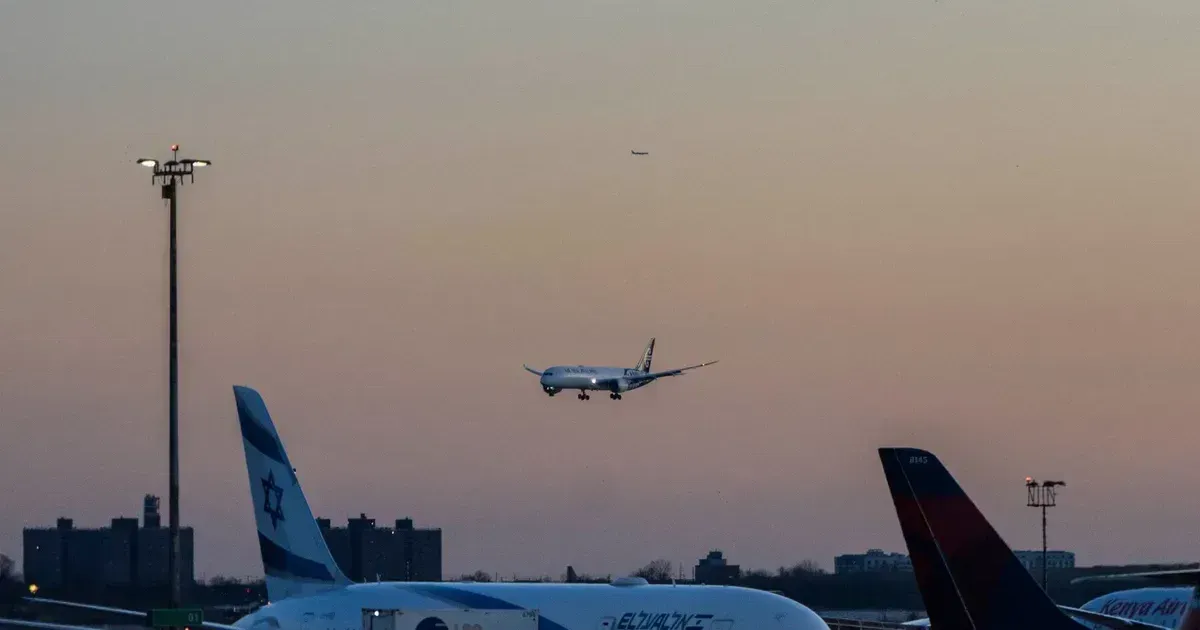
A Republic Airways jet’s deviation toward an Air Canada regional aircraft at JFK puts parallel approaches, cockpit workload and airport traffic density under federal scrutiny. Federal investigators initiated a probe on April 22, 2026, into a close call between two passenger jets that occurred at New York’s John F. Kennedy International Airport. This investigation centers on a breakdown in separation between two regional aircraft attempting to navigate one of the busiest air corridors in the United States. Pilots operating Republic Airways Flight 4464 were forced to abort their landing sequence after deviating from their assigned path. This move placed them in immediate proximity to another arriving vessel.
Flight 4464, which operates as part of the American Eagle network, was scheduled for a routine arrival. Data retrieved from the Federal Aviation Administration suggests the Embraer regional jet missed its intended approach path. Deviation from these strictly defined aerial corridors often forces immediate corrective action to prevent collisions. Pilots commonly refer to this maneuver as a go-around. During this climb, the Republic Airways jet drifted toward a parallel runway where Jazz Aviation Flight 554 was already established for its final descent.
Jazz Aviation operates regional services for Air Canada. Cockpit data indicates that Flight 554 was cleared to land and was maintaining its assigned glide slope when the other aircraft intruded upon its safety buffer. Traffic Collision Avoidance System (TCAS) alerts activated in both cockpits. These onboard electronic safeguards provide vertical guidance to pilots when they detect an imminent risk of collision. Crew members must follow these instructions immediately, often overriding air traffic control commands to ensure separation.
“The crew of Republic Airways Flight 4464 performed a go-around at John F Kennedy International Airport after missing the intended approach path and flying too close to Jazz Aviation Flight 554, which was cleared to land on a parallel runway. Both flight crews responded to onboard alerts,” the FAA said in a statement.
Proximity measurements are now the primary focus for the National Transportation Safety Board and federal regulators. Early reports indicate the two planes flew much closer than the standard separation requirements allow. While the FAA has not yet released the minimum distance between the two fuselages, similar incidents at John F. Kennedy International Airport have involved distances of less than 700 feet. Safety protocols at major hubs rely on precise timing that leaves little margin for navigational errors.
JFK Flight Path Deviations and Cockpit Alerts
Radar records show Flight 4464 was attempting to land when the sequence failed. Missing an approach path can happen for several reasons, including sudden wind shear, mechanical issues, or pilot disorientation. The FAA investigation will examine the specific meteorological conditions at the time of the incident. Clear skies were reported, which shifts the focus toward human factors or technical malfunctions within the flight management system. Precision is a requirement at JFK due to the volume of heavy international traffic.
Republic Airways pilots initiated the climb to reset their approach. Standard procedures dictate that a go-around should follow a predetermined track to avoid traffic on adjacent runways. Flight 4464 failed to hold this track. Aviation experts suggest that the stress of a sudden landing abort can lead to task saturation in the cockpit. If one pilot is focused on aircraft configuration while the other manages communication, navigational drift can occur rapidly.
Onboard alerts likely prevented a catastrophe. Modern TCAS II systems coordinate between the two aircraft, telling one pilot to climb while instructing the other to descend. This automated resolution happens in seconds. Jazz Aviation pilots would have seen a visual warning on their primary flight displays while an audible voice commanded a specific maneuver. Both crews successfully followed these commands. They eventually landed their respective aircraft without further incident. This recent JFK near miss has sparked intense political debate regarding the future of air traffic management technology.
Air Traffic Control and JFK Operations
Controllers at New York’s primary international gateway manage hundreds of arrivals daily. Their role involves maintaining a delicate balance between aircraft on crossing and parallel runways. When Flight 4464 missed its path, the burden of safety shifted from the tower to the cockpit automation. Investigation of the audio logs will reveal if controllers issued an immediate warning or if the TCAS system acted first. Every second of delay in high-density airspace increases the risk of a metal-on-metal event.
Operational complexity at JFK remains a persistent challenge for regional carriers. Republic Airways and Jazz Aviation often fly smaller jets that are more susceptible to the wake turbulence of larger Boeing 777 or Airbus A350 aircraft. If Flight 4464 encountered the heavy air wash of a preceding wide-body jet, it could have struggled to maintain its flight path. Federal regulators are looking into the spacing between the regional jets and the larger planes that landed just before them. Wake turbulence is a known factor in many landing incidents.
Safety margins are being squeezed by a desire for higher throughput. Major airports seek to maximize landings per hour to reduce delays. The environment places immense pressure on flight crews to execute perfect approaches every time. When a pilot realizes a landing is not stabilized, they are trained to go around, but the exit must be as precise as the entry. The failure to maintain lateral separation during an abort suggests a breakdown in basic airmanship.
Systemic Pressures on Regional Aviation
Regional airlines are the backbone of US domestic travel. Companies like Republic Airways and Jazz Aviation provide the essential feeder traffic that fuels the hubs of major carriers like American Airlines and Air Canada. However, these regional operators have faced persistent challenges involving pilot experience and retention over the last five years. Senior captains are frequently recruited by mainline carriers, leaving regional cockpits with less experienced crews. The churn creates a continuous training cycle that can impact operational consistency.
Fatigue also plays a role in the safety equation. Regional pilots often fly more segments per day than their mainline counterparts. Flying five or six short-haul hops into congested environments like New York or Chicago increases the cognitive load on the crew. The FAA will review the duty schedules of the pilots involved in the JFK incident to determine if exhaustion contributed to the missed approach path. Human performance is rarely perfect under conditions of repetitive high-stakes stress.
Industry data shows a troubling rise in near-miss incidents across the US aviation system. The JFK event is the second such close call at a major airport in just a few days. Frequent occurrences suggest that the layers of safety redundancy are being tested more often than in previous decades. While the technology to prevent collisions has improved, the volume of traffic has grown to a point where any single error can cascade into a crisis. The aviation community is now debating whether the current infrastructure can handle planned growth.
Precision is not optional in the New York terminal area. Thousands of lives depend on the invisible lines drawn in the sky by air traffic controllers. When those lines are crossed, the margin for error disappears. The investigation into Republic Airways Flight 4464 and Jazz Aviation Flight 554 will take months to complete. Investigators will analyze every button press and radio call. They will look for the root cause of why a professional crew missed a landing path at one of the most monitored airports in the world.
JFK Near Miss Tests Runway Safety Margins
Does the flying public realize how often they are saved by a computer voice shouting "CLIMB" in a cockpit? The recent near-miss at JFK is not an isolated anomaly but a symptom of a system operating at its absolute breaking point. We have built an aviation infrastructure that prioritizes volume and efficiency over the steady safety buffers that used to define the industry. The FAA can launch all the investigations it wants, but the core issue is the relentless overcrowding of our terminal airspace. We are treating our skies like a game of Tetris, hoping the pieces always fit perfectly at the last second.
Relying on the Traffic Collision Avoidance System to prevent a tragedy is like relying on a car's airbags to compensate for a driver who is blindfolded. Automation is a safety net, not a license to operate with reckless density. That this is the second major close call in a matter of days should be causing a national panic. Instead, it is treated as a routine bureaucratic inquiry. The regional airline model is particularly vulnerable, as it operates on the thinnest margins with the highest operational tempo. We are asking regional pilots to perform flawlessly in the most complex environments while the system around them grows increasingly chaotic. If we do not reduce the density of traffic at major hubs, a collision is inevitable. Technology has delayed the disaster, but it cannot permanently outpace human error in an overcrowded sky. End the obsession with throughput before the cost is measured in lives.