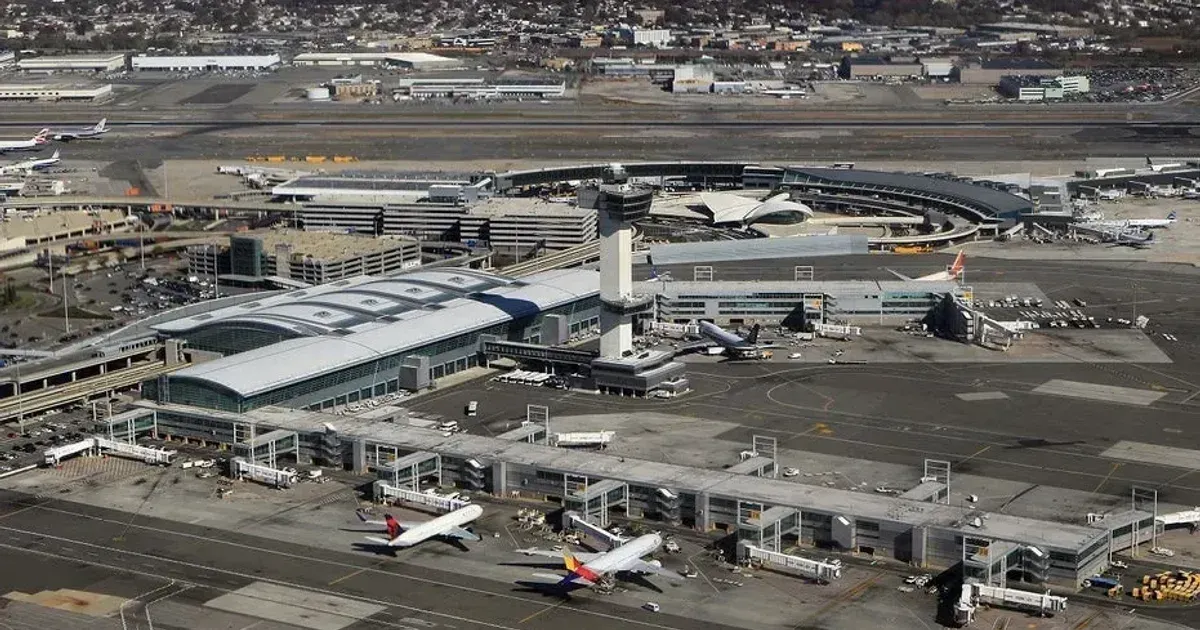
A near-collision at JFK has sharpened scrutiny of controller shortages and Sean Duffy’s rejection of fully automated airspace management. Transportation Secretary Sean Duffy confirmed on April 22, 2026, that federal authorities have launched a formal inquiry into a near-collision involving two passenger jets at John F. Kennedy International Airport. Investigators are focusing on the coordination between local controllers and the cockpit crews of Republic Airways Flight 4464 and Air Canada Express Flight 8554. Preliminary data indicates the two aircraft drifted into dangerous proximity during their simultaneous arrival sequences on Monday afternoon. Pilots on both planes reportedly received immediate cockpit warnings as their flight paths converged near the runway threshold. Records from the Federal Aviation Administration show the incident occurred at approximately 2:35 p.m. local time.
Republic Airways Flight 4464, operating under the American Airlines banner, abandoned its approach after drifting away from its assigned path. Simultaneously, Air Canada Express Flight 8554 was continuing its descent toward a parallel runway. Automated systems triggered a Resolution Advisory, which is a high-priority command from the Traffic Collision Avoidance System requiring immediate pilot action. Cockpit crews from Republic Airways executed a standard go-around maneuver to gain altitude and clear the immediate airspace. Air Canada officials confirmed their pilots also received a traffic warning and followed specific directions from ground control to maintain separation. No injuries were reported among the passengers or crew members on either flight.
John F. Kennedy International Airport Collision Risk
Safe operation at John F. Kennedy International Airport relies on precise vertical and lateral separation between aircraft landing on closely spaced parallel runways. Monday's incident involved a Republic Airways Embraer 175 and an Air Canada Express Bombardier CRJ-900. These regional jets frequently populate the short-haul corridors connecting New York to major hubs like Toronto. Because the Federal Aviation Administration mandates specific spacing intervals, any deviation from a glide slope creates an immediate risk for intersecting traffic. Republic Airways management stated the crew complied with all onboard advisories and safely repositioned for a subsequent landing attempt. Air Canada Express crews reported they took immediate action to resolve the conflict upon receiving the automated alert.
Go-around procedures are routine safety drills where pilots abort a landing to climb back into the sky for another attempt. Flight 4464 pilots initiated this climb while Air Canada Express Flight 8554 remained on its descent path. Ground radar captured the moment the two symbols on the controller screens flashed yellow, indicating a breach of standard separation minimums. Terminal Radar Approach controls (TRACON) specialists intervened to provide heading corrections to both aircraft. The Federal Aviation Administration is now reviewing audio recordings and digital flight data to determine if human error or technical lag contributed to the proximity. Safety investigators are examining the specific atmospheric conditions at the time of the event.
Federal Aviation Administration Investigates Parallel Approaches
Air Canada Express Flight 8554 landed safely shortly after the encounter ended. Despite the safe outcome, the narrow margin of error has intensified calls for a review of parallel runway operations at New York airports. Republic Airways emphasized that their pilots are trained extensively for these high-stress resolution scenarios. Aviation safety experts point to the increasing density of regional flight schedules as a primary driver of these close-call events. Modern cockpit technology provides a final layer of defense, yet the Federal Aviation Administration maintains that human controllers remain the ultimate authority in busy terminal environments. Detailed reports from the National Transportation Safety Board usually take months to finalize after such incursions.
Multiple recent close calls at major U.S. hubs have forced the Department of Transportation to address systemic weaknesses. Previous incidents at San Francisco and Austin featured similar patterns of converging flight paths. Sean Duffy has faced repeated inquiries from lawmakers regarding the reliability of the aging air traffic control infrastructure. Budgetary constraints and a persistent shortage of certified controllers have slowed the rollout of modernized tracking systems. These technical gaps often leave pilots reliant on legacy radar systems that may not update quickly enough for rapid-response maneuvers. Current staffing levels at New York TRACON are below the recommended capacity for peak travel periods.
Sean Duffy Rejects Automated Airspace Management
Secretary Sean Duffy addressed the potential for artificial intelligence to manage these complex traffic patterns during a recent briefing. He dismissed the notion that software could soon replace the human element in the control tower. Public concern over automation has grown as commercial AI applications enter other sectors of the economy. Duffy framed the issue as one of ultimate accountability and instinctive decision-making. He asserted that the chaos of a busy terminal environment requires a level of judgment that algorithms currently lack. These comments come as several tech firms lobby for increased AI integration in federal aviation systems.
"Am I gonna replace a controller and have AI manage the airspace? The answer to that is hell no, that's not gonna happen," Transportation Secretary Sean Duffy said.
Aviation labor unions have praised the Secretary's hardline stance against total automation. Air traffic controllers frequently cite the unpredictable nature of weather and pilot communications as variables that code cannot fully replicate. Secretary Sean Duffy noted that while digital tools can assist in monitoring, they could not assume command of the national airspace. Instead, the department plans to focus on upgrading existing radar hardware and hiring more human personnel. Industry groups suggest that AI could be used for predictive maintenance or scheduling but should never handle active separation. Safety remains manual labor.
Technological Integration and Human Oversight Constraints
Modernization efforts at the Federal Aviation Administration have focused on the NextGen program for over a decade. This initiative utilizes satellite-based tracking to replace ground-based radar systems. While John F. Kennedy International Airport has received several hardware updates, the integration of advanced software remains incomplete. Secretary Sean Duffy argues that the $11 billion invested in these upgrades must prioritize human-in-the-loop systems. Some analysts at Reuters suggest that full automation could reduce delays by 20 percent, but Duffy insists the safety trade-off is too high. Air Canada Express and Republic Airways continue to rely on human pilots to interpret Resolution Advisories.
Control towers are not server farms. Pilots and controllers form a verbal contract that ensures every movement is documented and confirmed. When a computer issues a resolution advisory, it acts as a failsafe, not a primary navigator. Monday's near miss at John F. Kennedy International Airport demonstrates the necessity of this dual-layered approach. Had the AI-driven TCAS not fired, the human controllers might have had seconds less to react. By contrast, had the pilots not had the training to execute the go-around, the automated warning would have been useless. The Federal Aviation Administration investigation will likely focus on why the separation was lost in the first place.
JFK Near Miss Tests Aviation Automation
Aviation safety relies on the illusion of absolute control, yet the recent near-miss at JFK exposes a crumbling foundation. Sean Duffy may win political points by rejecting AI, but his "hell no" stance ignores the reality that human error remains the primary cause of runway incursions. The Federal Aviation Administration is trapped between a legacy of manual oversight and the inevitable pressure of a digital future. Choosing to prioritize human controllers while failing to fix the chronic staffing shortage is a recipe for catastrophe.
If the department refuses to automate, it must find a way to make the human element more resilient. Stubbornly clinging to 20th-century labor models in a 21st-century sky is not a strategy; it is a delay tactic.
Can a human controller really process five simultaneous emergencies better than a machine? Duffy's rejection of AI management treats safety as a binary choice between man and machine, ignoring the potential for a hybrid system that offloads cognitive stress. The Republic Airways incident shows that humans are already secondary to the machines when the alerts start screaming. Controllers were reacting to the planes, not the other way around. By the time a human speaks, the computer has already calculated the escape route.
Future air travel will eventually demand the very automation Duffy currently scorns to handle the sheer volume of drone and air-taxi traffic. The Secretary's position may hold for 2026, but it will be rendered obsolete by the end of the decade as the Federal Aviation Administration budget continues to hemorrhage funds into old systems. Resistance to AI integration will soon be seen as a liability rather than a safeguard. Safety remains human.