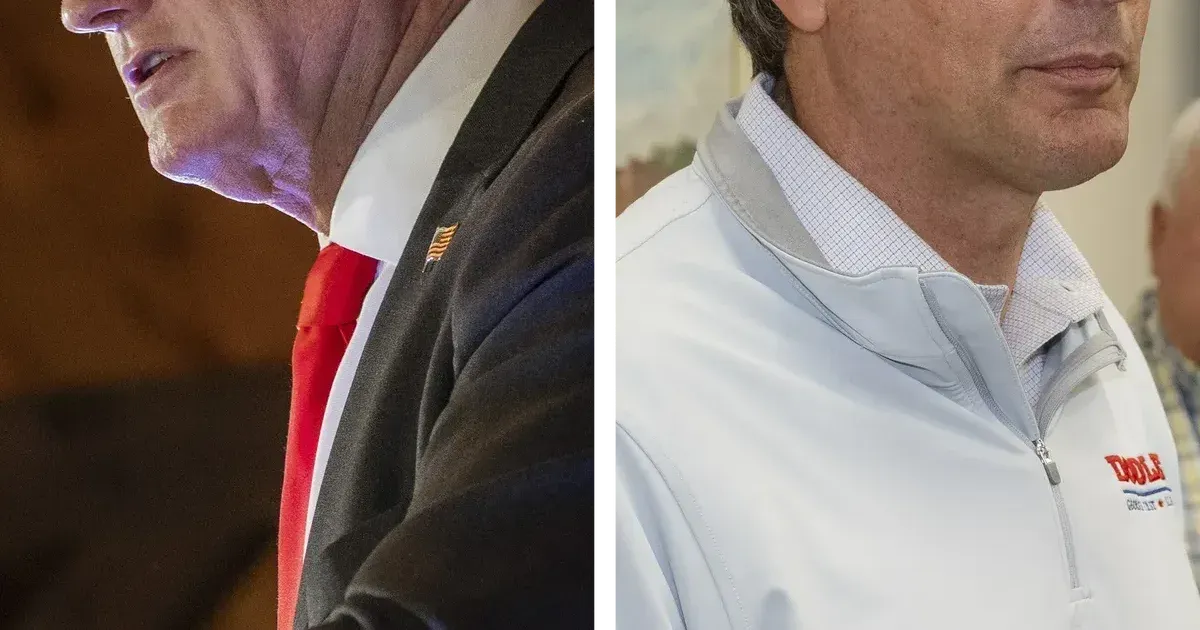
Donald Trump continues to exert serious pressure on the Republican primary landscape as candidates in Georgia and South Carolina struggle to consolidate support before the 2026 general election. The primaries give Trump a test of influence in states where his brand remains powerful but not automatic. Local candidate quality still matters. The latest developments exposed a more complicated endorsement environment than party leaders expected. The political dynamics in these southern strongholds shifted on June 7, 2026, when polling data and campaign developments suggested that a formal nod from Mar-a-Lago may no longer guarantee a quick victory. Both states serve as high-stakes laboratories for the president's ability to dictate party direction.
Georgia Republicans are currently locked in a tense Senate runoff to determine who will challenge the Democratic incumbent, Jon Ossoff. Representative Mike Collins and Derek Dooley, a former football coach, are the two finalists remaining in a field that has yet to see a definitive endorsement from Trump. The absence of a formal pick has left the two campaigns in a state of tactical competition, with each candidate attempting to mirror the president's populist rhetoric to secure his base. Collins relies on his congressional record to prove his conservative bona fides, while Dooley emphasizes his outsider status as a tool for institutional disruption.
Neither candidate has been able to pull away in the polls, suggesting that the primary electorate is waiting for a signal that has yet to arrive. The national Republican apparatus is watching the Georgia race closely, as Ossoff is widely considered one of the most vulnerable Democrats in the upcoming cycle. Republicans believe that a unified party is necessary to reclaim the seat, but the lack of an endorsement keeps the donor class and grassroots activists divided between the two contenders.
South Carolina presents a different challenge to the conventional wisdom regarding executive endorsements. In the race for governor, Republican candidates spent months engaging in public displays of loyalty to secure Trump's backing. This competition ended when Trump formally selected Lieutenant Governor Pamela Evette as his preferred candidate. The decision was expected to clear the field and streamline the path to the nomination, but recent voter data indicates that the endorsement has not produced the expected surge in support.
Voters in the state appear to be prioritizing individual candidate platforms and local issues alongside the preference of the president. Evette has struggled to expand her lead beyond a narrow margin, forcing her campaign to spend more on television advertising and ground operations than initially projected. Opponents of Evette have stayed in the race, banking on the idea that the Republican base is increasingly comfortable making independent choices when the endorsed candidate does not align perfectly with their specific regional priorities.
Political analysts suggest the South Carolina race is a metric for the diminishing returns of high-profile endorsements when they encounter established local rivals. Every candidate in the field remains vocally supportive of the broader MAGA platform, which creates a scenario where the endorsement itself becomes a secondary factor for informed voters. This indicates that the ideological shift of the party has been so successful that the movement no longer relies solely on the direction of its founder.
Candidates in both Georgia and South Carolina must now navigate a dual reality where personal charisma and policy specifics are just as critical as national alignments. The financial cost of these prolonged primary battles is also a concern for the state parties, as millions of dollars are being diverted away from the eventual general election fight against Democratic opponents. Republican strategists in Atlanta and Columbia are monitoring the situation to see if the eventual winners will emerge with enough momentum to survive a statewide challenge from consolidated Democratic operations.
Georgia candidates are particularly sensitive to this dynamic because the state has shown a tendency to punish Republican division in recent statewide contests. Mike Collins has attempted to bridge the gap by emphasizing his support for border security and economic protectionism, themes that resonate with the Trump base regardless of an official endorsement. Derek Dooley, by contrast, has focused on his lack of political baggage, presenting himself as a clean slate for the MAGA movement.
The Georgia Senate Runoff Dynamics
Republican primary voters in Georgia are often looking for a fighter who can match the fundraising and organizational strength of the Democratic machine. Ossoff has already built a powerful campaign war chest, and the eventual Republican nominee will need to hit the ground running immediately after the runoff. The delay in an endorsement prevents the party from beginning its general election messaging in earnest. Within the party, there is a growing fear that a late endorsement could even be counterproductive if it alienates the supporters of the candidate who is passed over.
Strategists have noted that the 2026 cycle is proving to be less about personality and more about the specific application of populist principles. The shift puts the burden of proof on the candidates rather than the endorser. Every internal poll suggests that while the base remains loyal to the president, it is becoming more discerning about the individuals he chooses to carry the banner. In South Carolina, the resilience of Evette's challengers proves that a nomination cannot be won through a social media post alone.
South Carolina Voters and Endorsement Weight
Pamela Evette remains the frontrunner, but her inability to seal the deal has emboldened her critics. The governor's office is a powerful prize, and the candidates who lost out on the endorsement are refusing to concede the race. They are betting that the primary electorate is large enough to support a candidate who has all the right policy positions but lacks the Mar-a-Lago seal of approval. The internal friction creates a difficult path for Evette, who must now defend her record as Lieutenant Governor while simultaneously acting as the national party's chosen representative.
Public interest in these races is high, but the engagement is largely driven by local anxieties about the economy and social policy. National figures may provide the frame for the debate, but the candidates must still win on the ground. The result of these two southern contests will likely determine the Republican strategy for the 2028 presidential cycle.
Southern Primaries Test Trump's Endorsement Power
The Southern primary results will reveal the current elasticity of the Trump brand within a party that has largely adopted his image. If Pamela Evette fails to secure a decisive victory in South Carolina, or if the Georgia winner emerges without a Mar-a-Lago nod, the Republican National Committee may have to rethink its reliance on top-down endorsements as a primary tool for candidate recruitment. The cycle suggests that the Republican base is moving toward a decentralized model of populism where the platform is more important than the person who validates it.
National donors will be watching the final tallies to see if their investments in Trump-backed candidates are yielding the necessary returns for a general election victory. A split result across these two states would signal a complex future for party leadership. The outcome in Georgia is especially critical, as the Senate seat is a non-negotiable target for Republican leadership in Washington. Failure there would be a meaningful setback.