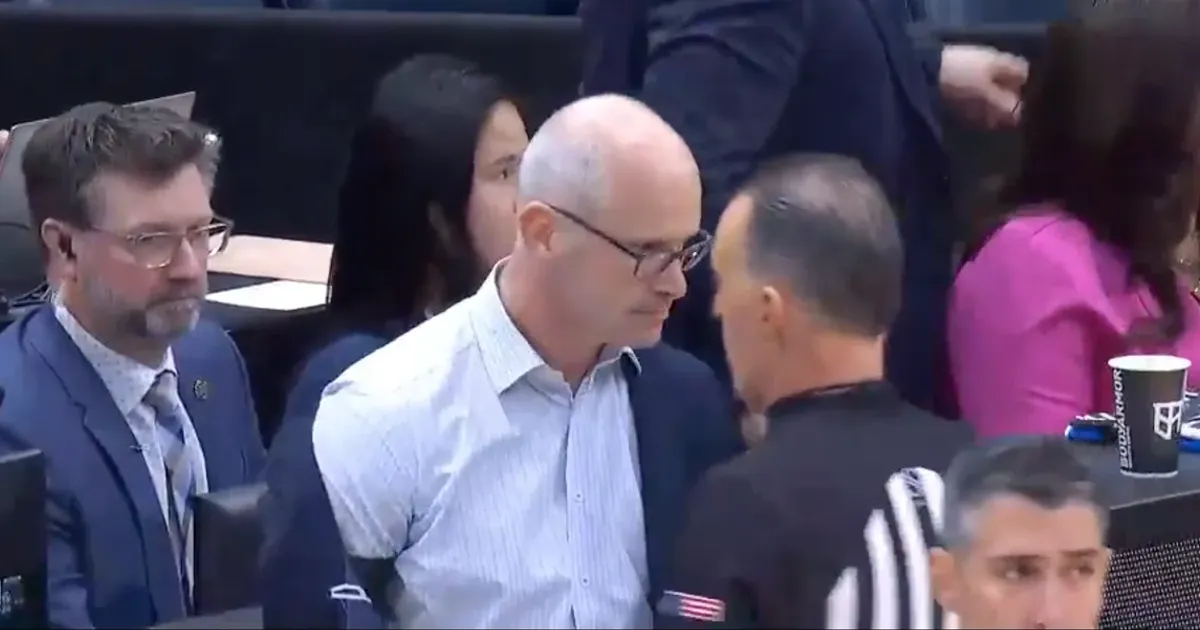
Connecticut had just secured a narrow 73-72 victory over Duke in the Elite Eight when cameras caught the head coach and the official in a close-proximity exchange. Video footage from the broadcast appeared to show the two men making head-to-head contact on the sideline. On April 1, 2026, Ayers's Final Four exclusion turned an officiating incident into a selection story. Fans and analysts immediately questioned why Hurley did not receive a technical foul for the encounter. Making physical contact with an official usually triggers an immediate penalty or ejection under NCAA guidelines.
Roger Ayers will not officiate in the Final Four this year. Sources close to the selection committee confirmed that his whistle will remain silent for the remainder of the tournament. While the NCAA has not released a formal statement linking the decision directly to the Dan Hurley contact review, the timing of the removal matches the fallout from the Duke game. Professional officiating assignments for the national semifinals represent the highest honor for referees in the collegiate system. Ayers has been a staple of deep tournament runs for years. His absence from the 2026 Final Four roster is a serious shift in the usual officiating hierarchy.
Roger Ayers Excluded From Final Four Selection
Officiating committees typically reward consistency and the ability to maintain game control under pressure. Selection for the final three games of the season involves a rigorous review process by regional directors. $11 billion in annual television revenue depends on the perceived integrity of these contests. When an official becomes part of the post-game narrative for reasons other than their calls, their standing often suffers. Ayers found himself at the center of a social media firestorm after a specific camera angle suggested a confrontation. The footage showed Hurley leaning into Ayers while the referee appeared to maintain his ground.
Official reports indicate the NCAA prefers referees to keep a professional distance from emotional coaches during high-stakes moments. Several other referees moved up in the rankings to fill the void left by Ayers. This marks a rare occasion where a top-tier official loses a marquee assignment immediately following a winning-shot sequence. Braylon Mullins hit the buzzer-beating shot that sent the Huskies to the next round. The bench cleared in a frenzy of white jerseys. Amid the celebration, the contact between the coach and the referee occurred near the scorer's table. Ayers did not report the incident as an aggressive act in his post-game notes.
Dan Hurley Clarifies Physical Contact With Official
Hurley addressed the controversy during a scheduled appearance on The Triple Option podcast. He insisted that his relationship with Ayers was friendly throughout the game. The coach described a rapport that included jokes and casual conversation during timeouts. He claimed his actions were a response to what he perceived as an invitation to celebrate. Hurley stated that he thought the official was coming over to chest-bump him. Such a gesture would be highly irregular for a working referee. Hurley argued that the emotion of the shot dictated his physical response.
Really, at that point in the game we had it won, and he's such an easy guy to work with during the game, I thought he was coming over to chest-bump me and celebrate the shot.
Critics point to the optics of a head coach putting his face against an official's face. Rules regarding bench conduct prohibit any physical interference with game personnel. Hurley previously faced an ejection during a game against Marquette earlier in the season for making contact with an official. That history of volatility complicates his current defense. He acknowledged the Marquette incident involved a different level of aggression. He maintained that the interaction with Ayers lacked any malice or anger. The coach noted that he had his arm around Ayers earlier in the same game.
Video evidence pushed the NCAA conduct review into public view.
Digital clips of the headbutt circulated within minutes of the final whistle. One specific angle gained over 2.4 million views on social media platforms. Users labeled the behavior as erratic or unprofessional for a high-profile coach. Despite the outcry, Hurley remains the head of the defending national champions. The NCAA has not announced any fines or suspensions for the Connecticut coach. Officials frequently weigh the intent behind physical contact when determining sanctions. Hurley explained that he felt carried away by the magnitude of the victory. The shot by Mullins changed the lead with only 0.3 seconds on the clock.
Refereeing experts suggest that Ayers likely failed to move away quickly enough to avoid the optics of a confrontation. Standard operating procedure requires officials to exit the floor immediately after the final horn or a game-deciding bucket. Ayers remained near the Husky bench as the celebration erupted. This proximity created the window for the head-to-head moment. Other officials on the floor observed the exchange but did not blow their whistles. Game tape shows several other coaches and players nearly colliding with the officiating crew. The intensity of the Elite Eight environment often leads to crowded sidelines.
The controversy also gives the NCAA a communication problem because officials rarely get a full public explanation before the bracket moves on.
A short, clear account of the review would help separate accountability from speculation.
Officiating Trust Before the Final Four
The Ayers decision matters because NCAA officiating trust depends on public confidence as much as technical accuracy. A disputed interaction with a high-profile coach can become part of the tournament story even if the game itself has moved on.
The review also gives officials a reminder that cameras now shape accountability. Selection decisions must be defensible to teams, broadcasters and fans who have already watched the clip repeatedly.