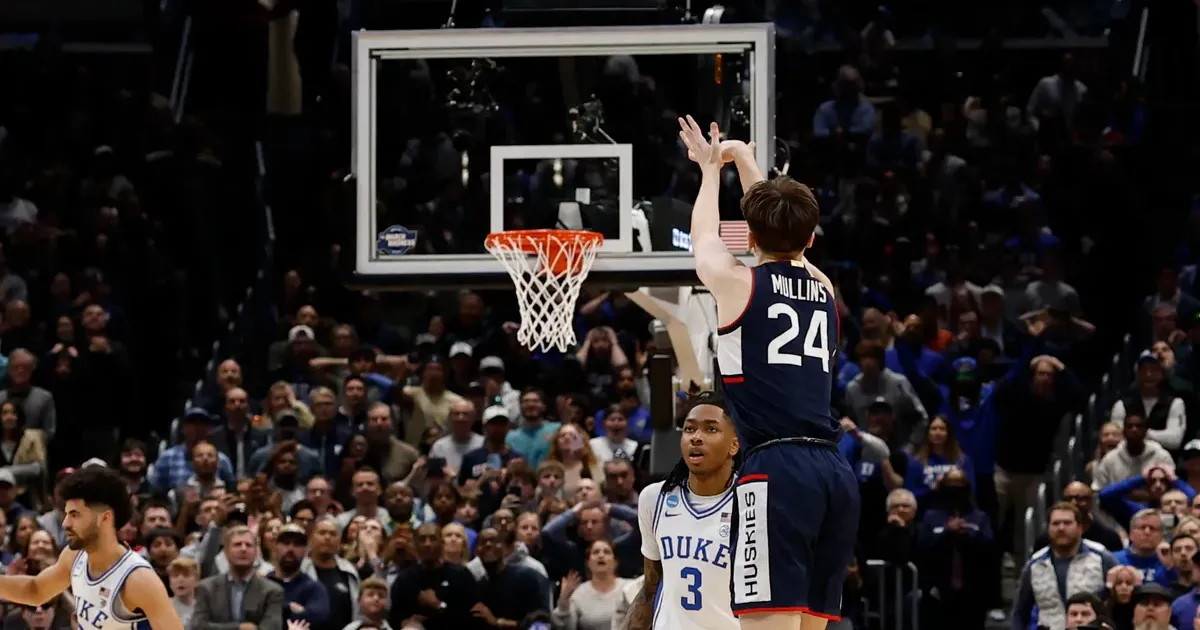
UConn turned a lost-looking game into another Final Four memory. The shot changed the bracket, but the larger story is development. Braylon Mullins silenced the Newark crowd on March 30, 2026, when his 35-foot jump shot ripped through the net to secure a 73-72 victory for UConn. UConn overcame a 19-point deficit to topple top-seeded Duke in a game that rewrote the tournament record books. Blue Devils players collapsed to the hardwood as the ball fell through the rim with 0.4 seconds remaining on the clock. Duke held a 15-point lead at halftime, a margin that traditionally guaranteed victory in the NCAA tournament.
Statistics maintained by the NCAA reveal that No. 1 seeds were previously 134-0 when leading by at least 15 points at the half. UConn broke that perfect streak in the East Regional final. Duke controlled the tempo early, establishing a 44-29 advantage at the break. Blue Devils fans appeared confident in the first half because their defense limited the perimeter game of the UConn backcourt. Duke had not lost a game after leading by double digits all season. That security evaporated during the second half rally led by Mullins and Alex Karaban.
Alex Karaban anchored the interior defense while UConn began its steady climbs back into contention. The deficit shrank to 10 points within the first five minutes of the second period. Duke struggled to maintain offensive rhythm because the UConn pressure defense forced early shot clock selections. Fatigue seemed to impact the young Duke roster as the game entered its final quadrant. While Bloomberg reported on the economic impact of the Newark regional, the focus on the court shifted entirely to the closing defensive sequence. UConn chipped away at the lead until only a single point separated the programs in the final minute of play.
East Regional Final Scoring Dynamics
Duke appeared to hold the winning hand with a 72-70 lead and possession of the ball in the final ten seconds. Cayden Boozer attempted to bring the ball across halfcourt under intense pressure from the UConn guards. Silas Demery deflected a pass intended for the wing, creating a scramble in the frontcourt. Braylon Mullins intercepted the loose ball and immediately looked for an outlet. UConn moved the ball with practiced precision during a sequence where most teams would have panicked. Mullins passed to Karaban, who stood near the top of the key. Karaban recognized the closing defender and immediately fired the ball back to Mullins near the center court logo.
Mullins did not hesitate to launch a shot from 35 feet away. The ball cleared the outstretched hand of a closing defender before finding the bottom of the net. Officials stopped the game to review the timing of the release. Replay footage confirmed the ball left the fingertips of Mullins with less than a second on the countdown. After a brief deliberation, the officiating crew added 0.1 seconds to the clock, setting the final duration at 0.4 seconds. Duke stood stunned as the realization of the comeback settled over the arena. One long heave from the baseline by Duke fell short of the basket as the horn sounded.
UConn is going back to the Final Four, and it took a miracle sequence to get there, even if the Huskies looked down and out in the first half. This historic comeback follows the high-stakes intensity previewed in the Duke and UConn matchup leading up to the game.
This result ties the sixth-largest comeback in the history of the NCAA tournament. VCU previously set a similar mark against North Carolina in the first round of a prior tournament. Duke suffered a collapse that mirrors its late-game breakdown against Houston in the Final Four of the previous season. The Blue Devils roster features high-level professional prospects, but the veteran composure of the UConn squad proved more effective in the closing moments. Coach Jon Scheyer watched his team surrender a lead that most analysts considered overwhelming at the intermission.
Defensive Pressure and the Boozer Turnover
Dan Hurley emphasized full-court pressure during the final four minutes of the contest. The strategy forced Duke into three turnovers during that span. Cayden Boozer, usually a reliable ball handler, faced a double team that restricted his passing lanes. Silas Demery played the role of disruptor, using his length to poke the ball away and spark the fast breaks. UConn relied on these transition opportunities because its half-court offense struggled against the Duke zone defense. The game plan required perfect execution to overcome the 19-point hole. Every possession in the second half carried the weight of the season for the defending champions.
Braylon Mullins finished the game with 22 points, including four three-pointers in the second half. His performance solidified his status as a premier clutch shooter in collegiate basketball. Duke failed to adjust to the high screen action that allowed Mullins to find open space on the perimeter. The Blue Devils defense remained focused on Karaban in the paint, which left the logo open for the final shot. Momentum shifted visibly after the ten-minute mark when UConn cut the lead to single digits. Crowd noise favored the Huskies as the pro-UConn contingent in Newark grew louder with every made basket.
Historic Win Statistics for the Huskies
UConn advances to the Final Four for the third time in the last four seasons. This level of consistency places the program among the most dominant forces in modern college athletics. Duke face another offseason of questioning after failing to reach the final weekend despite holding a No. 1 overall seed. The loss ends the collegiate careers of several Duke stars who are expected to enter the professional draft. While the Blue Devils had won 134 consecutive tournament games when leading by 15 at the half, that record is now 134-1. UConn is the only team to ever erase such a deficit against a top seed.
Preparation for the Final Four begins immediately for the UConn coaching staff. They will travel to the next venue knowing they possess the resilience to overcome any deficit. Duke returns to Durham to evaluate a season that ended in heartbreak for the second consecutive year. The Huskies now stand two wins away from adding another championship banner to their rafters in Storrs. Fans celebrated in the streets of Connecticut long after the final buzzer sounded in New Jersey. The victory is a definitive statement regarding the hierarchy of college basketball in 2026.
Tournament Momentum Shift
Dynasties are not built on luck, but Duke fans might disagree after witnessing the methodical dismantling of a 19-point lead. The collapse of the Blue Devils in Newark is a searing indictment of the one-and-done era when matched against the battle-hardened continuity Dan Hurley has cultivated at UConn. While Duke recruits for the draft, UConn recruits for the trophy case. The 134-1 statistic is not just a historical anomaly; it is a sign of a shift in how games are won in March. Talent wins halves, but system-driven resilience wins titles. Jon Scheyer must answer for how a team with superior individual athletes could surrender such a large cushion in under twenty minutes of play.
The evidence shows the total eclipse of the old blue-blood order. The logo three by Braylon Mullins was not a desperate heave, but a calculated execution of a program that expects to win every situation. Duke looks fragile when the lights are brightest, repeating the same structural failures that doomed them against Houston. If the Blue Devils cannot protect a 15-point halftime lead with a No. 1 overall seed, the program is effectively a finishing school for the NBA rather than a championship contender. UConn is the new gold standard. Duke is merely the shadow. The Huskies win.