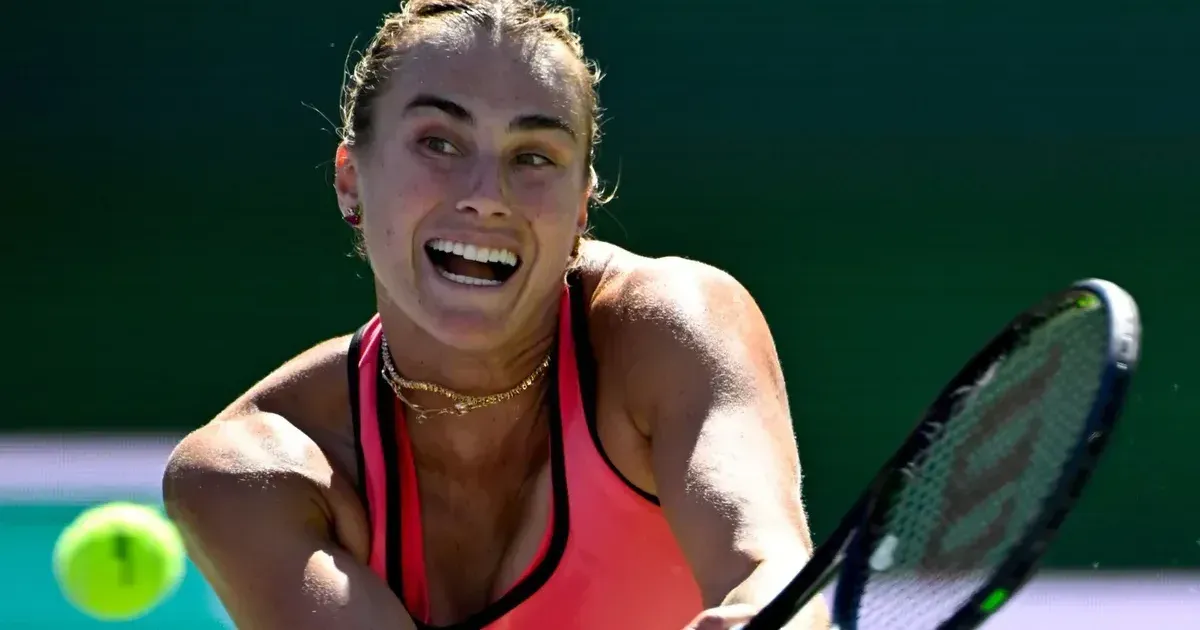
Aryna Sabalenka secured her spot in the BNP Paribas Open final on Friday evening with a clinical performance that underscores her current dominance on hard courts. Both players have advanced through the Indian Wells draw, setting up another final between the two clearest power centers in the women's game. The world number two dismantled her semi-final opponent with a mixture of raw power and tactical patience. Victory in the desert sets the stage for a championship clash that has become the defining rivalry of the 2026 season. Fans in the California sun witnessed a display of serving that peaked at 124 miles per hour. Elena Rybakina advanced through her side of the draw with equal efficiency, relying on her trademark composure and flat, piercing groundstrokes. She has reached the final by dropping only one set throughout the tournament. Her ability to neutralize heavy hitters with short, compact swings makes her a unique threat to the top-ranked players. The 2022 Wimbledon champion appears physically fresh despite the grueling two-week schedule in the Coachella Valley. Sunday's encounter marks the third time these two athletes have met in a tournament final within the last four months. This frequency of high-stakes competition suggests a stabilization at the top of the women's game. Previous years were characterized by a rotating cast of champions, but 2026 has narrowed the field of true contenders. Aryna Sabalenka enters the match with a slight edge in recent head-to-head statistics.
Sabalenka and Rybakina Meet Again
Preparation for this tournament began months ago in training blocks designed to handle the gritty, slow surface of Indian Wells. Sabalenka adjusted her ball toss to account for the swirling desert winds that often plague evening matches. Her semi-final win showcased a newfound willingness to use the slice backhand to reset rallies. She won 82 percent of her first-serve points during the straight-sets victory. Her opponent struggled to find any rhythm against the heavy topspin depth. But the focus now shifts entirely to the strategic puzzle posed by Rybakina. Both players possess the ability to take the racket out of their opponent's hands with an ace or a return winner. Sabalenka has reduced her double-fault count sharply since her early career struggles. She did not commit a single double fault during the second set of her semi-final match. Power will meet precision under the desert sun. Coaching staff for the Sabalenka camp have emphasized the importance of lateral movement on this particular court. The sand-infused paint makes the ball jump higher than it does in Melbourne or New York. This requires a high level of core strength to stay balanced during lunging defensive shots. Sabalenka spent nearly three hours in the gym on her off-day focusing on explosive footwork drills. She hit 42 winners in her semi-final victory.
Serve Patterns Shape the Final
Elena Rybakina represents the antithesis of the modern, vocal power player. Her silent demeanor on court masks a complex analytical approach to shot selection. In particular, her cross-court forehand has been clocked as one of the fastest on the tour this month. She rarely shows emotion regardless of the scoreboard. Her internal intensity is evident in the way she attacks second serves. She forced 15 break points in her semi-final match. Their third final in four months gives Indian Wells the feel of another referendum on power, precision and tactical nerve. The physical conditioning of Elena Rybakina has improved under her current fitness regime. She has avoided the nagging injuries that stalled her progress during the 2025 swing through North America. Her serve remains the most reliable weapon in her arsenal, often bailing her out of 0-30 holes. She leads the tournament in total aces with a count of 38 heading into the final. Her first-serve percentage hovered around 70 percent during her Friday win. The desert air provides no resistance to her flat groundstrokes. Rybakina prefers the dry heat of the Coachella Valley because it keeps the felt on the balls from fluffing up too quickly. When the balls stay thin, her flat shots skip through the court with lethal speed. Sabalenka prefers a heavier ball that she can manipulate with spin. Sunday's weather forecast predicts a drop in humidity, which generally favors the Kazakh player's style. She won 85 percent of her first-serve points in the quarter-final round.
Indian Wells Rewards Patience
Memories of their clash in Melbourne still linger for both athletes and spectators.
Data from previous encounters shows that the player who wins the first set has gone on to win the match in 80 percent of their meetings.
Elite players often evolve their tactics when facing the same opponent multiple times in a short window.
The psychological battle is just as intense as the physical one. Both women have spoken openly about the respect they have for each other's games. On the court, the atmosphere is notoriously cold and focused. There are no friendly exchanges at the net until the final point is decided. The professional detachment has earned praise from former champions who grew tired of the friendlier nature of the tour. Sabalenka spent 45 minutes on the practice court practicing high-velocity returns.
The stakes exceed a simple trophy. Broadcasters have used new 3D tracking technology to show the difference in ball height between the two players. Sabalenka's average ball height over the net is nearly 18 inches higher than Rybakina's. The disparity creates a chaotic rhythm that tests the timing of both competitors. If the wind stays calm on Sunday, the match will likely be decided by who can dictate play from the center of the baseline. Rybakina won 12 of 14 net points in her last match.
The Rivalry Gives the WTA a Center
Is the WTA finally escaping the era of one-hit wonders and entering a period of genuine, lasting rivalry? For nearly a decade, women's tennis was a carousel of surprise champions who disappeared as quickly as they arrived. The repetitive final between Sabalenka and Rybakina is exactly what the sport requires to build a coherent story for casual fans. We should stop pretending that parity is better than a duopoly. A sport without a clear king or queen is just a series of random events without stakes.
The commercial success of this 2026 season rests entirely on the shoulders of these two women. They provide the necessary contrast in personality and style that defines all great sporting eras. Sabalenka is the fire, the loud grunts, and the visible emotion. Rybakina is the ice, the stoic assassin who barely acknowledges a winning shot. The dynamic is the engine of ticket sales and television contracts. If the tour continues to surface these two in every major final, it will finally regain the cultural relevance it lost after the retirement of the previous generation.
Predictability in the final rounds is not a flaw; it is the ultimate proof of quality and professional separation. The desert will provide the answers, but the trend is already clear. The era of the Big Two has arrived.