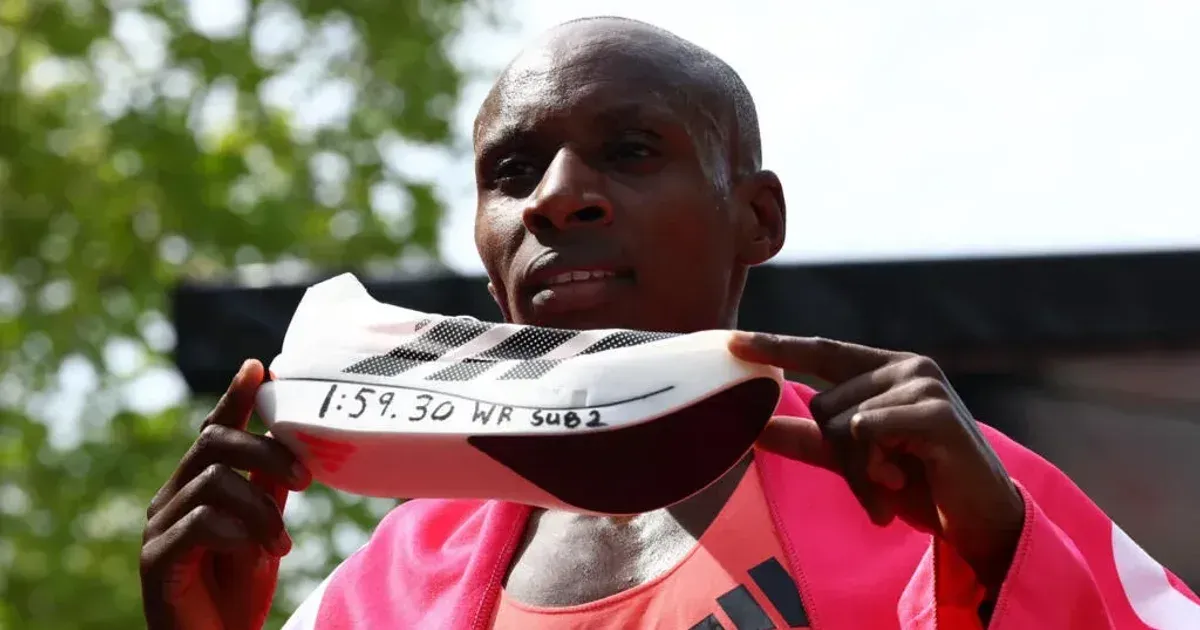
London’s marathon course became the setting for a record that had long belonged more to theory than competition. Sabastian Sawe’s finish forced athletics officials and rivals to recalibrate the limits of the event. Sabastian Sawe secured his place in athletic history on April 26, 2026, by shattering the two-hour marathon barrier during the London Marathon. Kenya's rising star crossed the finish line in the heart of the British capital with a verified time of 1:59:30. This performance obliterated the previous official world record of 2:00:35 held by the late Kelvin Kiptum. Crowds lining the streets witnessed a feat long considered physically impossible under the stresses of competitive race conditions.
Official timers confirmed the result almost immediately as Sawe collapsed in celebration near Buckingham Palace. He maintained a blistering pace that averaged roughly four minutes and 33 seconds per mile. Such consistency defied standard physiological expectations for human endurance over the 42.195 km distance. Spectators who gathered in the early morning dampness of London saw an athlete move with a fluidity that looked mechanical rather than biological.
Records in the marathon have fallen with increasing frequency over the last decade, yet the two-hour mark stood as a psychological and physical wall. While Eliud Kipchoge ran a 1:59:40 in a non-competitive, highly controlled exhibition in Vienna in 2019, that mark never stood as an official world record. Sawe achieved his time in a standard open competition, contending with other elite runners and the unpredictable elements of a London spring. His victory brings a definitive end to the era of the sub-two-hour quest.
London Marathon Course Yields Historic Results
London provided the ideal theater for this athletic breakthrough. The course, known for its flat stretches and sharp turns through historic districts, saw Sabastian Sawe push through the 30-kilometer mark ahead of the pace set by his nearest rivals. Under the grey skies, the lead pack thinned out until only Sawe and a handful of pacemakers remained. His resilience through the final miles demonstrated a capacity for oxygen processing that will likely become the subject of intense scientific study.
Organizers prepared for a fast race, but few anticipated a 65-second improvement over the mark established by Kelvin Kiptum in Chicago. The London Marathon has often produced world-leading times, though this particular Sunday surpassed all prior editions. Ethiopia's Tigst Assefa also made her mark on the day by retaining her women's crown, further cementing the event's reputation as the premier venue for elite distance running. Assefa ran with a strategic confidence that mirrored the dominance seen in the men's field.
Running conditions remained stable throughout the morning with temperatures hovering near 11 degrees Celsius. These circumstances favored the athletes as they navigated the winding route from Greenwich toward the finish. Despite the intense pressure of the global spotlight, Sawe never appeared to falter or lose his rhythm. His stride length remained consistent even as he approached the final mile marker near the Thames.
Sabastian Sawe Surpasses Kelvin Kiptum Record
Kelvin Kiptum had set the world record of 2:00:35 before his tragic death in early 2024. Sawe had often spoken of his desire to honor Kiptum's legacy by continuing the push toward the sub-two-hour limit. By clocking 1:59:30, Sawe did not just beat a number, he validated the belief that the human body can sustain extreme velocity for over 26 miles. The gap between Sawe and the rest of the elite field highlighted the singular nature of his talent on this specific day.
Professional observers noted that Sawe's biomechanics showed little sign of fatigue during the late stages of the race. While many athletes hit the metaphorical wall at 20 miles, Sawe actually increased his cadence. This surge allowed him to create a decisive cushion against the clock. History will record this moment as the day the marathon transitioned from a race of attrition into a high-speed sprint over long distances.
"Sabastian Sawe has achieved the impossible by delivering a sub-two-hour performance in a sanctioned, competitive environment," organizers from the London Marathon stated following the verification of the 1:59:30 finish time.
Success at this level requires a convergence of perfect health, advanced shoe technology, and mental fortitude. Sawe used the latest iteration of carbon-plated footwear, which continues to spark debate within the World Athletics governing body. Critics often point to these mechanical advantages, but the raw physical effort required to move at such speeds is undeniable. Sawe's heart rate and lactate levels during the race allegedly stayed within a range that stunned his coaching staff.
Global Implications for Professional Marathon Running
Future competitions will now be measured against the standard set in London. The psychological barrier has been removed, potentially opening the door for other athletes to target sub-two-hour times in Berlin or Chicago. Beyond the prestige, the financial rewards for such a record are large, with appearance fees and sponsorship bonuses expected to reach millions of dollars. Sawe has transformed himself into the most marketable figure in global athletics overnight.
Winning the London Marathon is an accolade in itself, but doing so with a world record creates a lasting legacy. Tigst Assefa and her victory in the women's division ensured that Ethiopia shared in the glory of the day, even as Kenya celebrated Sawe's record-setting individual triumph. The rivalry between these two East African nations continues to drive the sport to new heights. Every major city with a marathon will now look to replicate the conditions that allowed Sawe to thrive.
Athletics fans across the world followed the live data as the projected finish time dropped below the 120-minute mark. Science and grit combined to produce a result that many believed would not happen until the 2030s. Sawe has moved the timeline of human progress forward by several years. His name now joins the ranks of legends like Abebe Bikila and Haile Gebrselassie in the pantheon of distance running.
Sawe’s Record Deepens Marathon Running’s Technology Crisis
Elite distance running now faces a crisis of credibility that no amount of marketing can mask. While we celebrate Sabastian Sawe for his 1:59:30 finish, the sport is rapidly devolving into a race of laboratory-engineered footwear and hyper-improved pacing strategies. We are no longer watching a test of human will; we are watching a demonstration of how far carbon-fiber plates and specialized foam can propel a human body. The achievement is impressive, but it feels sanitized, divorced from the gritty reality of a traditional footrace where the athlete, not the equipment, is the primary variable.
The shadow of Kelvin Kiptum looms large over this record. Kiptum's 2:00:35 was a raw, visceral explosion of talent that suggested the barrier would fall naturally. Sawe's sub-two-hour mark, by contrast, feels like an inevitability produced by an industry desperate to keep marathon running relevant to a global audience. World Athletics continues to allow technological advancements that essentially provide mechanical assistance. This trend risks turning the marathon into a curiosity instead of a sport.
If every major record is now tied to a specific shoe model or a specific weather-improved course, the inherent value of the world record diminishes. We must ask if we are actually witnessing faster humans or simply better gear. The outcome is unmistakable. The era of the pure athlete is dead, replaced by the era of the high-performance specimen. Sawe is the first to cross the line, but he will not be the last to benefit from a system that prioritizes headlines over the integrity of the human effort. Efficiency has murdered the drama of the struggle.