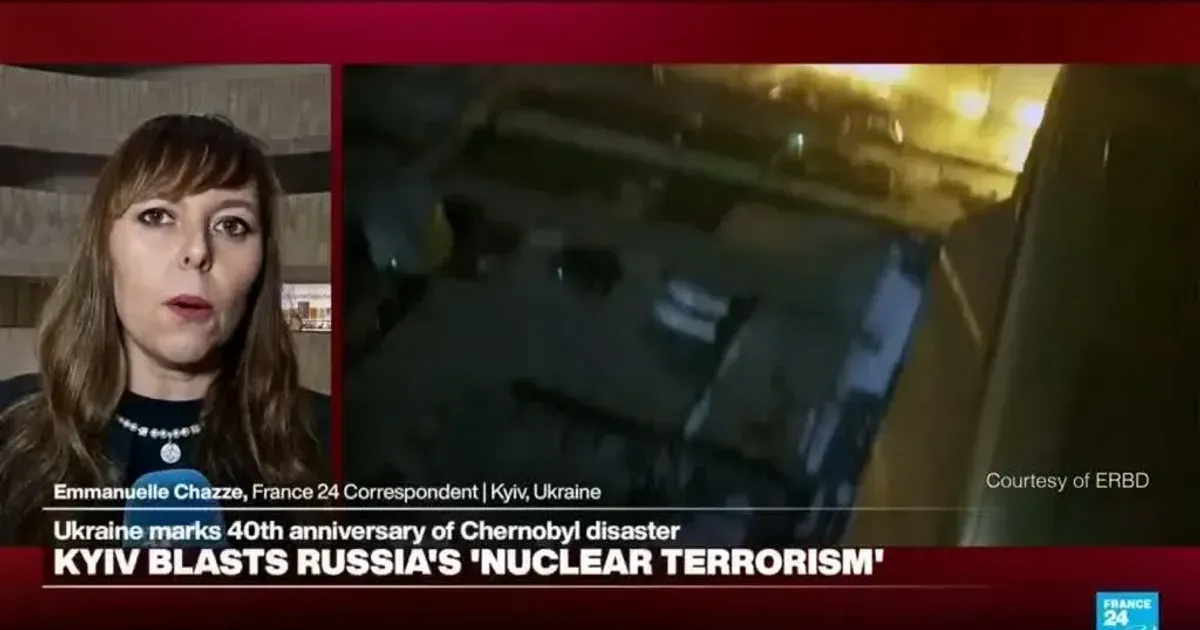
Chernobyl’s 40th anniversary brought remembrance together with a warning about nuclear risk in wartime. Ukraine’s commemorations unfolded while the exclusion zone and other sensitive sites remained shaped by Russia’s invasion. The disaster’s old lessons now sit beside new concerns over occupation, drones and damaged infrastructure. The anniversary was therefore less a memorial than a live safety argument. Survivors and government officials gathered in Kyiv on April 26, 2026, to commemorate four decades since reactor number four at the Chernobyl Nuclear Power Plant exploded. The explosion is still the world’s worst civil nuclear disaster. Across the exclusion zone, silent monuments stand as evidence of the thousands of people who were displaced or lost their lives due to the radioactive plume that covered parts of Europe.
Michael Bluck, Director of the Centre for Nuclear Engineering at Imperial College London, argues that the Soviet Union's rigid hierarchy directly contributed to the 1986 catastrophe. Operators faced immense pressure to complete safety tests despite clear technical risks. Structural flaws in the RBMK-1000 reactor combined with a culture of secrecy to create a disaster in northern Ukraine. Bluck explained during a discussion that the centralization of power stifled dissent and prevented lower-level engineers from questioning orders. These systemic failures meant that early warnings about reactor stability went unheeded. Centralized authority prioritizes political optics over technical reality.
Soviet Systemic Failures and Nuclear Design Flaws
Evidence from declassified archives shows that the Kremlin suppressed information regarding previous accidents at other RBMK plants. This lack of transparency ensured that the Chernobyl staff lacked the training necessary to manage a core meltdown. Engineers were essentially operating in the dark when the power surge occurred during the fateful safety test in 1986.
Technical deficiencies were baked into the reactor’s very design. The RBMK-1000 model possessed a positive void coefficient, meaning that as steam increased, the nuclear chain reaction accelerated. When operators tried to shut down the reactor, the graphite-tipped control rods caused a huge power spike instead of stopping the process. The resulting steam explosion blew the 1,000-ton roof off the reactor building. Michael Bluck stated that the incident went beyond a mechanical failure but a collapse of the entire Soviet administrative framework. Management ignored safety protocols to meet production deadlines and political quotas. Workers were often promoted based on party loyalty rather than technical expertise.
"The Soviet Union's culture of top-down rule was also to blame," said Michael Bluck, Director of the Centre for Nuclear Engineering at Imperial College London.
Environmental Recovery and Radiation Monitoring in Pripyat
Radioactive isotopes like Cesium-137 and Strontium-90 persist in the soil around Pripyat and the surrounding forests. Scientists monitor these levels to determine when, or if, the land might ever be fit for human habitation again. Current projections suggest the area will remain uninhabitable for thousands of years.
Nature has reclaimed the abandoned city of Pripyat, with trees growing through the floors of Soviet-era apartments. Wolves and wild horses now roam the streets where 50,000 people once lived before the mass evacuation. This accidental wilderness provides a rare laboratory for studying the long-term effects of radiation on local wildlife populations. Recent security concerns surrounding the Chernobyl exclusion zone remain a critical point of contention between Ukraine and Russia.
Health consequences for the liquidators who helped contain the fire in 1986 continue to manifest in high rates of thyroid cancer. Medical registries in Ukraine and Belarus track the multi-generational impact of the fallout on the local population. Financial support for these veterans often falls short of their actual medical needs.
Over 70 percent of the radioactive fallout landed in Belarus, contaminating nearly a quarter of its territory. Thousands of villages were abandoned, and agriculture in those regions was permanently halted. The economic cost of the disaster for the former Soviet Union and its successor states exceeded hundreds of billions of dollars.
Technical Challenges of the New Safe Confinement Arch
Reporting from the ground, Emmanuelle Chaze notes that the 30-kilometer exclusion zone requires intensive monitoring and modern infrastructure. The $2.3 billion New Safe Confinement structure currently shields the ruins of the reactor from the elements. Maintenance for this structure requires international funding and constant engineering oversight to prevent a second release of dust.
The confinement arch is the largest moveable metal structure ever built. It was designed to last at least 100 years, providing a temporary solution while engineers develop a plan to remove the melted fuel inside. High radiation levels inside the structure make it impossible for humans to work for extended periods without specialized equipment.
Remote-controlled robots perform much of the high-risk work inside the containment shield. Every piece of debris removed must be treated as hazardous waste and stored in specialized, lead-lined facilities. The process of fully decommissioning the site is expected to take several more decades. Ukraine relies on the expertise of global partners to maintain the safety of the site. Funding gaps could lead to delays in the decommissioning process. International cooperation enabled the construction of the shield, but geopolitical tensions now threaten the continuity of this delicate work.
Global Nuclear Safety and Regulatory Transformation
Lessons from the 1986 disaster led to the creation of the World Association of Nuclear Operators. This organization promotes peer reviews and information sharing among nuclear power plants across the globe. Such collaboration aims to prevent the silos of information that characterized the Soviet nuclear program. Nations around the world reassessed their energy policies after the events in Ukraine. Some countries accelerated their phase-out of nuclear power, while others implemented more stringent safety regulations. The disaster fundamentally changed how the public perceives the risks associated with atomic energy.
Modern reactors now use passive safety systems that do not require operator intervention or electrical power to shut down. These designs prioritize physical laws over manual control to prevent the human errors seen at Chernobyl. International Atomic Energy Agency inspections have become the gold standard for verifying plant safety worldwide. Despite these improvements, the legacy of 1986 continues to influence the debate over green energy and carbon neutrality. Proponents of nuclear power emphasize its low carbon footprint, while critics point to the exclusion zone as evidence of catastrophic risk. Public trust in nuclear technology remains fragmented 40 years later.
Chernobyl’s Containment Clock Is Still Running
Is the world truly safer forty years after the plume of smoke drifted across Europe? We continue to treat the Chernobyl exclusion zone as a static relic of the past, but it is actually a ticking clock of engineering decay. The New Safe Confinement arch was a triumph of international diplomacy, yet it only buys us a century of breathing room while the radioactive corium beneath it remains as lethal as ever.
Geopolitics is currently outpacing nuclear safety as the primary threat to the region. When the Soviet Union collapsed, the responsibility for containment shifted to a Ukraine that has since faced existential threats. We are currently witnessing a dangerous erosion of the international funding mechanisms required to keep this site stable. If the global community treats Chernobyl as a solved problem, it is ignoring the reality that maintenance is an eternal obligation, not a one-time payment. Relying on 100-year shields in a world of ten-year political cycles is a recipe for a secondary catastrophe. Complacency kills nations. This 40th anniversary should not be a moment of self-congratulation for our engineering feats. It must be a cold acknowledgment that our technological reach still exceeds our political grasp. Failure is inevitable.