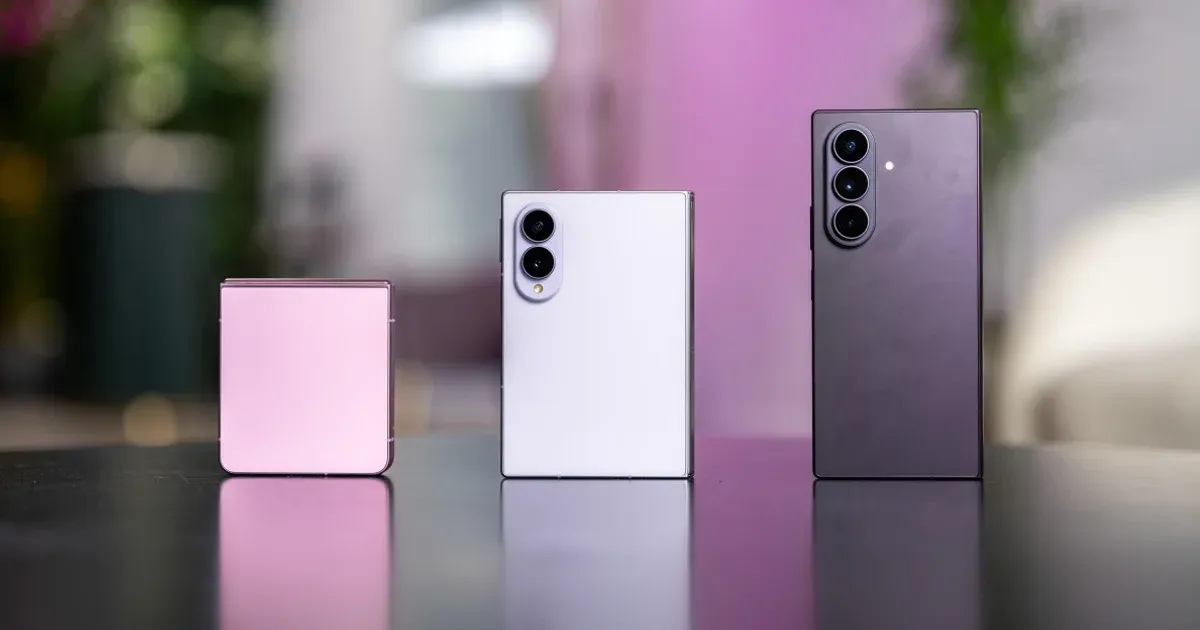
Samsung has divided its book-style foldable phone into two distinct products instead of treating one model as the answer for every buyer. The launch creates a lighter, wider Galaxy Z Fold 8 and a more expensive Fold 8 Ultra built around screen size, cameras and battery capacity. Preorders opened on July 22, 2026, with retail availability scheduled for August 7.
The phones now form a clear price ladder: $1,199 for the Galaxy Z Flip 8, $1,899 for the Fold 8 and $2,099 for the Fold 8 Ultra. Samsung also raised the starting prices of its mainstream and rugged watches to $379 and $699. The announcements make improved portability and longer battery life easier to compare, but they also move several entry points upward.
The Fold 8 Trades Height for a Wider Working Area
The regular Fold 8 changes the proportions of Samsung's folding tablet. It has a 7.6-inch inner display with a 4:3 aspect ratio and a 5.5-inch outer screen shaped at 10:16, producing a shorter and broader device than the company's previous book-style phones. It measures 4.5 millimeters when open, 9.7 millimeters when closed and weighs 201 grams. Those dimensions make it the lighter of the two new Fold models despite the substantial interior screen.
The Fold 8 runs on Qualcomm's Snapdragon 8 Elite Gen 5. The ceiling is 16GB of memory alongside 1TB of storage. Its rear camera system pairs a 50-megapixel main sensor with a 50-megapixel ultrawide camera, but there is no dedicated telephoto lens. The battery is rated at 4,800mAh. Samsung's Flex Titanium construction is also intended to make the crease less prominent across the new folding range.
This combination defines the $1,899 phone more clearly than the Fold name alone. Its broad inner canvas suits two applications placed side by side, while the lower weight addresses a recurring complaint about large foldables. Buyers who want optical zoom, the biggest possible screen or the longest battery specification are being directed to the Ultra instead of receiving those features in the base Fold.
The Ultra Charges $200 More for Cameras and Battery
The Fold 8 Ultra preserves the taller outline associated with last year's Fold while becoming thinner. The interior panel measures 8 inches, while the cover panel spans 6.5 inches. The phone weighs 215 grams. At 4.1 millimeters when open, it is thinner than the regular model even though it is heavier and has the larger panels. Both Fold phones use the same top-tier Qualcomm platform and offer as much as 16GB of memory and 1TB of storage.
Its $200 premium buys the most visible hardware additions. The Ultra combines a 200-megapixel main camera, a 50-megapixel ultrawide and a 10-megapixel telephoto with three-times optical zoom. Battery capacity rises to 5,000mAh, and wired charging reaches 45 watts. Those differences make the Ultra the photography and endurance option rather than merely a storage upgrade with another badge.
The two-model strategy also reduces one familiar compromise. A buyer can choose the lighter Fold 8 for shape and handling without paying for a telephoto camera, or choose the Ultra for hardware closer to a conventional flagship phone. The trade remains expensive on either branch. Samsung's least costly new book-style foldable starts $700 above the Flip 8 before storage upgrades, accessories or protection plans are added.
The Flip 8 Keeps Its Shape but Adds $100
The clamshell Galaxy Z Flip 8 receives a smaller visual overhaul. It retains a 6.9-inch main display and a 4.1-inch cover screen, while the closed body measures 13.1 millimeters and the phone weighs 180 grams. Battery capacity increases to 4,300mAh. The rear cameras remain a 50-megapixel main unit and a 12-megapixel ultrawide, placing the emphasis on endurance and software use of the outer display rather than a new camera tier.
Samsung added an app drawer and gesture controls to the cover-screen experience, allowing more routine tasks before the phone is opened. The starting price, however, moves from the previous generation's $1,099 level to $1,199. That $100 increase matters because the Flip has served as the lower-cost route into Samsung's foldable range. Its battery gain may correct a practical weakness, but the higher bill arrives without the sweeping shape change given to the Fold 8.
Watch Price Increases Pay for Battery and Health Tracking
Galaxy Watch 9 comes in 40mm and 44mm cases with 390mAh and 445mAh batteries, respectively. Samsung rates it for as long as 30 hours with the always-on display enabled. The $379 starting price is $30 above the prior model. Watch Ultra 2 uses a 47mm case, an 800mAh battery and a body Samsung says is 12 percent thinner, with up to 60 hours of always-on-display use. Its $699 price is $50 higher.
Both watches use Qualcomm's Snapdragon Wear Elite platform. Samsung calls one measurement Vitals; it is joined by Heart Health Score, Daily Cardio Load and a Fitness Index. These additions position the watches around daily interpretation of fitness and cardiovascular data rather than a single headline sensor. Google also previewed forthcoming smart-glasses designs made with Gentle Monster and Warby Parker, though those frames were not part of the August 7 product release.
Samsung's launch is best read as a reorganization of choices rather than one uniform upgrade. The Fold 8 and Ultra separate portability from maximum hardware, while the Flip and watches ask buyers to pay more for incremental gains in battery life and health software. That structure makes each product's purpose easier to identify. It also leaves the entry price as a larger part of the decision, especially for buyers who previously chose a Flip or standard watch to avoid flagship-level spending.